01Facts
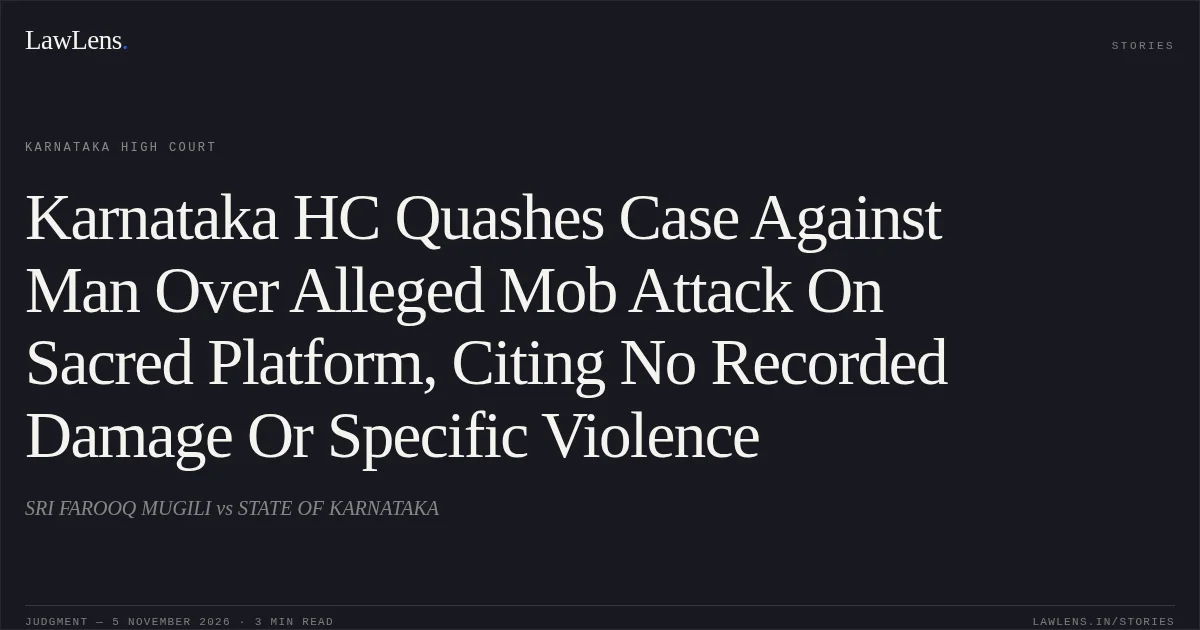
Respondent No. 2’s complaint alleged that on 19 May 2018 the petitioner and approximately 150–200 others arrived on motorcycles, damaged the complainant’s property and a Devarakatte, and abused, threatened and assaulted the complainant.
¶ 2–8, 10Vitla Police registered Crime No. 183/2018 under Sections 143, 147, 148, 506 read with 149 IPC and Sections 2(a) and 2(b) of the KPDLP Act; although Section 427 IPC was initially alleged, it was not included in the charge-sheet filed on 26 July 2020.
¶ 2–8, 10The petitioner sought to quash the resulting proceedings in C.C. No. 1496/2021, contending that the investigation material did not substantiate the alleged damage, violence or other offences.
¶ 2–8, 1002Issues
i.1. Whether the charge-sheet material disclosed loss or damage to property sufficient to attract Sections 2(a) and 2(b) of the KPDLP Act
¶ 11–14ii.2. Whether the material disclosed the ingredients of unlawful assembly, rioting, rioting armed with a deadly weapon, criminal intimidation, or constructive liability under Sections 143, 147, 148, 506 and 149 IPC
¶ 15–24iii.3. Whether, in light of the material collected, continuation of the proceedings against the petitioner would constitute an abuse of process warranting exercise of the High Court’s inherent jurisdiction
¶ 25–2803Law Applied
Section 2(a) and (b) of the KPDLP Act requires mischief resulting in loss or damage to property; under Section 2(a), the relevant mischief is that defined in Section 425 IPC.
¶ 11–12An assembly of five or more persons is not an unlawful assembly under Section 141 IPC unless its common object falls within one of that section’s specified categories; Sections 143 and 149 depend on the existence of such an unlawful assembly, while Section 147 requires force or violence in prosecution of its common object.
¶ 18–19, 23Section 148 additionally requires the accused to be armed with a deadly weapon or an article likely to cause death when used as a weapon.
¶ 19Criminal intimidation under Section 506 IPC requires a threat with the requisite intent to cause alarm or compel an act or omission.
¶ 22The Court exercised its inherent jurisdiction under Section 482 CrPC, corresponding to Section 528 BNSS, where the material, taken at face value, fails to disclose the essential ingredients of the alleged offences and continuation of proceedings would abuse the process of law.
¶ 1, 27–28No precedent was cited.
Provisions in the judgment · 11 · Linked ones open on LawLens
Code of Criminal Procedure, 1973 Section 482
Bharatiya Nagarik Suraksha Sanhita, 2023 Section 528
Indian Penal Code, 1860 Section 143Section 147Section 148Section 506Section 427Section 149Section 425Section 141
PREVENTION OF DESTRUCTION AND LOSS OF PROPERTY ACT, 1981 Section 2
04Reasoning
The mahazar recorded no specific damage to the complainant’s property or the Devarakatte, and the prosecution identified no other material establishing property loss; the KPDLP Act offences therefore lacked an essential ingredient.
¶ 13–14, 26The witness statements did not disclose specific violence or injury, a common object falling within Section 141 IPC, the petitioner’s possession of a qualifying weapon, or particulars showing criminal intimidation within Section 506 IPC.
¶ 16–17, 20–26The Court considered the absence of independent witnesses insufficient by itself to quash the case, but found that even the complainant’s and other witnesses’ statements did not disclose the essential ingredients of the alleged offences.
¶ 16–17, 20–26On that material, Section 149 could not supply constructive liability without an unlawful assembly and qualifying common object.
¶ 23–2405Holding
The Court held that the charge-sheet material, even taken at face value, did not disclose the alleged offences and that continuing the prosecution would amount to an abuse of process.
¶ 27It allowed the petition and quashed the proceedings in C.C. No. 1496/2021, arising from Crime No. 183/2018, against the petitioner.
¶ 28–29Original Court PDF
SRI FAROOQ MUGILIvsSTATE OF KARNATAKA
Click to open original judgment
Original judgment, available to read, download and summarize on LawLens.in