01Facts
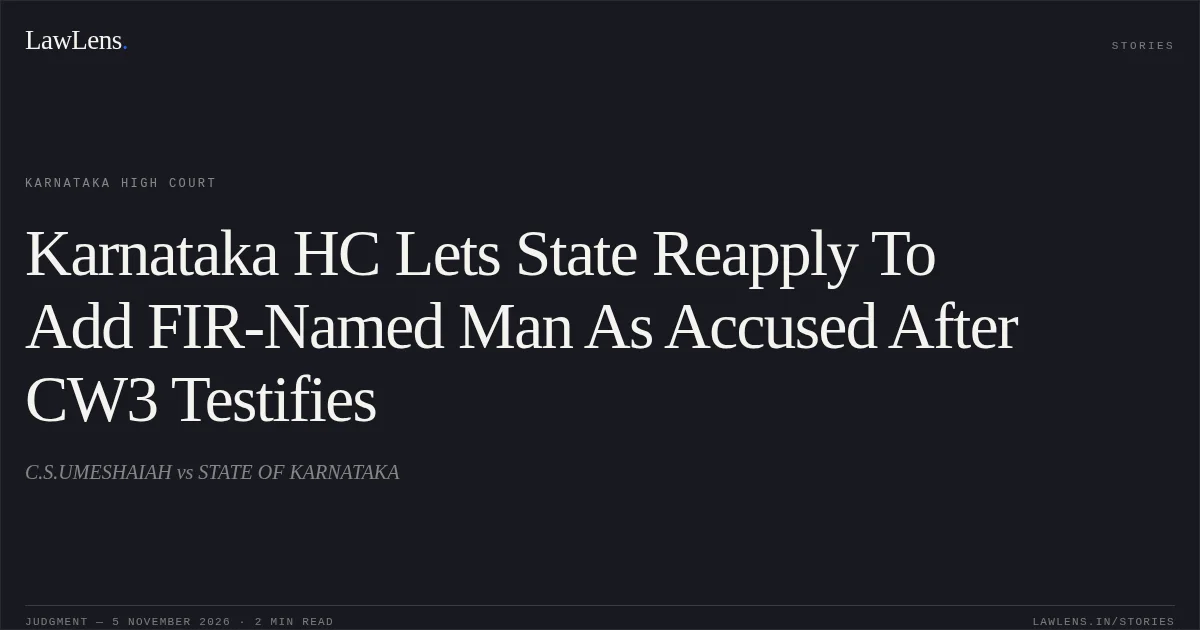
The petitioner, the complainant in the underlying case, challenged the JMFC’s order rejecting the State’s application under Section 319 Cr.P.C. to summon respondent No. 2 as an additional accused in a prosecution under Sections 143, 147, 148, 324, 504 and 506 read with Section 149 IPC.
pp. 2–3Respondent No. 2 had been named in the FIR but was not charge-sheeted; the charge sheet was filed against seven others.
p. 3The complainant had testified, but the prosecution had not yet examined CW3, an eyewitness.
p. 3The petitioner relied on the complainant’s examination-in-chief, while respondent No. 2 relied on the cross-examination and the absence of supporting evidence.
pp. 3–6The High Court noted that the trial court’s order proceeded on the mistaken premise that CW3 had already been examined.
p. 702Issues
i.1. Whether the High Court should set aside the order rejecting the State’s application under Section 319 Cr.P.C. to summon respondent No. 2 as an additional accused.
pp. 2–3, 7–8ii.2. Whether the State could be permitted to make a fresh application after CW3’s evidence was recorded.
p. 703Law Applied
Section 319 Cr.P.C. empowers the court, during an inquiry or trial, to proceed against a person who appears from the evidence to have committed an offence for which that person could be tried with the accused.
The petitioner relied on Hardeep Singh v. State of Punjab and Mohammad Kaleem v. State of Uttar Pradesh in support of summoning respondent No. 2.
p. 4Respondent No. 2 referred to the principle that the evidence required to summon an additional accused must be higher than mere prima facie material.
p. 5The High Court did not decide the merits of these competing submissions or determine the applicable evidentiary threshold; it treated the application as premature because CW3 had not yet testified.
pp. 7–8Provisions in the judgment · 10 · Linked ones open on LawLens
Code of Criminal Procedure, 1973 Section 482Section 319
Bharatiya Nagarik Suraksha Sanhita, 2023 Section 528
Indian Penal Code, 1860 Section 143Section 147Section 148Section 324Section 504Section 506Section 149
04Reasoning
The Court considered the complainant’s testimony, the submissions concerning his cross-examination, and the trial court’s order.
pp. 6–7It observed that the trial court had noted the absence of material to summon respondent No. 2 and had considered the charge-sheet materials, but had also erroneously recorded that CW3 had been examined.
pp. 6–7Since CW3 remained to be examined, the Court considered it appropriate for the State to seek summoning, if advised in law, after that evidence was recorded.
pp. 7–8It therefore declined to interfere with the existing order and expressly left the merits of any later application open.
pp. 7–805Holding
The petition was disposed of without setting aside the trial court’s order.
p. 8After CW3’s evidence is recorded, the State may file an application to summon any person it considers appropriate, if so advised in law; the trial court must consider any such application in accordance with law and without being influenced by its earlier order.
p. 8Original Court PDF
C.S.UMESHAIAHvsSTATE OF KARNATAKA
Click to open original judgment
Original judgment, available to read, download and summarize on LawLens.in