01Facts
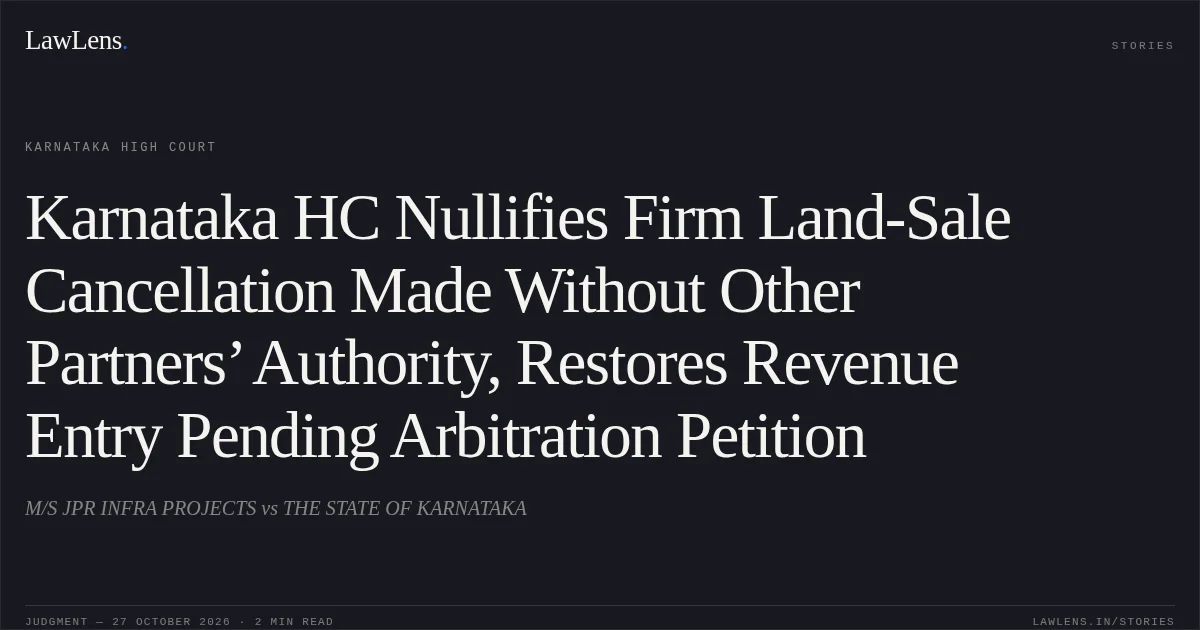
The petitioner-firm, constituted by a partnership deed and later reconstituted, purchased converted land under a registered sale deed dated 18 January 2022. The firm’s partners included the petitioners and respondent Thulasiram S.
p. 10, 18In November 2024, Thulasiram executed and registered a deed cancelling the sale deed in favour of the vendor, relying on a purported resolution. The petitioners alleged that he lacked authority and that the document was registered without the other partners’ authorisation.
pp. 11–13, 18In W.P. No. 53 of 2025, they challenged the registration of the cancellation deed; in W.P. No. 26735 of 2025, they challenged related mutation entries and a communication by the Assistant Commissioner concerning the land’s revenue records.
pp. 9–1202Issues
i.1. Whether a petition under Article 226 is maintainable to challenge the registration of the deed cancelling the sale deed dated 12 November 2024.
¶ 13(i) · p. 17ii.2. Whether registration of the cancellation deed was contrary to Section 32 of the Registration Act, 1908.
¶ 13(ii) · p. 1803Law Applied
Sections 32 and 33 of the Registration Act, 1908 prescribe who may present a document for registration and, where presentation is by an agent under Section 32(c), require due authorisation by a power of attorney executed and authenticated in the prescribed manner.
¶ 17–18 · pp. 24–38Relying on Asset Reconstruction Company (India) Ltd. v. S.P. Velayutham, (2022) 8 SCC 210, the Court held that a writ court may review whether a registering authority complied with its statutory duties, although a declaration that a document is void on grounds concerning its execution or title ordinarily falls within the civil court’s domain.
¶ 17–18 · pp. 24–38The Court also relied on the Karnataka High Court’s decision in W.P. No. 28962 of 2015 and connected matters, affirmed in W.A. No. 310 of 2025, for the principle that a registered document may be cancelled by all parties to the original document or pursuant to a competent court’s decree; a person acting for others must have proper authority.
¶ 15–16 · pp. 19–23Provisions in the judgment · 19 · Linked ones open on LawLens
Indian Partnership Act, 1932 Section 14Section 15Section 18Section 19
Registration Act, 1908 10 provisions
Section 6Section 17Section 18Section 31Section 32Section 33Section 34Section 69Section 88Section 89Arbitration and Conciliation Act, 1996 Section 11
KARNATAKA STAMP ACT, 1957 Section 33
Specific Relief Act, 1963 Section 31
Limitation Act, 1963 Section 59
Code of Criminal Procedure, 1973 Section 145
04Reasoning
The Court distinguished a challenge to the underlying execution or title from a challenge to the registering authority’s statutory conduct. The petitioners alleged that the cancellation deed was registered despite the absence of authority from the other partners.
¶ 17–19 · pp. 24–40On examining the deed, the Court found that Thulasiram had acted without the remaining partners and without a duly authorised power of attorney from them. It therefore held that the Sub-Registrar had acted arbitrarily and contrary to Sections 32 and 33 in registering the deed. Because the challenge concerned the authority’s compliance with its statutory duties, the Court considered writ review appropriate notwithstanding the availability of civil proceedings.
¶ 17–19 · pp. 24–4005Holding
The Court answered the issues in the petitioners’ favour and allowed both writ petitions.
¶ 20 · pp. 40–41It cancelled the registration of the deed of cancellation as null and void, subject to the outcome of the pending civil miscellaneous petition concerning arbitration. It also set aside the Assistant Commissioner’s communication and directed the Tahsildar to enter the petitioner-firm’s name in the revenue records for the subject land.
¶ 20 · pp. 40–41Original Court PDF
M/S JPR INFRA PROJECTSvsTHE STATE OF KARNATAKA
Click to open original judgment
Original judgment, available to read, download and summarize on LawLens.in