01Facts
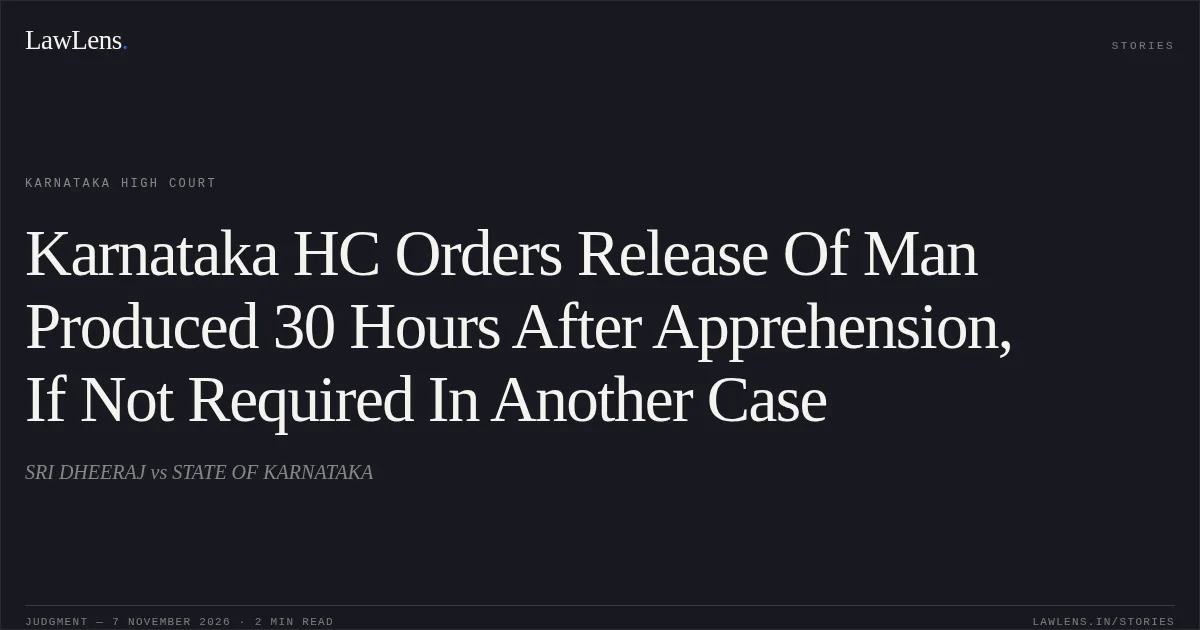
The petitioner was apprehended in Delhi at 11:00 a.m. on 14 May 2026 and produced before a Magistrate at 5:00 p.m. the following day
¶ 2 · ¶ 8He sought to set aside the transit warrant and the initial and subsequent remand orders arising from Crime No. 92/2026, contending that his detention exceeded the constitutional 24-hour limit
p. 1 · ¶ 3The State argued, among other things, that he had failed to disclose an earlier bail petition, which had been withdrawn without liberty to file afresh
¶ 4–602Issues
i.1. Whether detention and production before a Magistrate more than 24 hours after the petitioner was apprehended violated Article 22(2) of the Constitution and required his release
¶ 2–3, 8–10ii.2. Whether the petitioner’s failure to disclose his earlier bail petition barred relief in the present petition
¶ 4–5, 12–1303Law Applied
Article 22(2) of the Constitution requires a detained person to be produced before the nearest Magistrate within 24 hours of detention, excluding only the time necessary for the journey from the place of arrest to the court.
¶ 8In Sri Sujit Das and Others v. Union of India, the Supreme Court held that this period begins when the person’s liberty is curtailed, not at the time of formal arrest; detention beyond that period requires forthwith release, and the Magistrate must examine the actual time of detention and compliance with the deadline
¶ 8The Supreme Court also addressed the requirement under Section 58 of the BNSS that detention not exceed a reasonable period
¶ 8Provisions in the judgment · 4 · Linked ones open on LawLens
Code of Criminal Procedure, 1973 Section 482Section 57
Bharatiya Nagarik Suraksha Sanhita, 2023 Section 528Section 58
04Reasoning
Applying Sujit Das, the Court treated the petitioner’s apprehension at 11:00 a.m. as the start of the 24-hour period, rather than the time of any formal arrest.
¶ 8–10Because he was produced at 5:00 p.m. the next day, the Court held that his detention beyond 24 hours was per se illegal
¶ 8–10The Court acknowledged that the petitioner should have disclosed the earlier bail petition, but held that the omission did not bar relief on the distinct ground of unlawful detention; it nevertheless disapproved of his failure to disclose it
¶ 12–1305Holding
The petition was allowed, and the petitioner was ordered to be released forthwith unless required in another case
¶ 14(i)–(ii)The State remained at liberty to take such action as advised in law if his custody was required for justifiable reasons
¶ 14(iii)Original Court PDF
SRI DHEERAJvsSTATE OF KARNATAKA
Click to open original judgment
Original judgment, available to read, download and summarize on LawLens.in