01Facts
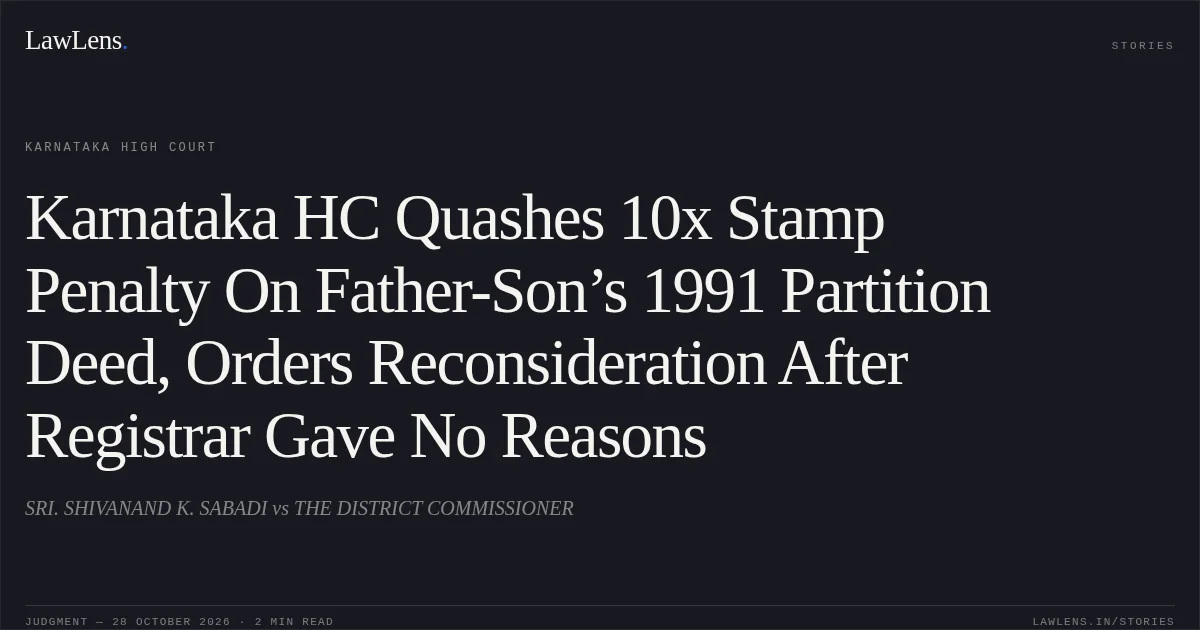
The petitioner, defendant No. 2 in a partition suit, relied on a partition deed dated 27 November 1991 between himself and his father.
pp. 6–8The trial court impounded the deed and forwarded it to the stamp authorities.
pp. 6–8The District Registrar determined the stamp duty payable and imposed a penalty at ten times that duty.
pp. 6–8The petitioner challenged the determination only insofar as it imposed the maximum penalty, accepting the stamp-duty assessment.
pp. 6–802Issues
i.1. Whether the District Registrar could impose the maximum ten-times penalty without giving reasons that justified imposing the statutory maximum.
pp. 8–13ii.2. Whether the penalty determination should be set aside and remitted for reconsideration.
pp. 13–1503Law Applied
Section 39(1)(b) of the Karnataka Stamp Act, 1957 authorises the Deputy Commissioner to impose a penalty up to ten times the proper duty or deficient portion, but does not require the maximum penalty to be imposed as a matter of course.
pp. 11–12In Trustees of H.C. Dhandha Trust v. State of Madhya Pradesh, the Supreme Court held that the maximum penalty should not be imposed mechanically and that fraud, deceit, or undue enrichment may be relevant to determining its extent.
p. 12In Petiti Subba Rao v. Anumala S. Narendra, the Supreme Court described ten times the duty as the “farthest limit,” appropriate only in very extreme situations, and required consideration of the circumstances, including the person’s financial position.
p. 13The Court applied these principles as affirmed in Seetharama Shetty v. Monappa Shetty, 2024 SCC OnLine SC 2320.
pp. 7–8, 13Provisions in the judgment · 9 · Linked ones open on LawLens
KARNATAKA STAMP ACT, 1957 Section 34Section 2Section 39Section 37Section 3Section 13Section 14Section 33
Indian Stamp Act, 1899 Section 40
04Reasoning
The District Registrar’s stated reasons addressed the deed’s execution, its classification for stamp-duty purposes, and the calculation of the property’s value.
pp. 10–11, 14They did not explain why the petitioner’s circumstances warranted the maximum penalty or identify circumstances justifying that exceptional measure.
pp. 10–11, 14Since the maximum is reserved for extreme situations and must reflect a reasoned exercise of discretion, the determination did not demonstrate the required application of mind.
pp. 13–1505Holding
The Court held that the ten-times penalty could not stand without reasons supporting its imposition.
pp. 14–15It quashed the impugned determination only to the extent of the penalty and remitted the matter to the District Registrar to redetermine the penalty in light of the Supreme Court’s guidance and the Court’s observations.
pp. 14–15The redetermination was directed to be completed within 30 days of receipt of a certified copy of the order; the petition was disposed of.
pp. 14–15Original Court PDF
SRI. SHIVANAND K. SABADIvsTHE DISTRICT COMMISSIONER
Click to open original judgment
Original judgment, available to read, download and summarize on LawLens.in