01Facts
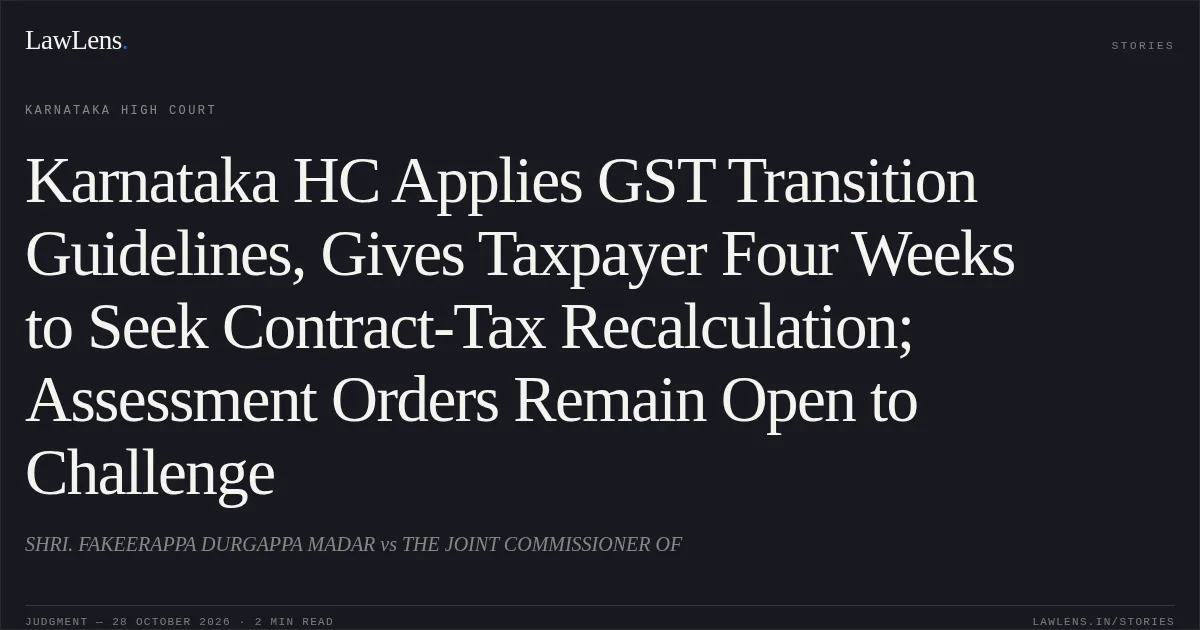
The petitioner, a proprietor of a consultancy services business, challenged an appellate order dated 1 December 2025 and an adjudication order dated 16 December 2023 concerning GST.
p. 1He sought certiorari quashing both orders.
¶ 3 · p. 2The petition was taken up for final disposal by consent, and the Court found the issue identical to that considered in an earlier decision concerning the GST transition and works contracts.
¶ 2, 4 · pp. 2–302Issues
i.1. Whether the directions in Chandrashekharaiah, as modified by the Division Bench, applied to the petitioner’s case concerning the GST transition.
¶ 4–6 · pp. 2–7ii.2. Whether the petitioner’s challenge to the assessment orders could be determined in this petition, or should remain open for appropriate proceedings.
¶ 7 · p. 703Law Applied
The Court acted under Articles 226 and 227 of the Constitution of India and applied the principles in Chandrashekharaiah v. State of Karnataka, as modified by the Division Bench in Office of Principal Commissioner GST and Central Excise v. R. Chandrashekhar S/o Ramaiah.
¶ 5 · pp. 5–7The Division Bench held that GST liability must be determined under the applicable GST statutes; contractual disputes over the incremental tax burden are between contractors and their employers, and directions cannot be issued to tax authorities to alter statutory requirements concerning tax, returns, penalty, interest, or limitation.
¶ 5 · pp. 5–7The directions in Chandrashekharaiah concerning calculation of pre- and post-GST work and consideration of representations by the relevant employers remained applicable, but directions concerning revised returns, waiver of penalty or interest, and limitation had been set aside.
¶ 5 · p. 704Reasoning
Because the parties’ dispute was identical to the issue addressed in the cited coordinate-bench decision, and that decision had been modified by the Division Bench, the Court applied only the surviving directions: calculation of the relevant pre- and post-GST work and tax components, and consideration of the petitioner’s representation by the concerned employer.
¶ 4–6 · pp. 2–7The Court did not determine the validity of the challenged assessment orders on their merits; it expressly left the petitioner free to contest them in appropriate proceedings.
¶ 7 · p. 705Holding
The writ petition was disposed of in terms of the surviving directions in Chandrashekharaiah—operative directions (i), (ii)(a) to (ii)(f), (iii), (iv), and (vii).
¶ 6 · p. 7The petitioner may challenge the assessment orders in appropriate proceedings, and the authorities must exclude the time spent prosecuting this writ petition when considering such proceedings.
¶ 7 · p. 7The Court did not quash the impugned orders or grant the requested substantive relief against them.
¶ 7 · p. 7Original Court PDF
SHRI. FAKEERAPPA DURGAPPA MADARvsTHE JOINT COMMISSIONER OF
Click to open original judgment
Original judgment, available to read, download and summarize on LawLens.in