01Facts
The petitioner claimed to be the Mutawalli of a family waqf created by a registered deed dated 8 January 1945.
The dispute concerned two parcels at Bazar Bunder Village, Mangaluru Taluk.
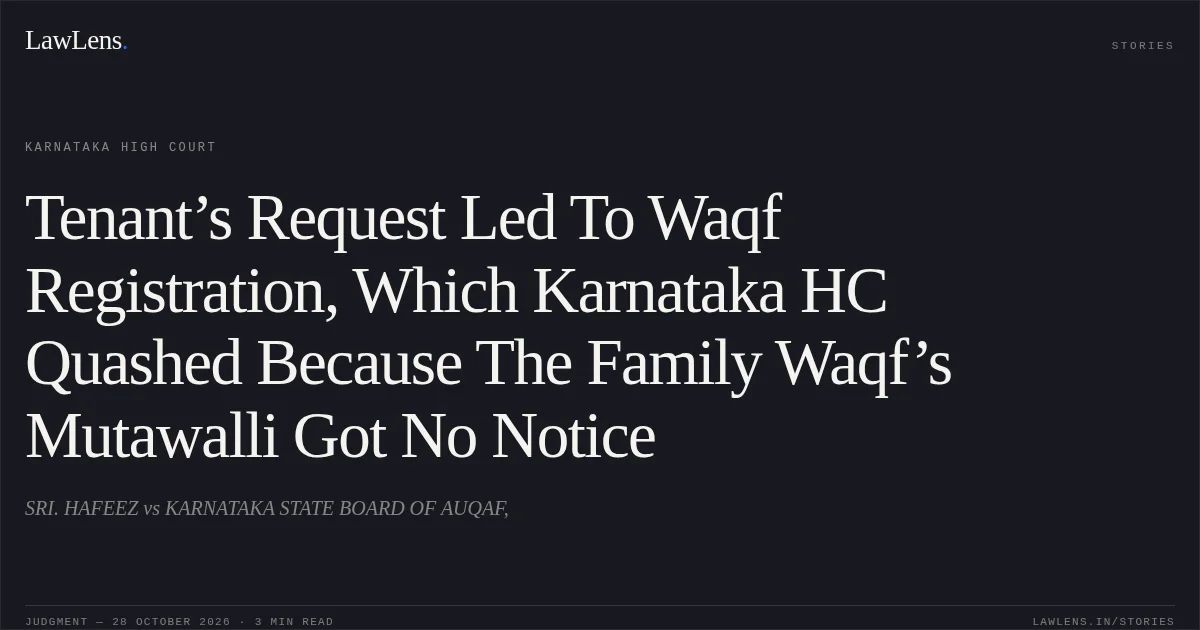
While the petitioner’s eviction suit against tenants was pending, respondent No. 1 registered the parcels as waqf property on 28 December 2020, following a representation by tenant Ayoob.
pp. 2–5, 6–7The petitioner said he first learned of the registration when the Board sought to be impleaded in the suit and challenged the certificate, alleging lack of notice and non-compliance with Section 36 of the Waqf Act, 1995
pp. 2–5, 6–7The Board objected that the petition was time-barred and that the petitioner should pursue the statutory remedy before the Waqf Tribunal
pp. 4–6, 12–13The petitioner also relied on earlier civil-court decisions concerning the same waqf deed and property, which had treated the waqf as private or family waqf.
pp. 9–12, 18–1902Issues
i.1. Whether the writ petition challenging registration under Section 36 of the Waqf Act was maintainable, or the petitioner should be relegated to a remedy under Section 83
p. 14ii.2. Whether the registration certificate dated 28 December 2020 was issued in compliance with the procedure under Section 36
p. 14iii.3. Whether the property was private waqf in light of the registered deed dated 8 January 1945
p. 1403Law Applied
Section 3(r) of the Waqf Act, 1995 defines waqf as the permanent dedication of property for a purpose recognised by Muslim law as pious, religious or charitable.
p. 5Section 36 governs registration of waqf, while Sections 6 and 83 provide statutory routes for disputes concerning waqf property and recourse to the Waqf Tribunal.
pp. 5–6, 12–14The High Court’s jurisdiction under Article 226 may be exercised despite an alternative remedy where, among other circumstances, there is a breach of natural justice or the impugned action is wholly without jurisdiction; the Court relied on the principles discussed in Whirlpool Corporation v. Registrar of Trade Marks and M/s Godrej Sara Lee Ltd. v. Excise and Taxation Officer-cum-Assessing Authority.
pp. 7–9It also considered Hydersha Abusha Malangsha v. Karnataka State Board of Wakfs as supporting writ intervention in the face of an alleged statutory violation.
p. 9The Board’s reliance on Board of Wakf, West Bengal v. Anis Fatma Begum and Rashid Wali Beg v. Farid Pindari—concerning recourse to the Tribunal—did not displace writ review in the circumstances found here.
pp. 12–16Provisions in the judgment · 5
Waqf (Amendment) Act, 2025 Section 3Section 6Section 36Section 83Section 90
04Reasoning
The Court held that the Board registered the property on the basis of a tenant’s representation rather than an application by the Mutawalli, and did so without notifying the petitioner, who claimed to manage the family waqf.
pp. 14–15, 17–18It considered the rapid sequence from the tenant’s application through the public notice and mahazar to registration, together with the earlier civil-court findings concerning the same property, and concluded that the certificate had been issued without following Section 36’s procedure and in breach of natural justice.
pp. 15–18Those circumstances justified entertaining the writ petition rather than relegating the petitioner to the Tribunal.
pp. 14–15The Court also read the 1945 deed as providing for family management while lineal descendants remained available, and found that it did not establish a public waqf under the Board’s management; earlier judicial findings supported that conclusion.
pp. 15–16, 18–1905Holding
The Court answered the maintainability issue in the petitioner’s favour and held that the registration certificate could not stand because it was issued without proper notice and compliance with the statutory procedure.
pp. 14–18It allowed the writ petition and quashed the Waqf Registration Certificate dated 28 December 2020.
pp. 14–18The Court clarified that quashing the certificate would not affect adjudication of the parties’ rights in pending civil suits or other proceedings in accordance with law.
p. 19Original Court PDF
SRI. HAFEEZvsKARNATAKA STATE BOARD OF AUQAF,
Click to open original judgment
Original judgment, available to read, download and summarize on LawLens.in