01Facts
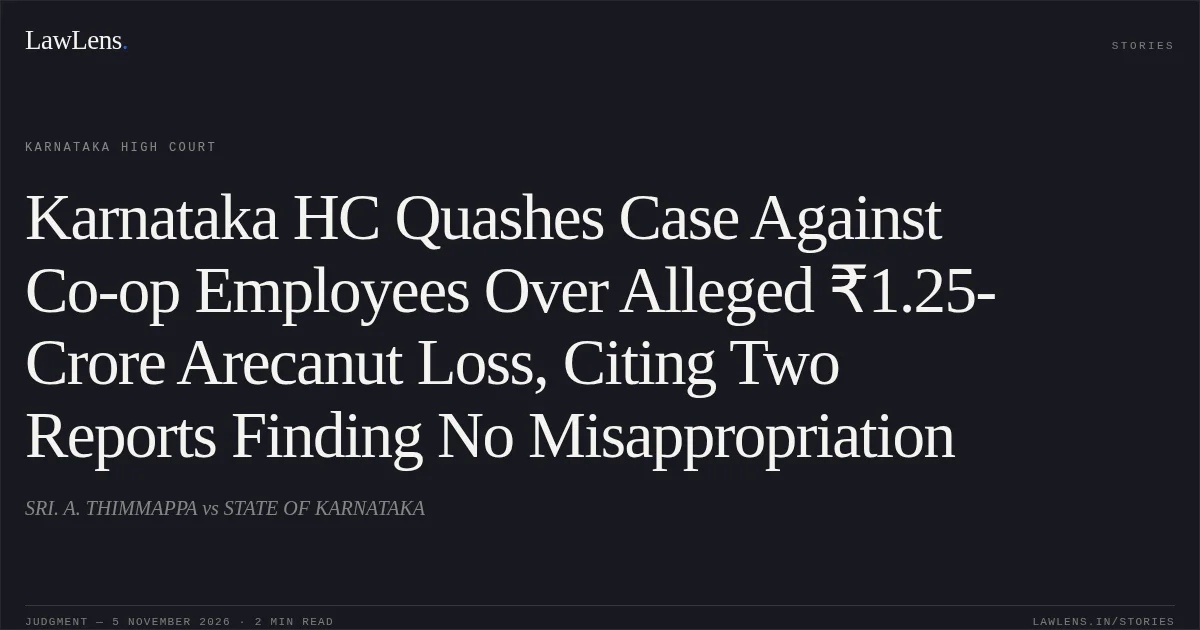
Respondent No. 2 alleged that, between 7 February 2013 and 3 February 2015, the petitioners—employees of a co-operative society—sold 1,006.5 kg of his deposited arecanut using allegedly fraudulent vouchers and forged signatures, causing a loss of ₹1,25,65,240.
p. 4An enquiry by the Assistant Registrar of Co-operative Societies resulted in a report finding no misappropriation, and the complaint was closed on 3 October 2019; respondent No. 2 did not challenge that order.
p. 5A subsequent police enquiry into a 2022 complaint also reported that no misappropriation had occurred.
p. 6Respondent No. 2 then filed a private complaint, which the Magistrate referred to the police under Section 156(3) Cr.P.C.; the police registered Crime No. 52/2023 against the petitioners.
pp. 3–4The petitioners sought to quash the proceedings under Section 482 Cr.P.C.
p. 302Issues
i.1. Whether continuation of the criminal proceedings was an abuse of the process of law where two prior enquiries into substantially the same allegations had found no misappropriation.
pp. 5–8ii.2. Whether the proceedings in Crime No. 52/2023 should be quashed under Section 482 Cr.P.C.
pp. 3, 7–803Law Applied
Section 482 of the Code of Criminal Procedure, 1973 preserves the High Court’s inherent power to prevent abuse of the process of any court and to secure the ends of justice; the Court invoked that provision to consider quashing the proceedings.
p. 3The Magistrate’s referral of the private complaint for police investigation was made under Section 156(3) Cr.P.C.
p. 4The judgment cited no precedent and stated no separate statutory test; it treated continuation of proceedings based on repeated allegations, following two adverse enquiry reports that had not been challenged, as an abuse of process.
pp. 5–8Provisions in the judgment · 8 · Linked ones open on LawLens
Code of Criminal Procedure, 1973 Section 482Section 156
Indian Penal Code, 1860 Section 427Section 34Section 212Section 409Section 420Section 468
04Reasoning
The Court noted that the private complaint repeated the allegations previously considered by the Assistant Registrar and the police, and that both enquiries had concluded that no misappropriation had occurred.
pp. 5–8It also took into account that respondent No. 2 had not challenged the closure order of 3 October 2019 through the appropriate legal process.
p. 5In those circumstances, the Court concluded that requiring the petitioners to face criminal proceedings founded on the same allegations would amount to an abuse of process and cause them unnecessary hardship.
p. 705Holding
The Court answered the issues in favour of the petitioners, allowed the criminal petition, and quashed the proceedings in Crime No. 52/2023—including the offences alleged under Sections 427, 34, 120B, 212, 409, 420 and 468 IPC—as against the petitioners.
p. 8Original Court PDF
SRI. A. THIMMAPPAvsSTATE OF KARNATAKA
Click to open original judgment
Original judgment, available to read, download and summarize on LawLens.in