01Facts
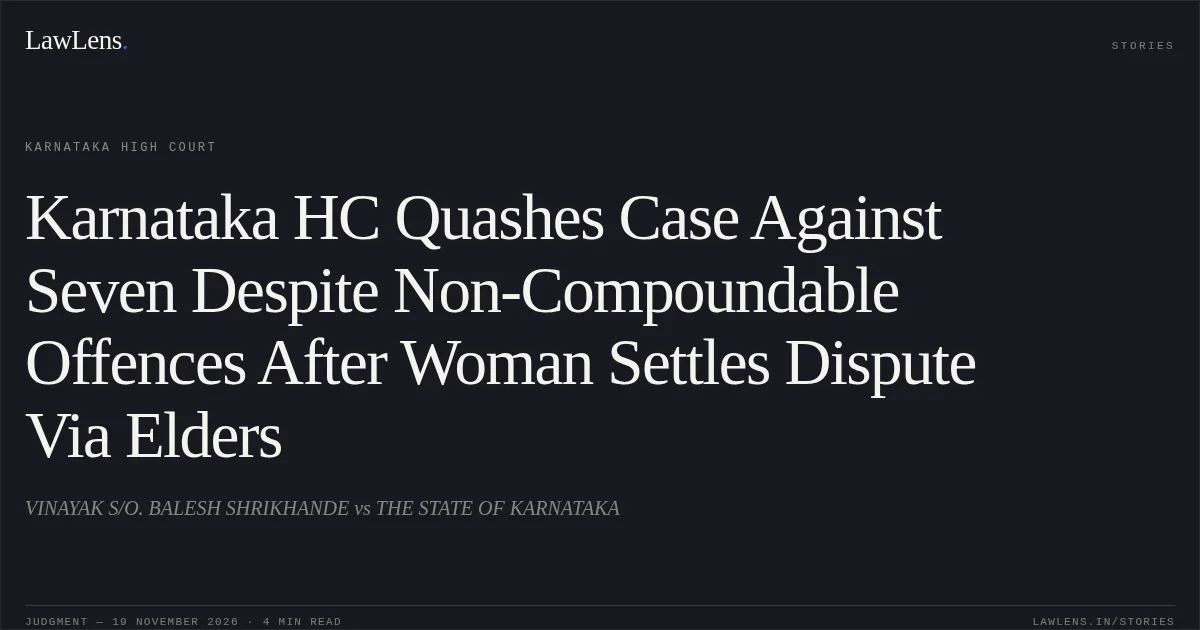
Accused Nos. 1 to 7 filed a petition under s. 482 Cr.P.C. / s. 528 BNSS to quash the entire proceedings in C.C. No. 13/2026 (Principal Civil Judge & JMFC, Chikkodi), arising out of Crime No. 114/2025 of Chikkodi Police Station. The charges are under ss. 189(2), 191(2), 351(2), 352 and 190 of the Bharatiya Nyaya Sanhita, 2023 (BNS).
¶ 2The case was registered on the complaint of respondent No. 2, Smt. Savita W/o Arun Shrikhande. The matter is pending trial.
¶ 3Before the Court, the parties filed a joint compromise petition/I.A. under s. 359(1) r/w s. 528 BNSS for compounding. It states the dispute was settled with the intervention of elders of both families.
¶ 4The I.A. describes the offences as including ss. 329(1) and 324(5) BNS, which do not appear in the charge sections listed in the order. This discrepancy is noted but not addressed by the Court.
¶ 4Affidavits were filed by the petitioners and by respondent No. 2. Each deposed that the dispute was settled in the presence of elders, that there was no pressure or coercion, and that the parties will not fight or make allegations against each other in future.
¶ 5The learned HCGP for the State and counsel for all parties supported acceptance of the compromise and quashing of the proceedings.
¶ 602Issues
i.1. Whether the criminal proceedings in C.C. No. 13/2026 may be quashed under the inherent powers of the High Court, on the basis of a compromise between the parties, in respect of offences that are admittedly non-compoundable.
¶ 7ii.2. Whether the dispute is predominantly of a private/civil character, such that continuation of the prosecution would be an abuse of process and the chances of conviction are remote.
¶ 7, 903Law Applied
The Court relied on s. 482 Cr.P.C., read with s. 528 BNSS, which preserves the High Court's inherent power to prevent abuse of process and secure the ends of justice.
¶ 2, 7The Court relied on s. 359(1) BNSS, which governs compounding, and noted that the offences are non-compoundable, so relief had to rest on inherent power rather than compounding alone.
¶ 7The Court followed the principles in Narinder Singh & Ors v. State of Punjab & Anr., (2014) 6 SCC 466, paras 31–35. These hold that: (I) inherent power to quash non-compoundable offences is to be exercised sparingly and with caution; (II) the guiding considerations are the ends of justice or prevention of abuse of process; (III) heinous or serious offences of mental depravity, or offences against society, are excluded; (IV) cases of predominantly civil character, such as family or commercial disputes, may be quashed once the parties have settled their disputes; (V) the court must assess whether conviction is remote or bleak and whether continuation would cause oppression or extreme injustice; and (VII) the timing of the settlement is relevant.
¶ 8Provisions in the judgment · 15 · Linked ones open on LawLens
Bharatiya Nagarik Suraksha Sanhita, 2023 Section 528Section 359
Bharatiya Nyaya Sanhita, 2023 Section 189Section 191Section 351Section 352Section 190Section 329Section 324
Code of Criminal Procedure, 1973 Section 482Section 320
Indian Penal Code, 1860 Section 307Section 324Section 323Section 34
04Reasoning
The Court found that respondent No. 2 had filed the complaint on a misconception of facts and in a fit of anger. She had since realised her mistake and wished to withdraw the case on the advice of elders.
¶ 9The elders' intervention, the parties' agreement to live peacefully, and the absence of any likelihood of further investigation were treated as important considerations.
¶ 9The Court also noted that the role attributed to the accused was unclear and that the complainant had not clearly established a direct nexus between herself and the accused.
¶ 9Based on these factors, and on the minimal likelihood of witnesses supporting the prosecution, the Court held that the chances of conviction were "very remote" and that continuing the proceedings would be unnecessary.
¶ 9Applying Narinder Singh (IV) and (V), the Court treated the dispute as essentially familial/private and concluded that the compromise should be accepted.
¶ 8, 9The Court did not expressly address the offences' seriousness or the stage of trial beyond noting the matter is pending trial.
¶ 3, 9The affidavits, which contain reciprocal undertakings and a voluntariness declaration, were relied upon as establishing a genuine settlement.
¶ 505Holding
The Court held that the compromise between the parties was genuine, that the dispute was predominantly private, and that the chances of conviction were remote. The compromise petition was accepted.
¶ 10The criminal petition was allowed, and the proceedings in C.C. No. 13/2026 arising out of Crime No. 114/2025 (Chikkodi PS) under ss. 189(2), 191(2), 351(2), 352 and 190 BNS were quashed insofar as accused Nos. 1 to 7 are concerned. Pending I.A.s were disposed of as not surviving.
¶ 9, 10Original Court PDF
VINAYAK S/O. BALESH SHRIKHANDEvsTHE STATE OF KARNATAKA
Click to open original judgment
Original judgment, available to read, download and summarize on LawLens.in