01Facts
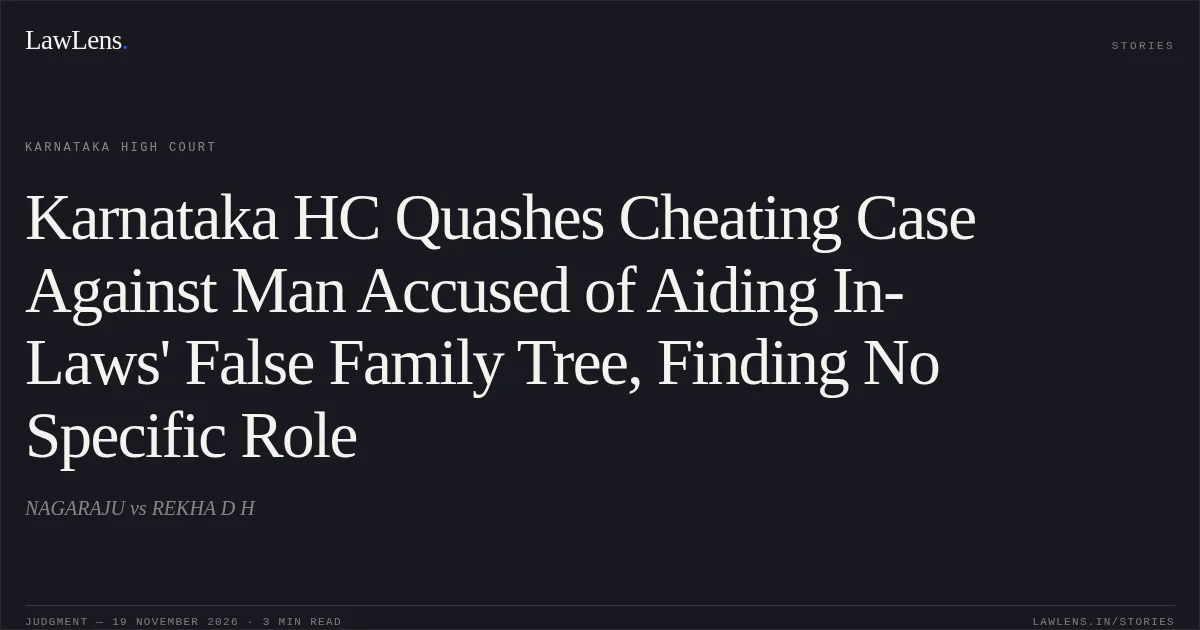
The respondent-complainant, Rekha D H, held a private complaint under Section 200 CrPC (PCR No. 287/2023) before the II Additional Civil Judge and JMFC, Channarayapatna, on 26.05.2023 against the petitioner (accused No. 3) and others.
p. 2 · ¶ 2The complaint alleged that accused Nos. 1 (Chaithra) and 2 (Venkatesh) are the complainant's sister and brother-in-law.
p. 2 · ¶ 2In O.S. No. 87/2022, a partition suit filed by the complainant concerning joint family property, the accused allegedly produced a false family tree that omitted the complainant and used it to obtain khata entries.
pp. 2–3 · ¶ 2The complaint alleged offences under Sections 420 and 464 IPC against the petitioner.
p. 3 · ¶ 2The Magistrate recorded the complainant's evidence (CW-1), took cognizance, and issued summons to the petitioner.
p. 3 · ¶ 2The petitioner sought quashing under Section 482 CrPC. The respondent was absent for the hearing.
p. 3 · ¶ 302Issues
i.1. Whether the complaint and the evidence of CW-1 disclose specific overt acts attributing participation by accused No. 3 in the alleged cheating (s. 420 IPC) and false-document (s. 464 IPC) offences, or only an omnibus allegation.
p. 4 · ¶ 4 · p. 5 · ¶ 6ii.2. Whether the complaint was filed out of vengeance and constitutes an abuse of the process of court, warranting quashing under Section 482 CrPC.
p. 5 · ¶ 7 · pp. 6–7 · ¶ 11iii.3. Whether the Magistrate erred in taking cognizance where the complainant's evidence merely reiterated the complaint without new material.
p. 13 · ¶ 8 · p. 13 · ¶ 903Law Applied
The Court invoked its inherent power under Section 482 CrPC, applying the principles laid down in Mohammed Ali and Ors. v. State of U.P. (2023) 15 SCC 488, which adopted the seven categories of State of Haryana v. Bhajan Lal, AIR 1992 SC 604, under which proceedings may be quashed where the allegations, even if accepted, do not constitute an offence, are absurd or inherently improbable, or are instituted maliciously to wreak vengeance.
pp. 5–7 · ¶ 11Mohammed Ali further holds that where the proceedings appear frivolous or vexatious, the court must examine the surrounding circumstances and not merely the averments in the complaint.
pp. 7–9 · ¶ 12The Court also relied on State of A.P. v. Golconda Linga Swamy (2004) 6 SCC 522, which permits the High Court to assess whether the material manifestly fails to support the accusation, without embarking on an appreciation of evidence, and on R.P. Kapur v. State of Punjab, AIR 1960 SC 866, which recognises that inherent power may be exercised where the allegations do not constitute the alleged offence or the evidence clearly fails to prove it.
pp. 9–12 · ¶ 13The Court reaffirmed that judicial process must not be an instrument of harassment in a private complainant's hands.
pp. 12–13 · ¶ 13Provisions in the judgment · 5 · Linked ones open on LawLens
Code of Criminal Procedure, 1973 Section 482Section 156Section 155
Indian Penal Code, 1860 Section 420Section 464
04Reasoning
The only allegation against the petitioner was the omnibus assertion that he was known to accused Nos. 1 and 2 and assisted them in obtaining the false family tree. Neither the complaint nor CW-1's evidence specified how the petitioner assisted or what overt act he committed. Because the family tree was allegedly placed before the Tahsildar by accused Nos. 1 and 2, with no particulars of the petitioner's role, the ingredients of the offences were not made out against him.
p. 4 · ¶ 4 · p. 5 · ¶ 6The Court noted that a partition suit between the parties was pending, which, in its view, indicated that the complaint was filed out of vengeance, bringing the case within Bhajan Lal categories 1, 5 and 7 as applied in Mohammed Ali. Applying Mohammed Ali's guidance on looking beyond the averments, the Court considered the surrounding civil dispute as a relevant circumstance. The Court also found that the complainant's evidence merely reiterated the complaint and added no new material, a fact the Magistrate failed to consider before taking cognizance.
pp. 5–7 · ¶ 7 and 11 · pp. 7–9 · ¶ 12 · p. 13 · ¶ 805Holding
The Court answered the issues in the petitioner's favour: the complaint and evidence disclose no specific overt act by accused No. 3 under Sections 420 or 464 IPC, the complaint appears vexatious, and the Magistrate's cognizance was unsustainable as against him. No prima facie case was made out against the petitioner, and continuing the proceedings against him would amount to an abuse of the process of court.
p. 13 · ¶ 8–9The petition is allowed. The proceedings against the petitioner/accused No. 3 in C.C. No. 568/2023 (arising out of PCR No. 287/2023), pending before the II Additional Civil Judge and JMFC, Channarayapatna, for offences under Sections 420 and 464 IPC, are quashed. The proceedings shall continue against the other accused.
p. 14 · ¶ 10(ii) · p. 14 · ¶ 10(iii)Original Court PDF
NAGARAJUvsREKHA D H
Click to open original judgment
Original judgment, available to read, download and summarize on LawLens.in