01Facts
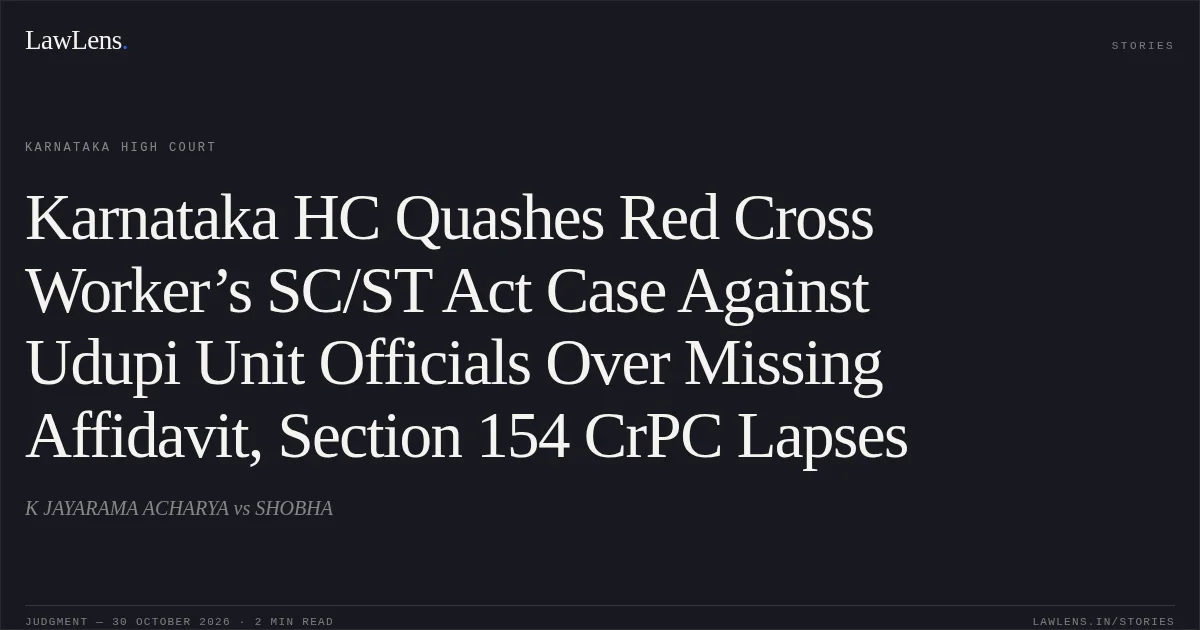
The petitioners sought to quash proceedings arising from a private complaint, P.C. No. 03/2021, alleging offences under the SC/ST (Prevention of Atrocities) Act and the IPC.
The complaint referred to incidents on 18 February, 16 March and 23 March 2021, including the complainant’s removal from service.
p. 4The petitioners argued that the complaint was unsupported by an affidavit and did not establish compliance with Sections 154(1) and 154(3) of the CrPC, as required by Priyanka Srivastava.
p. 3The complainant’s counsel stated that the police had not received the complaint and had issued an endorsement, and that an NCR was issued in relation to a subsequent complaint; counsel also acknowledged the absence of an affidavit and non-compliance with Sections 154(1) and 154(3).
p. 402Issues
i.1. Whether the private complaint was liable to be quashed for failure to comply with the requirements concerning an affidavit and prior recourse under Sections 154(1) and 154(3) of the CrPC
pp. 3, 5–6ii.2. Whether continuation of the proceedings, in light of those defects, would amount to abuse of process or miscarriage of justice
p. 603Law Applied
The Court relied on the Supreme Court’s decision in Priyanka Srivastava concerning applications invoking the Magistrate’s power under Section 156(3) CrPC.
p. 3, 5It treated that decision as requiring an affidavit and prior compliance with Sections 154(1) and 154(3) CrPC before such recourse.
p. 3, 5The Court held that non-compliance with those requirements constituted a foundational defect in the private complaint warranting exercise of the High Court’s inherent power under Section 482 CrPC.
p. 6Provisions in the judgment · 10 · Linked ones open on LawLens
Code of Criminal Procedure, 1973 Section 482Section 154
Scheduled Castes and the Scheduled Tribes (Prevention of Atrocities) Act, 1989 Section 3Section 4
Indian Penal Code, 1860 Section 254Section 321Section 354Section 506Section 509Section 34
04Reasoning
The complaint was filed in 2021, after the Priyanka Srivastava decision, but was not supported by an affidavit and did not demonstrate compliance with Sections 154(1) and 154(3) CrPC.
pp. 5–6Although the complainant sought an opportunity to cure the defects and referred to the police’s refusal to receive a complaint and the issuance of an NCR, the Court declined to permit a remand for that purpose.
pp. 4–6It concluded that the acknowledged omissions were foundational and that allowing the proceedings to continue would amount to an abuse of process or miscarriage of justice.
pp. 4–605Holding
The Court allowed the petition and quashed the proceedings in P.C. No. 03/2021 against the petitioners, identified in the order as accused Nos. 1, 2 and 4, for the alleged offences under the SC/ST (Prevention of Atrocities) Act and the IPC.
p. 7Original Court PDF
K JAYARAMA ACHARYAvsSHOBHA
Click to open original judgment
Original judgment, available to read, download and summarize on LawLens.in