01Facts
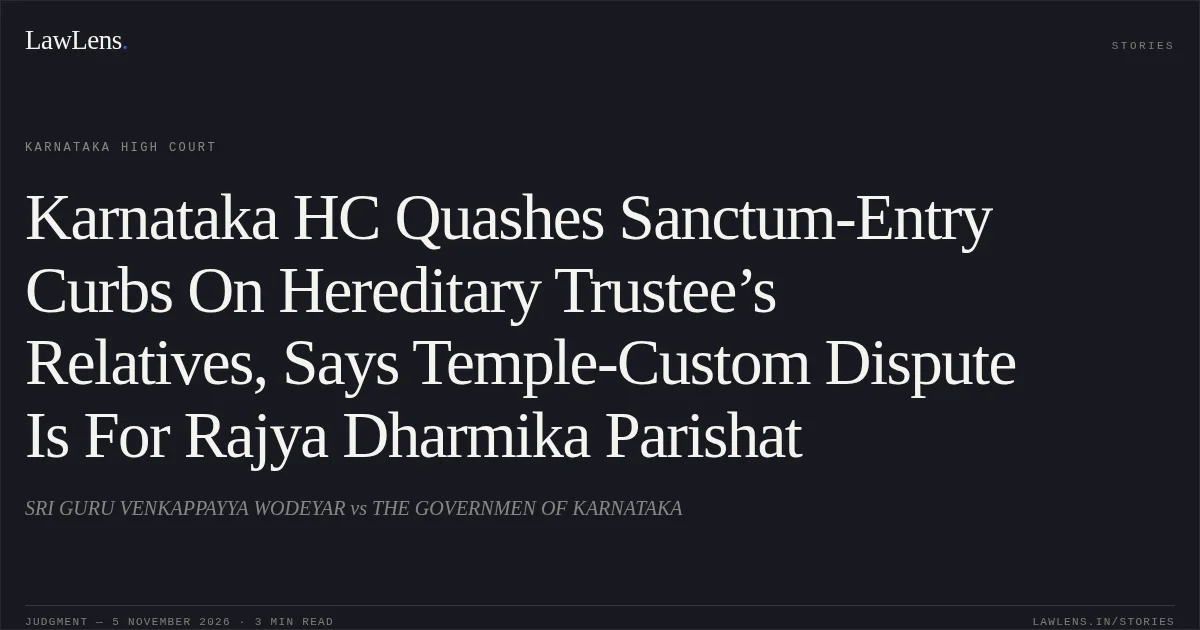
The petitions concerned the administration and religious practices of Sri Mylara Lingeshwara Swamy Temple, whose hereditary trustee was also its high priest.
¶ 7–10, 22The Executive Officer reported that the trustee’s family members were entering the Garbhagudi and participating in religious activities in a manner said to interfere with temple practices and administration.
¶ 7–10, 22On 22 December 2024, the Deputy Commissioner issued an official memorandum restricting entry into the Garbhagudi to the hereditary trustee and the appointed Archaka.
¶ 23, 28In W.P. No. 106994/2025, family members of the hereditary trustee challenged that restriction, asserting that their participation in long-standing rituals required entry into the Garbhagudi.
¶ 15The temple deity and hereditary trustee challenged the memorandum and the Executive Officer’s report in W.P. No. 103119/2025.
¶ 1, 8–12In W.P. No. 102900/2025, the hereditary trustee challenged a subsequent order dated 6 February 2025 insofar as it directed the Executive Officer to inquire into the matter on the basis of that report; the order also appointed another person as the temple’s Belli Betha carrier.
¶ 2, 13–14, 2702Issues
i.Whether the Deputy Commissioner and the Executive Officer had authority to issue the report, restrict entry into the Garbhagudi, and direct an inquiry concerning alleged violations of temple customs and practices
¶ 24–29, 34ii.Whether disputes concerning the temple’s religious practices, customs, usages and hereditary rights fell within the jurisdiction of the Rajya Dharmika Parishat rather than the Deputy Commissioner or Executive Officer
¶ 30–34iii.Whether the direction in the 6 February 2025 order to inquire into the matter on the basis of the Executive Officer’s report could stand
¶ 27, 34–3503Law Applied
Section 25A(1) of the Karnataka Hindu Religious Institutions and Charitable Endowments Act, 1997 protects the management powers of hereditary trustees, while Section 58 bars officials exercising powers under the Act from interfering with the customs, usages, ceremonies and practices of notified institutions.
¶ 6Section 24A and Rule 33B of the Karnataka Hindu Religious Institutions and Charitable Endowments Rules, 2002 impose duties on an Executive Officer concerning temple administration and the performance of specified religious functions.
¶ 16, 26Section 25B(6) authorises the Deputy Commissioner to decide specified disputes, including certain questions concerning hereditary office, honours, perquisites and existing usage.
¶ 31–32Section 20A empowers the Rajya Dharmika Parishat to resolve disputes concerning religious practices, customs, usages, traditions and hereditary trusteeship, and gives it general superintendence and control over religious institutions.
¶ 33The Court held that a restriction of this kind required an inquiry into the practices allegedly being violated and a lawful basis for the action; a general assertion of violation was insufficient.
¶ 25, 28–29Provisions in the judgment · 7 · Linked ones open on LawLens
HINDU RELIGIOUS INSTITUTIONS AND CHARITABLE ENDOWMENTS ACT, 1997 Section 25Section 58Section 24Section 20Section 21Section 28Section 29
04Reasoning
The report and memorandum did not identify the legal provision authorising the action, establish through an inquiry what customs or practices prevailed, or explain the basis for excluding the trustee’s family members from the Garbhagudi.
¶ 24–29The Court recognised the Executive Officer’s statutory duties under Rule 33B but found nothing in the report or memorandum showing that the action had been taken pursuant to those duties.
¶ 26Given that the dispute concerned alleged interference with religious practices and customs, the Court concluded that it fell within the Rajya Dharmika Parishat’s remit under Section 20A, rather than being resolved through the impugned communications or the resulting inquiry direction.
¶ 33–34The Court also directed that any matter taken to the Parishat should be heard with an opportunity for the petitioners to present their case and with consideration of the claimed longstanding practices and the historical judgment referred to by the parties.
¶ 35(iv)05Holding
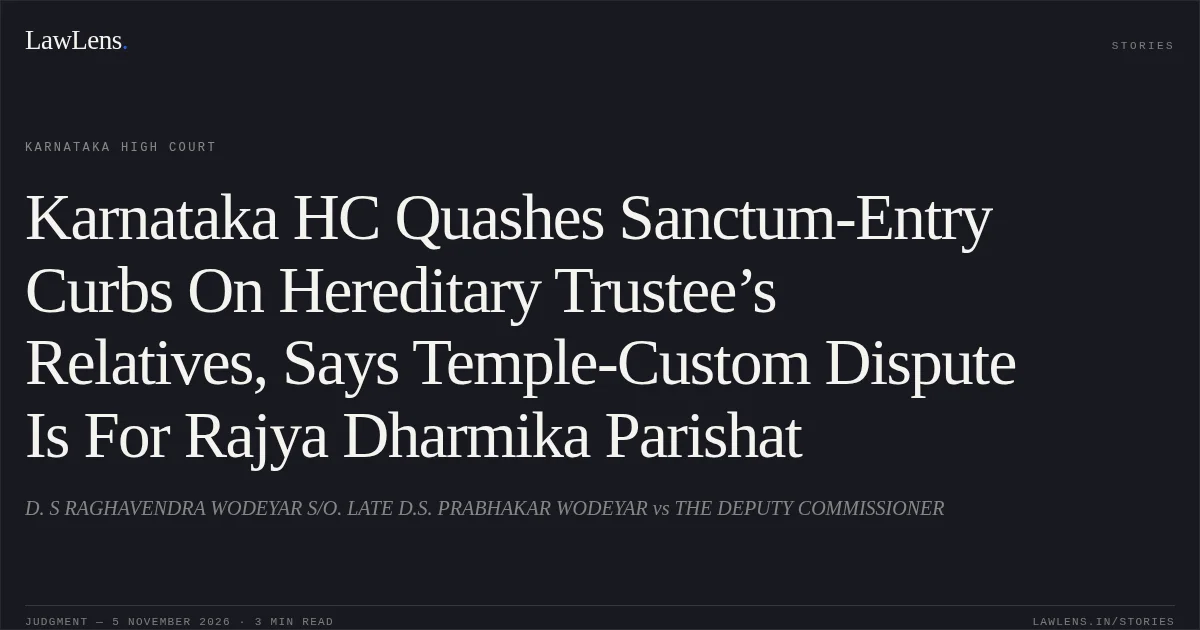
W.P. Nos. 103119/2025 and 106994/2025 were allowed.
¶ 35(i)–(ii)The Court quashed the 22 December 2024 official memorandum, the Executive Officer’s report dated 24 November 2024, and further correspondence or orders emanating from them.
¶ 35(i)–(ii)W.P. No. 102900/2025 was allowed only to the extent that the direction to the Executive Officer to conduct an inquiry based on that report was quashed; the order’s separate appointment of the Belli Betha carrier was not set aside by that relief.
¶ 27, 35(iii)The Executive Officer could, if advised, refer the dispute to the Rajya Dharmika Parishat, which was to provide the petitioners a sufficient opportunity of hearing and consider the claimed longstanding practices.
¶ 35(iv)Original Court PDF
D. S RAGHAVENDRA WODEYAR S/O. LATE D.S. PRABHAKAR WODEYARvsTHE DEPUTY COMMISSIONER
Click to open original judgment
Original judgment, available to read, download and summarize on LawLens.in