01Facts
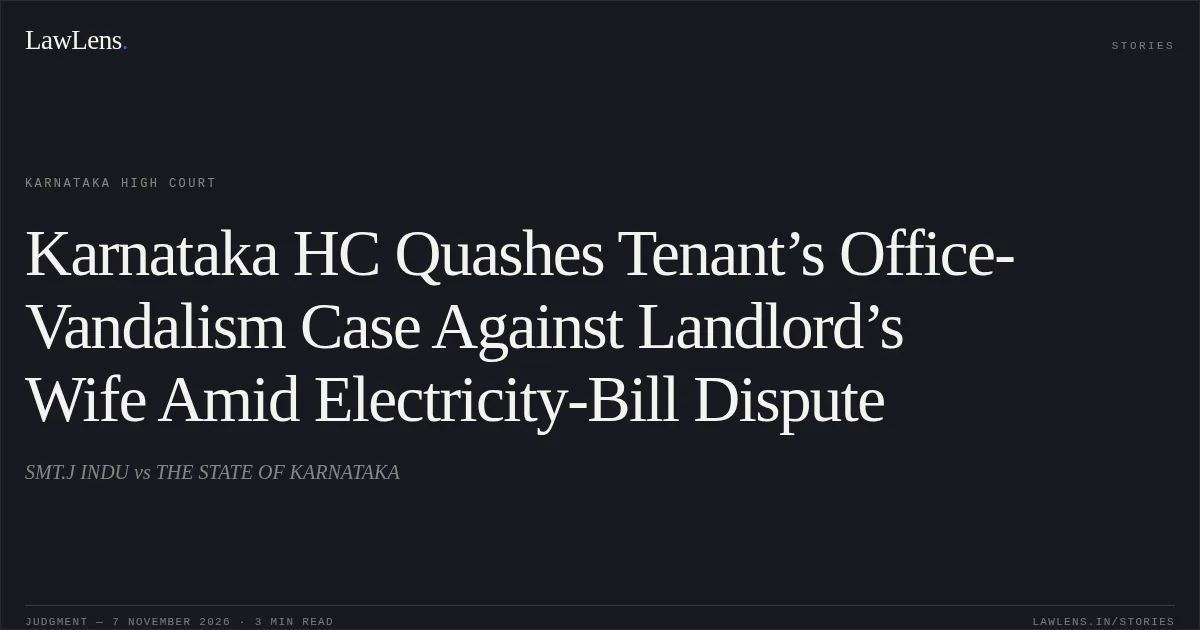
Respondent No. 2 rented premises owned by the petitioner’s husband under a tenancy agreement and operated an office there.
pp. 2–4Following a dispute concerning electricity bills and the tenancy, respondent No. 2 alleged that the petitioner and her husband entered the premises on 26 March 2023, damaged office equipment, and removed articles.
pp. 2–4He lodged a complaint on 4 April 2023.
pp. 2–4After investigation, police charged the petitioner and her husband under Sections 427 and 448 read with Section 34 of the IPC; the Section 379 allegation was dropped.
pp. 2–4The petitioner, arraigned as accused No. 2, sought quashing under Section 482 CrPC.
pp. 2–4She contended that the dispute was civil, that criminal trespass was not established, and that the investigation did not reliably support the damage allegation.
pp. 5–6The High Court allowed the petition and quashed the proceedings against her.
p. 1202Issues
i.1. Whether the charge-sheet materials disclosed the ingredients of criminal trespass under Section 448 IPC against the petitioner, given that the premises belonged to her husband
p. 8ii.2. Whether the materials disclosed a prima facie case of mischief under Section 427 IPC against the petitioner, or whether continuation of the proceedings would amount to an abuse of process
pp. 8–9, 11–1203Law Applied
Section 482 CrPC empowers the High Court to quash proceedings to prevent abuse of the court’s process and secure the ends of justice.
pp. 9–11Sections 427 and 448 IPC were the offences alleged, read with Section 34 IPC.
pp. 9–11In Mahmood Ali v. State of U.P., (2023) 15 SCC 488, the Supreme Court stated that, where proceedings are alleged to be frivolous, vexatious, or initiated with an ulterior motive, the court may examine the surrounding circumstances and investigation materials, not merely the complaint’s averments.
pp. 9–11Relying also on State of A.P. v. Golconda Linga Swamy, (2004) 6 SCC 522, the Court reiterated that proceedings may be quashed where the allegations and materials, taken at face value, fail to disclose an offence or where the available material manifestly fails to support the accusation; the quashing court should not ordinarily conduct a trial-level assessment of evidentiary reliability.
pp. 10–11Provisions in the judgment · 5 · Linked ones open on LawLens
Code of Criminal Procedure, 1973 Section 482
Indian Penal Code, 1860 Section 427Section 448Section 34Section 379
04Reasoning
The Court considered the landlord–tenant relationship, the dispute over electricity bills, and the eight-day delay in lodging the complaint, for which no satisfactory explanation was provided.
p. 8It held that the petitioner’s visit to premises owned by her husband did not, by itself, establish criminal trespass; the charge-sheet materials did not establish the requisite ingredients of Section 448 IPC against her.
p. 8As to Section 427 IPC, the mahazar at the house of CW-4 did not record recovery of the allegedly removed articles, while the articles were later produced by respondent No. 2 and seized by police.
pp. 8–9The Court found no reliable material prima facie connecting the petitioner to the alleged trespass or damage.
pp. 8–9Considering these deficiencies alongside the underlying tenancy and electricity-bill disputes, it concluded that the complaint against the petitioner appeared to arise from vengeance and that continuing the proceedings would abuse the court’s process.
pp. 9, 11–1205Holding
The High Court answered the issues in the petitioner’s favour.
p. 12It allowed the petition and quashed the proceedings against accused No. 2, the petitioner, in C.C. No. 28612/2023, arising from Crime No. 81/2023, for offences under Sections 427 and 448 read with Section 34 IPC.
p. 12Original Court PDF
SMT.J INDUvsTHE STATE OF KARNATAKA
Click to open original judgment
Original judgment, available to read, download and summarize on LawLens.in