Facts
A case was registered at Kamakshipalya Police Station, Bengaluru, in Crime No. 250 of 2024 for offences under Sections 302 and 201 IPC concerning the murder of Renukaswamy. After investigation, 17 accused were sent for trial in S.C. No. 1319 of 2024, pending before the LVI Additional City Civil and Sessions Judge, Bengaluru.
Source reference: para. 2The prosecution examined CW-8, the deceased’s mother, as PW-1, and marked Exhibits P-1 to P-13 and material objects 1 to 8. During cross-examination by the defence, PW-1 made statements concerning identification of the body through an identity card, mobile-number communications and call records, the weapons and injuries, and the statements allegedly given by her during investigation, which the prosecution considered inconsistent with its case.
Source reference: para. 3; pp. 9–15The Special Public Prosecutor orally sought permission to cross-examine PW-1 under Section 154 of the Indian Evidence Act, 1872. The Sessions Court rejected the request on the ground that PW-1 had not been shown to be hostile and that the circumstances did not justify prosecution cross-examination. The State challenged that order under Section 482 CrPC.
Source reference: para. 3; pp. 15–20Issues
1. Whether the trial court erred in rejecting the prosecution’s request to cross-examine PW-1 under Section 154 of the Evidence Act merely because she had not been formally declared hostile.
Source reference: para. 3; pp. 21–222. Whether PW-1’s statements regarding the identification of the deceased, mobile communications, prior statements, and weapons constituted sufficient material to warrant the exercise of judicial discretion under Section 154 of the Evidence Act.
Source reference: paras. 9–10; pp. 12–213. Whether the order dated 17 January 2026 rejecting the prosecution’s request warranted interference under Section 482 CrPC.
Source reference: paras. 1, 22–23; pp. 7–8, 45–46Law Applied
Section 154 of the Indian Evidence Act, 1872 confers a discretionary power on the court to permit the party calling a witness to ask questions that may be put in cross-examination by the adverse party; a formal declaration that the witness is “hostile” is not a statutory precondition.
Source reference: p. 21; para. 10Under Sat Paul v. Delhi Administration, (1976) 1 SCC 727, the discretion is broad but must be exercised judiciously when the witness’s demeanour, answers, previous inconsistent statements, or other circumstances indicate that cross-examination is necessary to discover the truth.
Source reference: pp. 22–24; para. 10.1Rabindra Kumar Dey v. State of Orissa, (1976) 4 SCC 233, holds that prosecution cross-examination of its own witness is extraordinary and ordinarily requires material showing hostility, departure from an earlier material statement, untruthfulness, or a change of allegiance; minor discrepancies or isolated omissions are insufficient.
Source reference: pp. 24–27; para. 10.2Gura Singh v. State of Rajasthan, (2001) 2 SCC 205, establishes that even evidence of a witness cross-examined by the party calling him is not wholly effaced and may be relied upon to the extent it remains credible.
Source reference: pp. 27–31; para. 10.3The same principles were reaffirmed in K.P. Tamilmaran v. State by Deputy Superintendent of Police, 2025 SCC OnLine SC 958, and Shivkumar alias Baleshwar Yadav v. State of Chhattisgarh, 2025 SCC OnLine SC 2223, which caution that Section 154 permission cannot be granted mechanically or merely because a witness gives an inconvenient answer.
Source reference: pp. 31–39; paras. 10.4–10.5Reasoning
The High Court held that the trial court correctly treated Section 154 as an exceptional provision requiring a judicial assessment of the witness’s evidence as a whole. PW-1 had not repudiated the substance of the prosecution case, demonstrated hostility, transferred allegiance to the defence, or materially resiled from her earlier version.
Source reference: paras. 15–16; pp. 42–43The matters relied upon by the prosecution were, at most, isolated or potentially explainable inconsistencies concerning the identity card, mobile numbers, call records, timing of seizure, and weapons. They did not establish that PW-1 was unwilling to speak the truth or had deliberately changed sides.
Source reference: paras. 17–18; pp. 43–44The Court further observed that any ambiguity arising from the defence cross-examination could have been addressed through re-examination, but the prosecution had not availed itself of that opportunity; Section 154 could not be used to obtain a procedural “second innings” to repair perceived deficiencies in examination-in-chief.
Source reference: para. 19; pp. 44–45Since the Sessions Court had considered the relevant material and given cogent reasons, its refusal to permit cross-examination was consistent with the governing Supreme Court precedents.
Source reference: paras. 20–22; pp. 45–46Holding
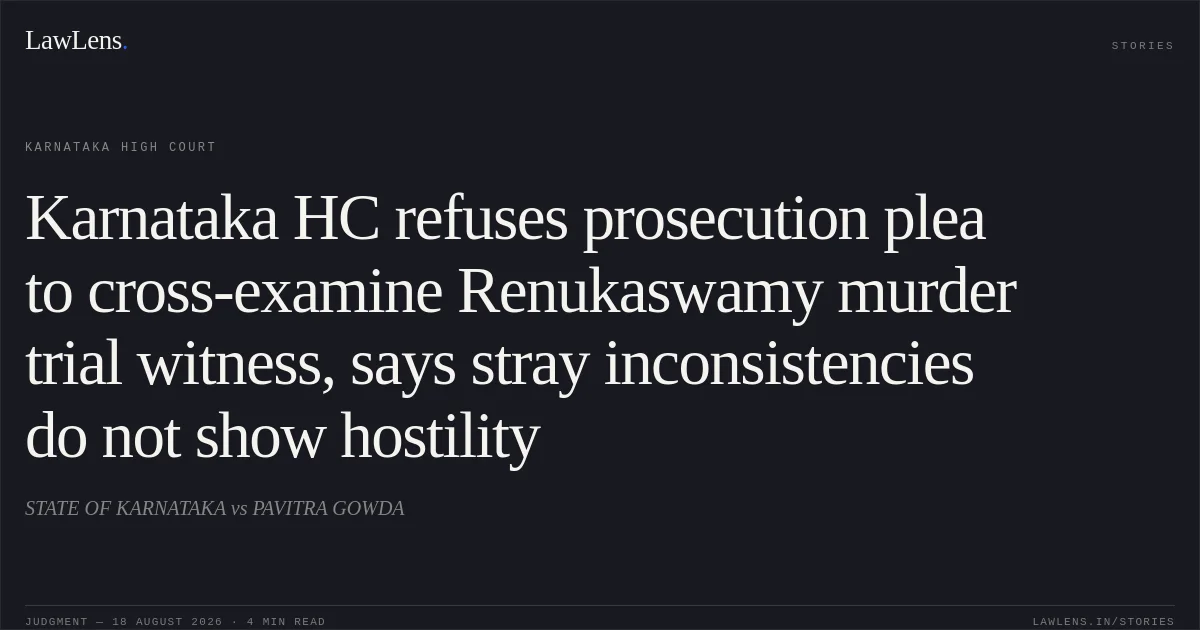
The Court answered the issues against the State. It held that PW-1’s stray or inconvenient answers did not amount to hostility or furnish sufficient grounds for permitting the prosecution to cross-examine its own witness under Section 154 of the Evidence Act.
The order dated 17 January 2026 passed in S.C. No. 1319 of 2024 was upheld, and Criminal Petition No. 6820 of 2026 was rejected as devoid of merit.
Source reference: para. 23; p. 46Acts & Sections Cited
9 provisions across 3 statutes referred to in this judgment. Each provision opens on LawLens.
Code of Criminal Procedure, 19735
Indian Penal Code, 18603
Bharatiya Sakshya Adhiniyam, 20231
Original Court PDF
STATE OF KARNATAKAvsPAVITRA GOWDA
Click to open original judgment
Original judgment, available to read, download and summarize on LawLens.in