01Facts
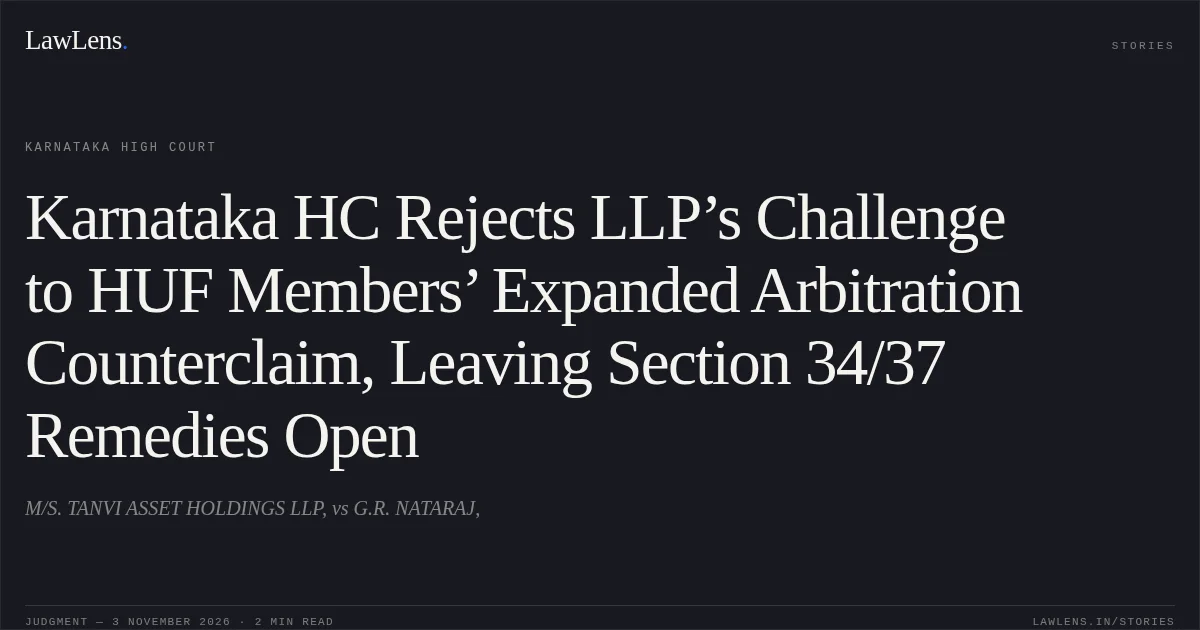
In an arbitration pending as A.C. No. 515/2023, respondents 1, 2, 4 and 6 applied to amend their counterclaim under Order VI Rule 17 CPC read with Section 23(3) of the Arbitration and Conciliation Act, 1996.
p. 3The petitioner challenged the arbitrator’s order dated 29 September 2026 allowing the amendment, contending that more than 60 arbitral sessions had taken place and evidence had been led.
pp. 4–6The arbitrator found, among other things, that the proposed amendments did not alter the nature or scope of the dispute, that the third-party claims were not previously known to the applicants, and that the amendments were bona fide.
pp. 4–6The High Court considered the challenge under Articles 226 and 227 of the Constitution.
p. 4, 1002Issues
i.1. Whether the arbitrator’s order allowing amendment of the counterclaim disclosed perversity warranting interference under Articles 226 or 227 of the Constitution.
pp. 4–6ii.2. Whether the petitioner should be left to pursue the remedies available under Sections 34 or 37 of the Arbitration and Conciliation Act, 1996, rather than obtain writ or supervisory relief against the order.
pp. 6–1003Law Applied
Section 23(3) of the Arbitration and Conciliation Act, 1996 permits amendment or supplementation of a party’s claim or defence during arbitral proceedings, subject to the tribunal’s consideration of the circumstances; the application here was also made under Order VI Rule 17 CPC.
p. 3The Court relied on Revajeetu Builders & Developers v. Narayanaswamy, (2009) 10 SCC 84, in connection with the tribunal’s assessment of the proposed amendment.
p. 5Under Nivedita Sharma v. COAI, (2011) 14 SCC 337, a writ petition ordinarily should not be entertained where a statutory forum provides a remedy.
p. 6Deep Industries v. ONGC, (2020) 15 SCC 706, establishes that constitutional supervision remains available but must be exercised with extreme circumspection in arbitration matters, with intervention confined to exceptional cases such as orders patently lacking inherent jurisdiction.
pp. 7–8Bhaven Construction v. Executive Engineer, Sardar Sarovar Narmada Nigam Ltd., (2022) 1 SCC 75, similarly limits judicial interference beyond the statutory scheme to exceptional cases, including where a party is left remediless or bad faith is shown.
pp. 8–9Sections 34 and 37 provide the statutory remedies identified by the Court.
pp. 6, 9–10Provisions in the judgment · 5 · Linked ones open on LawLens
Arbitration and Conciliation Act, 1996 Section 5Section 23Section 34Section 37
Limitation Act, 1963 Section 17
04Reasoning
The Court reviewed the arbitrator’s reasons, including the finding that the dispute’s nature and scope remained unchanged, that the relevant third-party claims were not known when the counterclaim was filed, and that the proposed amendments were bona fide and legitimate.
pp. 5–6It found no perversity in the decision to allow the amendment.
p. 6Applying the statutory-remedy principle and the caution against disrupting the arbitral process, the Court concluded that the challenge did not meet the exceptional threshold for intervention under Article 227; the petitioner could pursue an appropriate remedy under Sections 34 or 37 at the proper stage.
pp. 6–1005Holding
The High Court dismissed the writ petition, finding no basis for interference under Article 227 and leaving the petitioner to pursue any appropriate remedy under Sections 34 or 37 of the Arbitration and Conciliation Act, 1996.
p. 10The Court also declined the petitioner’s request for leave to challenge the order before the Supreme Court.
p. 10Original Court PDF
M/S. TANVI ASSET HOLDINGS LLP,vsG.R. NATARAJ,
Click to open original judgment
Original judgment, available to read, download and summarize on LawLens.in