01Facts
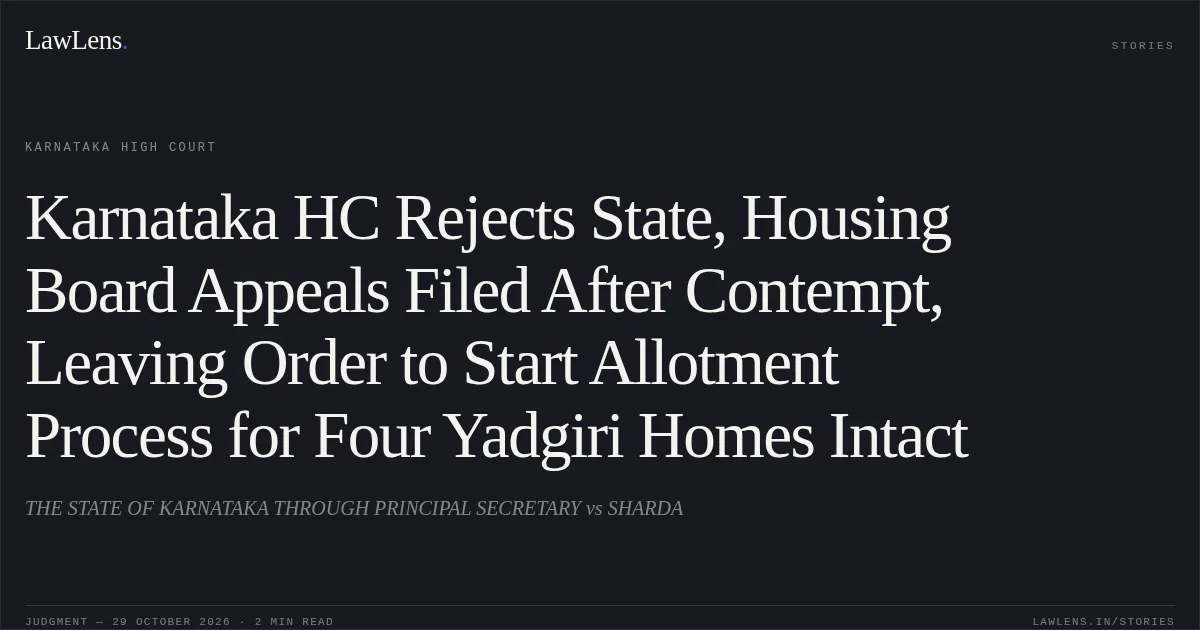
The respondents had challenged a Karnataka Housing Board endorsement dated 6 February 2019 concerning four LIG houses, Nos. 16 to 19, at the Housing Colony, Yadgiri.
pp. 7–9The learned Single Judge disposed of their writ petition by directing the Board to consider allotment of the houses under the applicable regulations, treating the respondents’ applications and initial deposits as applications under those regulations, and to commence the allotment procedure within two months.
pp. 7–9The Housing Board and the State filed appeals against that order; the respondents also filed an appeal seeking further relief against the endorsement.
p. 9The respondents had filed a contempt petition on 24 August 2024, before the appeals were filed.
p. 9All appeals were accompanied by applications to condone delay.
p. 9, 1302Issues
i.1. Whether the applicants had shown sufficient grounds to condone the delay in filing the connected writ appeals under Section 5 of the Limitation Act, 1963.
pp. 9–13ii.2. Whether, following rejection of the delay-condonation applications, the connected appeals should be dismissed without consideration of their merits.
p. 1303Law Applied
Section 5 of the Limitation Act, 1963 permits condonation of delay where sufficient cause is shown.
pp. 9–13Relying on Israr Ahmad Khan v. Amarnath Prasad (2026 SCC OnLine SC 322), the Court noted the Supreme Court’s disapproval of belated appeals filed after contempt proceedings have commenced, particularly where the filing is used to delay compliance with court orders.
pp. 10–11It also relied on Chennai Metropolitan Water Supply and Sewerage Board v. T.T. Murali Babu ((2014) 4 SCC 108), which holds that courts must scrutinise the explanation for delay and that unexplained or inordinate delay may warrant refusal of relief.
pp. 11–1304Reasoning
The Court observed that the appeals were filed only after the respondents had initiated contempt proceedings and that the appellants had not established sufficient grounds for the delay.
p. 9, 13Applying the principles in the cited Supreme Court decisions, it declined to condone the delay.
pp. 9–13The Court therefore did not examine the parties’ substantive challenges to the Single Judge’s directions or the underlying endorsement.
05Holding
The Court rejected the applications for condonation of delay under Section 5 of the Limitation Act, 1963, and consequently dismissed all three writ appeals.
p. 14Any other pending applications were disposed of.
p. 14Original Court PDF
THE STATE OF KARNATAKA THROUGH PRINCIPAL SECRETARYvsSHARDA
Click to open original judgment
Original judgment, available to read, download and summarize on LawLens.in