01Facts
The respondents had challenged a Deputy Commissioner’s 1998 notification declaring certain lands, including the lands they claimed, to be excess land under Section 79-B(3) of the Karnataka Land Reforms Act, 1961.
pp. 3–8The Single Judge allowed the writ petition and quashed the notification and a related 2005 allotment order insofar as they concerned the specified lands.
pp. 3–8The State appealed after a delay stated by the Division Bench to be five years, or 1,200 days.
pp. 3–8In its condonation application, the State attributed the delay to internal processing, legal opinions, departmental communications and the time taken to obtain government approval to appeal
pp. 3–802Issues
i.1. Whether the State had shown sufficient cause to condone the delay in filing the writ appeal
pp. 6–8ii.2. Whether the appeal should proceed to consideration of the Single Judge’s order despite the delay
p. 8, 1603Law Applied
Under Section 5 of the Limitation Act, 1963, delay may be condoned where sufficient cause is shown; condonation is discretionary and cannot be claimed as of right.
pp. 8–16Although Collector, Land Acquisition, Anantnag v. Mst. Katiji and G. Ramegowda v. Land Acquisition Officer recognise that some latitude may be appropriate for governmental decision-making, the State remains responsible for its officers’ acts and omissions, and that latitude has reasonable limits.
pp. 8–16The Court relied particularly on Israr Ahmad Khan v. Amarnath Prasad, 2026 SCC OnLine SC 322, and State of Odisha v. Managing Committee of Namatara Girls High School, 2026 SCC OnLine SC 191, for the principles that a generic or inadequate account of administrative delay does not establish sufficient cause and that courts should address such delay firmly
pp. 8–16Provisions in the judgment · 4 · Linked ones open on LawLens
KARNATAKA HIGH COURT ACT, 1961 Section 4
KARNATAKA LAND REFORMS ACT, 1961 Section 63Section 77
Limitation Act, 1963 Section 5
04Reasoning
The State’s explanation described routine administrative steps but did not satisfactorily account for the prolonged delay.
pp. 7–8The Court considered the explanation a “lame excuse,” rather than a sufficient explanation, and emphasised that the State’s institutional processes do not exempt it from the law of limitation.
pp. 7–8As sufficient cause was not established, the Court declined to entertain the appeal; it did not determine the underlying land-reform merits
pp. 7–8, 1605Holding
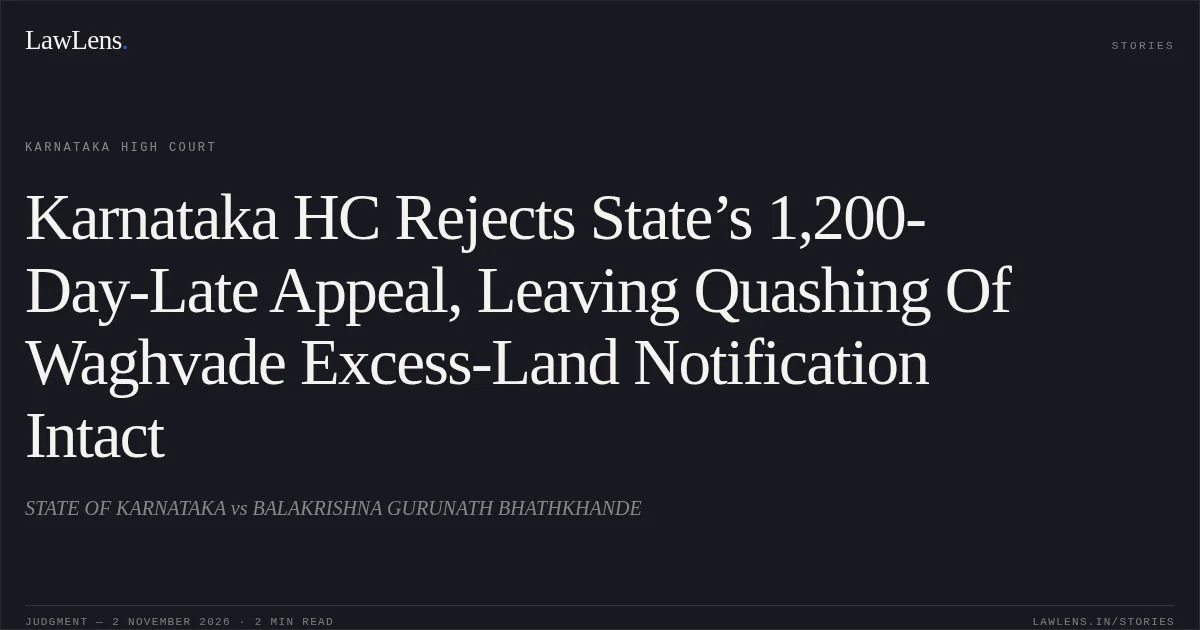
The Court rejected the writ appeal because the State had failed to justify the delay of five years (stated as 1,200 days).
p. 16The Single Judge’s order therefore remained undisturbed; the Division Bench did not grant relief on the merits of the appeal
p. 16Original Court PDF
STATE OF KARNATAKAvsBALAKRISHNA GURUNATH BHATHKHANDE
Click to open original judgment
Original judgment, available to read, download and summarize on LawLens.in