01Facts
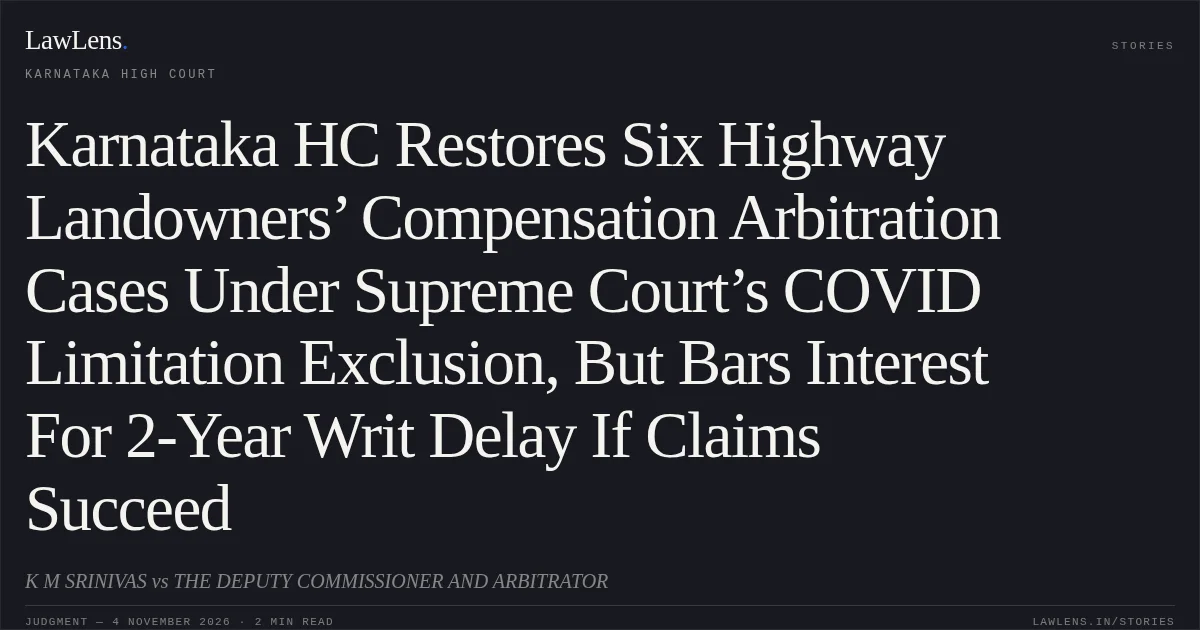
The petitioners owned lands acquired for the Bengaluru–Chennai Expressway.
pp. 10–15 · ¶ 7–12After the competent authority determined compensation, they sought arbitration under Section 3G(5) of the National Highways Act, 1956.
pp. 10–15 · ¶ 7–12The Deputy Commissioner and Arbitrator dismissed their applications as time-barred.
pp. 10–15 · ¶ 7–12The petitioners challenged those orders, contending that the Supreme Court’s COVID-19 limitation directions excluded the period from 15 March 2020 to 28 February 2022.
pp. 10–15 · ¶ 7–12The State and NHAI respondents accepted that the exclusion applied but opposed relief on the ground that the writ petitions were filed more than two years after the impugned orders; they also sought to deny interest for the period of writ delay.
pp. 10–15 · ¶ 7–1202Issues
i.1. Whether the petitioners’ applications under Section 3G(5) were within limitation after excluding the period directed by the Supreme Court during the COVID-19 pandemic
pp. 12–14 · ¶ 8, 11ii.2. Whether the petitioners’ delay in filing the writ petitions precluded relief or justified withholding interest for the period of that delay
pp. 13–15 · ¶ 9, 1203Law Applied
Section 3G(5) of the National Highways Act, 1956 provides for determination of compensation disputes by arbitration.
pp. 12–14 · ¶ 8, 11The Court applied Article 137 of the Limitation Act, 1963, under which the petitioners’ applications were assessed against a three-year limitation period.
pp. 12–14 · ¶ 8, 11It also applied the Supreme Court’s directions in Suo Motu W.P. (C) No. 3/2020, which excluded the period from 15 March 2020 to 28 February 2022 for calculating limitation.
pp. 12–14 · ¶ 8, 11Separately, the Court held that delay in approaching the High Court did not entitle the petitioners to interest for the period between the impugned orders and the filing of the writ petitions.
pp. 14–15 · ¶ 12Provisions in the judgment · 1 · Linked ones open on LawLens
Limitation Act, 1963 Section 137
04Reasoning
The Arbitrator had rejected the applications as time-barred without accounting for the Supreme Court’s COVID-19 exclusion.
p. 14 · ¶ 11Applying that exclusion to the relevant limitation period, the High Court concluded that the applications before the Arbitrator were within time and that the impugned orders could not stand.
p. 14 · ¶ 11However, because the petitioners waited more than two years after the impugned orders to approach the High Court, the Court limited the monetary consequence of the remand: if compensation proceedings were decided in the petitioners’ favour, they would receive no interest for the period from the relevant impugned order until 19 August 2026, the date the writ petitions were filed.
pp. 14–15 · ¶ 1205Holding
The High Court allowed the writ petitions and quashed the Arbitrator’s orders.
pp. 15–18 · ¶ 13It restored the Section 3G(5) proceedings and directed the Arbitrator to decide them in accordance with law, without reconsidering limitation.
pp. 15–18 · ¶ 13The Arbitrator was directed to conclude the proceedings within three months of receiving the order and, if the petitioners succeeded, to exclude interest for the period between the relevant impugned order and the filing of the writ petitions.
pp. 15–18 · ¶ 13Original Court PDF
K M SRINIVASvsTHE DEPUTY COMMISSIONER AND ARBITRATOR
Click to open original judgment
Original judgment, available to read, download and summarize on LawLens.in