01Facts
The five petitioners, members of the T.M. Kothara Maiah family, challenge two orders of the Karnataka Appellate Tribunal: (a) the order dated 29.06.2026 in Review Petition No. 18/2019, and (b) the order dated 14.06.2017 in Appeal No. 974/2012.
p. 5, para 3Respondents 1–6 are other members of the family. Respondents 7–9 are the Deputy Director of Land Records, the Tahasildar, and the Supervisor of Land Records, Chikkaballapura.
p. 4By the 29.06.2026 order, the Tribunal held that the petitioners' review petition was not maintainable under Section 8 of the Karnataka Appellate Tribunal Act, 1976 ("KAT Act").
p. 5, para 4The writ petition was filed under Articles 226 and 227 of the Constitution to quash that order and to allow the review petition.
p. 4The judgment does not describe the underlying land dispute.
02Issues
i.1. Whether the Karnataka Appellate Tribunal was correct in holding that the review petition filed by the petitioners was not maintainable under Section 8 of the KAT Act, 1976.
p. 5, para 4ii.2. Whether Section 8 of the KAT Act permits review at the instance of a third party affected by a Tribunal order, and not only the parties to the original order.
pp. 5–6, para 503Law Applied
Section 8 of the Karnataka Appellate Tribunal Act, 1976, which empowers the Tribunal to entertain a review either on its own motion or on the application of "any party affected" by its order.
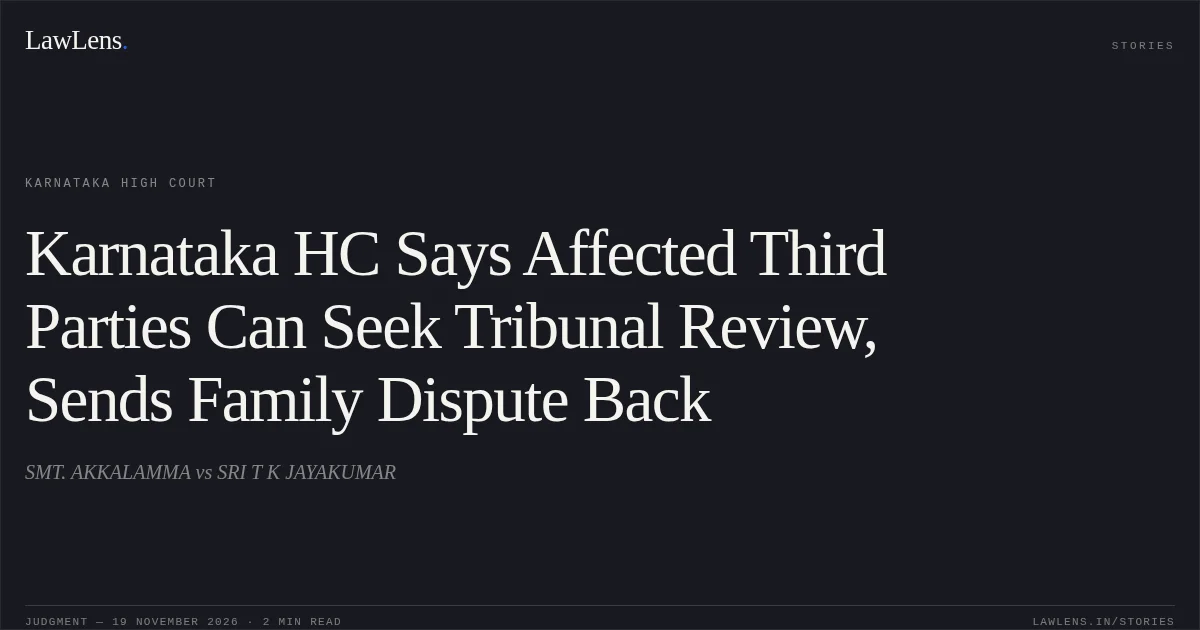
pp. 5–6, para 5The Court construed the phrase "any party affected" to extend beyond the parties to the original order, so that any affected third party may invoke Section 8.
p. 6, para 5The Court's power to interfere derives from Articles 226 and 227 of the Constitution, under which it set aside the Tribunal's order.
p. 6, para 6No precedents were cited in the order.
Provisions in the judgment · 1 · Linked ones open on LawLens
KARNATAKA APPELLATE TRIBUNAL ACT, 1976 Section 8
04Reasoning
The Tribunal treated Section 8 as available only to parties to the original order and rejected the petitioners' review on that basis.
p. 5, para 4The High Court held that this reading is incorrect. On its construction of the statutory language, the phrase "any party affected" is not confined to original parties, and any third party adversely affected by a Tribunal order may seek review.
pp. 5–6, para 5Because the Tribunal's maintainability ruling rested on a narrow reading of Section 8, the ruling could not stand. The Court therefore held the review petition maintainable and set aside the impugned order.
p. 6, para 6The Court expressly did not examine the merits of the land dispute, leaving that to the Tribunal.
pp. 6–705Holding
The Court answered both issues in the negative as to the Tribunal's reasoning: the review petition was maintainable, and Section 8 of the KAT Act extends to affected third parties.
pp. 5–6, paras 5–6The writ petition is allowed. The Tribunal's order dated 29.06.2026 in Review Petition No. 18/2019 is set aside, and the matter is remitted to the Karnataka Appellate Tribunal for fresh consideration on the merits in accordance with law.
p. 6The parties are directed to appear before the Tribunal on 10 December 2026 at 11:00 a.m.
p. 7The order does not decide the merits of the review or the challenge to the 14.06.2017 order in Appeal No. 974/2012.
pp. 6–7Original Court PDF
SMT. AKKALAMMAvsSRI T K JAYAKUMAR
Click to open original judgment
Original judgment, available to read, download and summarize on LawLens.in