Facts
The complainant alleged that the petitioner represented himself as a bachelor and promised to marry her, purchase property in her name, and secure government employment for her relative.
Source reference: para. 12–18She and her relatives allegedly transferred approximately ₹24,00,000 to him in reliance on those representations.
Source reference: para. 12–18The petitioner allegedly failed to fulfil the promises and concealed that he was already married.
Source reference: para. 12–18Following investigation, a charge sheet was filed for offences under Sections 406 and 420 of the Indian Penal Code, 1860, in C.C. No. 890/2023.
Source reference: para. 2, 19The petitioner sought to quash the proceedings, arguing that the dispute was civil, the offences’ ingredients were absent, and Sections 406 and 420 could not coexist.
Source reference: para. 5–7The complainant also produced emails and an alleged appointment order, prompting a request for further investigation into the employment allegation.
Source reference: para. 40–44Issues
1. Whether the complaint and charge-sheet materials disclosed a prima facie case under Sections 406 and 420 IPC, or whether the proceedings should be quashed as involving only civil transactions.
Source reference: para. 20–26, 35, 392. Whether Sections 406 and 420 IPC could be invoked together in the circumstances alleged.
Source reference: para. 27–353. Whether further investigation into the alleged procurement of government employment should be directed on the basis of documents produced before the Court.
Source reference: para. 40–47Law Applied
Section 415 IPC defines cheating to include deception that dishonestly induces delivery of property, and its Explanation treats dishonest concealment of facts as deception; Section 420 IPC applies where cheating dishonestly induces delivery of property.
Source reference: para. 23For Section 406 IPC, the property must be entrusted to the accused or placed under the accused’s dominion and dishonestly misappropriated.
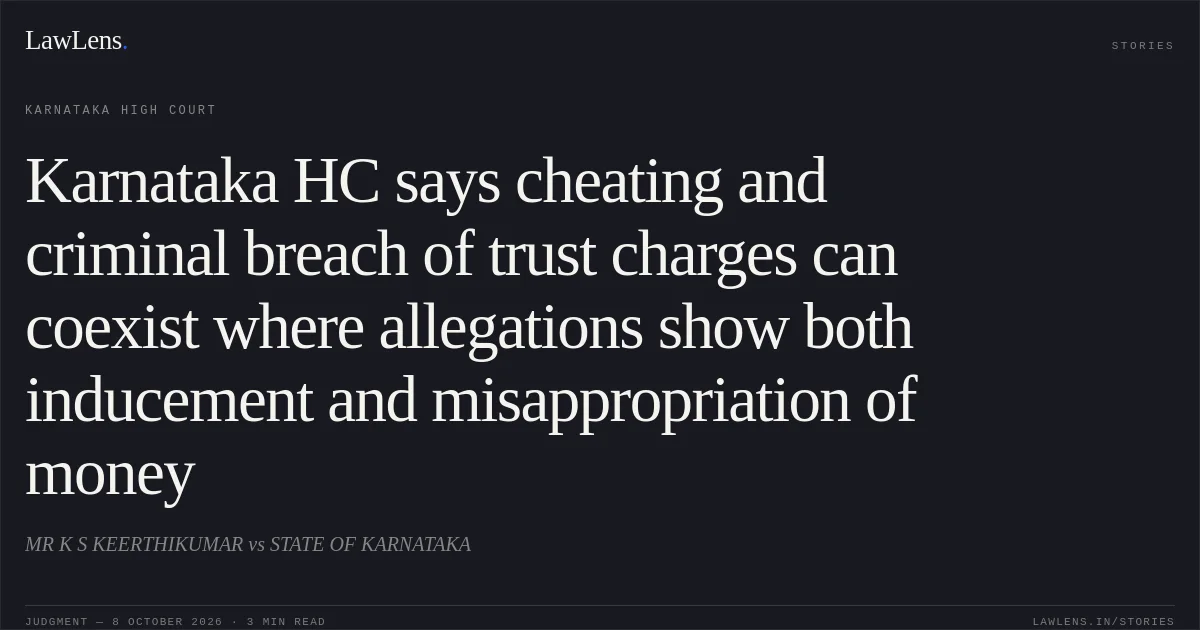
Source reference: para. 27Cheating requires dishonest or fraudulent intention at the time of inducement, whereas criminal breach of trust involves dishonest misappropriation after lawful entrustment; whether both offences apply depends on the facts, and they are not categorically incapable of coexisting.
Source reference: para. 27–35In Delhi Race Club (1940) Ltd. v. State of Uttar Pradesh, 2024 SCC OnLine SC 2248, the Supreme Court distinguished the ingredients of cheating and criminal breach of trust; the High Court held that the decision did not establish an inflexible bar against prosecuting both offences where the facts support each.
Source reference: para. 27–31Raju Krishna Shedbalkar v. State of Karnataka, SLP (Crl.) No. 13615 of 2023, concerned a mere promise to marry followed by refusal; the Court distinguished it on the allegation here that the petitioner concealed an existing marriage when making the promise.
Source reference: para. 36–38The High Court also held that it could direct further investigation where the record disclosed potentially material matters not investigated.
Source reference: para. 44–45Reasoning
The Court found that the allegations went beyond a mere failure to perform civil promises.
Source reference: para. 18–26, 35The petitioner allegedly represented that he was a bachelor despite being married and used that representation, together with promises concerning property and employment, to induce the complainant and her relatives to transfer money.
Source reference: para. 18–26, 35The alleged diversion of money entrusted for purchasing property could, if proved, support criminal breach of trust; the alleged deception and resulting payments could independently support cheating.
Source reference: para. 21, 25–26, 35The Court therefore rejected the argument that Sections 406 and 420 could not be tried together, distinguishing Delhi Race Club on its facts and treating Raju Krishna Shedbalkar as inapplicable to the alleged concealment of a subsisting marriage.
Source reference: para. 28–38It further considered the alleged appointment order and related email documents sufficiently material to warrant investigation into the employment allegation.
Source reference: para. 40–47Holding
The Court dismissed the criminal petition and declined to quash the proceedings under Sections 406 and 420 IPC.
It directed the State to investigate the allegation relating to procuring government employment and to file an appropriate additional report before the trial court within three months.
Source reference: Order, clauses (ii)–(iii)Acts & Sections Cited
5 provisions across 3 statutes referred to in this judgment. Each provision opens on LawLens.
Code of Criminal Procedure, 19731
Bharatiya Nagarik Suraksha Sanhita, 20231
Indian Penal Code, 18603
Original Court PDF
MR K S KEERTHIKUMARvsSTATE OF KARNATAKA
Click to open original judgment
Original judgment, available to read, download and summarize on LawLens.in