01Facts
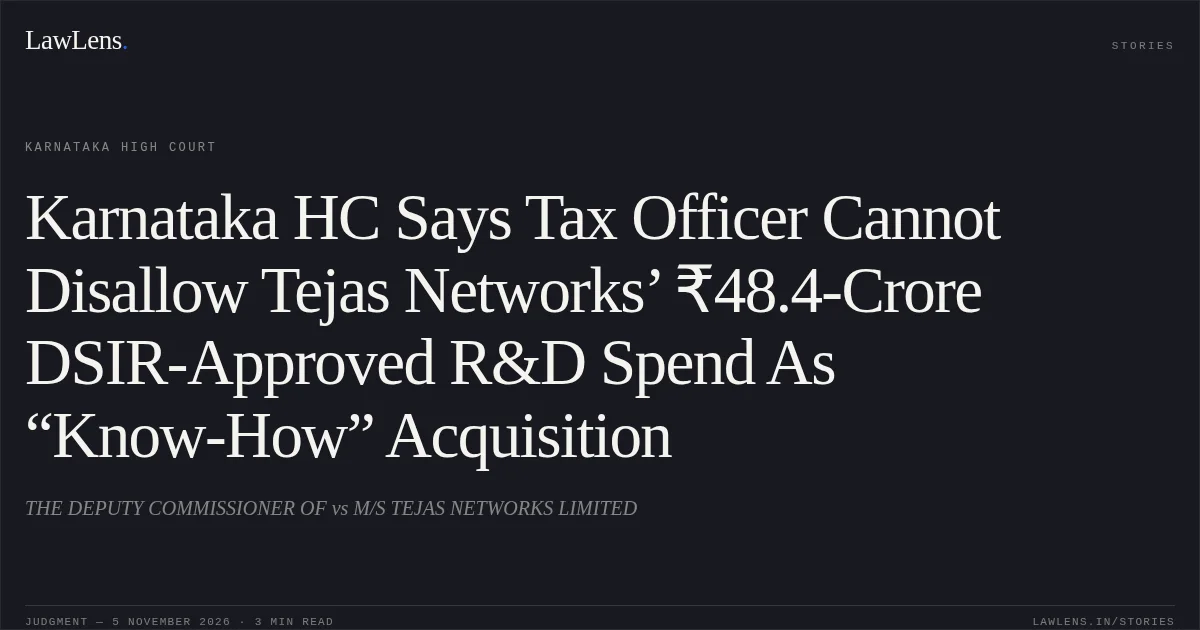
Tejas Networks claimed a weighted deduction under Section 35(2AB) of the Income Tax Act, 1961, for expenditure on in-house research and development (R&D) at two DSIR-approved facilities.
¶ 1–9, 13–15DSIR, the prescribed authority, had examined the expenditure and reported the approved amount in Form 3CL.
¶ 1–9, 13–15The Assessing Officer disallowed part of the claim, reasoning that product-development expenditure resulting in know-how or technology was capital expenditure or expenditure excluded by Section 43(4)(ii).
¶ 1–9, 13–15The Dispute Resolution Panel upheld the disallowance. The assessee challenged the assessment order in a writ petition, which the Single Judge allowed; the Revenue appealed.
¶ 1–9, 13–1502Issues
i.1. Whether expenditure approved by the prescribed authority under Section 35(2AB) must be excluded from the deduction because it results in intellectual property over which the assessee may exercise proprietary rights.
¶ 15ii.2. Whether the Assessing Officer may determine that expenditure approved by the prescribed authority was not expenditure on scientific research, including by applying Section 43(4)(ii).
¶ 1503Law Applied
Section 35(2AB) allows a weighted deduction for expenditure on scientific research incurred in an approved in-house R&D facility, except expenditure in the nature of the cost of land or building; the provision does not exclude other capital expenditure merely because it is capital in nature.
¶ 17, 33–35Under Section 35(3), where a question arises as to whether, or to what extent, an activity constitutes scientific research, the Board must refer it to the prescribed authority, whose decision is final.
¶ 21–22, 32Rule 6(5A) and Rule 6(7A) of the Income Tax Rules, 1962, govern the prescribed authority’s approval and reporting of eligible R&D expenditure.
¶ 18, 21, 25–30Section 43(4)(ii) excludes expenditure incurred to acquire rights in, or arising out of, scientific research; it does not exclude expenditure on research undertaken by the assessee merely because that research produces know-how or technology.
¶ 40–44The court relied on DCIT v. Mastek Limited, JK Synthetics Limited v. O.S. Bajpai, and CIT v. F.C.S. International Marketing (P) Limited on the prescribed authority’s role, and on the ITAT decisions in Tata Hitachi Construction Machinery Company Limited v. DCIT and Resil Chemicals (P) Ltd. v. DCIT regarding Section 43(4)(ii).
¶ 36–44Provisions in the judgment · 1 · Linked ones open on LawLens
KARNATAKA HIGH COURT ACT, 1961 Section 4
04Reasoning
DSIR had approved and reported the R&D expenditure, and the Assessing Officer’s objection was that the resulting know-how and technology made the expenditure ineligible.
¶ 20–24, 31–35The court held that the Assessing Officer could not revisit the prescribed authority’s determination that the activities constituted scientific research or re-assess the approved expenditure on that basis; any relevant question had to be referred through the Board under Section 35(3).
¶ 20–24, 31–35The Assessing Officer could still verify supporting material, audited accounts, and whether the claim matched the expenditure approved, but could not undertake a merits review of whether the approved activities were scientific research.
¶ 45Further, internally generated know-how is a purpose and potential outcome of scientific research, not, by itself, an acquisition of existing rights excluded by Section 43(4)(ii).
¶ 39–4405Holding
The court answered both issues in the assessee’s favour: the Assessing Officer could not disallow the approved R&D expenditure merely because it generated know-how or technology, and Section 43(4)(ii) concerns acquisition of rights arising from research, not the results of the assessee’s own research.
¶ 39–45The Revenue’s appeal was dismissed, leaving the Single Judge’s order undisturbed.
¶ 46–48Original Court PDF
THE DEPUTY COMMISSIONER OFvsM/S TEJAS NETWORKS LIMITED
Click to open original judgment
Original judgment, available to read, download and summarize on LawLens.in