01Facts
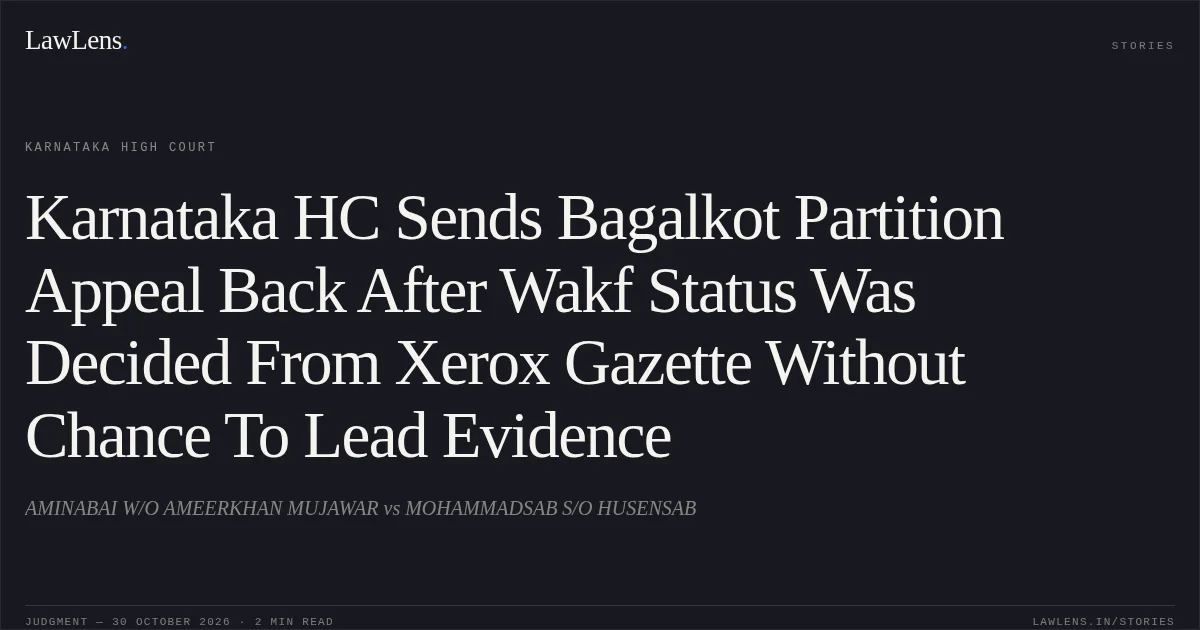
The plaintiffs sued for partition and separate possession of a claimed one-third share in three Bagalkot properties, or in compensation awarded for them.
The trial court partly decreed the suit, holding the plaintiffs and Defendant Nos. 1–23 entitled to shares in the schedule properties.
¶ 3 · p. 8 · ¶ 8 · p. 10In the first appeal, the appellants produced a photocopy of a 1973 Gazette notification and argued that the properties were wakf. The first appellate court framed an additional issue on maintainability, held the suit barred by Section 85 of the Wakf Act, 1995, and dismissed it without receiving further evidence. The plaintiffs and Defendant Nos. 1–23 challenged that decision in this second appeal.
¶ 9 · pp. 10–11 · ¶ 9 · p. 1102Issues
i.Whether the first appellate court was justified in framing an additional issue on the basis of a photocopy of a Gazette notification and deciding it without giving the parties an opportunity to adduce evidence?
¶ 12 · p. 1303Law Applied
Order XIV Rule 3 of the Code of Civil Procedure (CPC) identifies the pleadings, answers to interrogatories, and documents produced by the parties as materials from which issues may be framed.
¶ 15 · p. 14Order XLI Rule 27 CPC governs the receipt of additional evidence in appeal; the first appellate court should comply with its requirements before admitting additional material. Where an issue is a mixed question of law and fact, the parties must have an opportunity to adduce relevant evidence. A first appellate court, as the final court of fact, must consider the case as a whole and record findings after reappreciating the evidence.
¶ 15 · p. 15 · ¶ 16 · pp. 15–16Provisions in the judgment · 3 · Linked ones open on LawLens
Code of Civil Procedure, 1908 Section 100
Unified Waqf Management, Empowerment, Efficiency and Development Act, 1995 Section 85Section 52
04Reasoning
The wakf objection had not been raised before the trial court; it was advanced for the first time in appeal on the basis of a photocopy of the notification.
¶ 13–14 · pp. 13–14The first appellate court did not comply with Order XLI Rule 27 CPC and relied on a notification that, as it itself noted, lacked the property’s serial or registered survey number. It nevertheless treated an entry referring to Shanshawali Darga as determinative of the suit properties’ status. Because the wakf status and resulting maintainability objection involved factual questions requiring an opportunity to adduce evidence, the appellate court could not properly decide the issue on that material alone. It also failed to consider the other grounds of appeal or reappraise the evidence.
¶ 15 · p. 15 · ¶ 15–16 · pp. 15–1605Holding
The Court answered the substantial question of law in the negative: the first appellate court was not justified in deciding the additional issue without affording the parties an opportunity to adduce evidence.
¶ 16 · p. 16The second appeal was allowed, the first appellate court’s judgment and decree were set aside, and the matter was remitted to that court for fresh disposal in accordance with law.
¶ 17 · p. 16Original Court PDF
AMINABAI W/O AMEERKHAN MUJAWARvsMOHAMMADSAB S/O HUSENSAB
Click to open original judgment
Original judgment, available to read, download and summarize on LawLens.in