01Facts
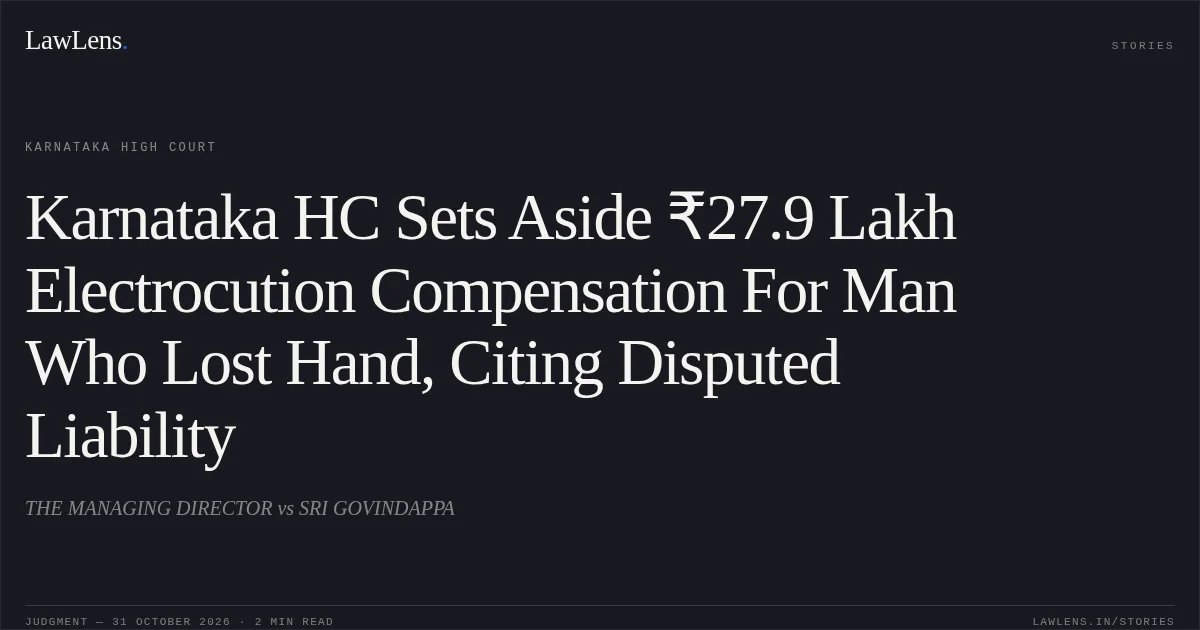
On 9 June 2015, Govindappa suffered electrical injuries near a transformer on private property, resulting in amputation of his left hand.
¶ 2, 11After earlier directions to consider his claim, BESCOM sanctioned ₹1,20,000 under an administrative compensation scheme.
¶ 3–5Govindappa sought higher compensation under Article 226, relying on the Motor Vehicles Act compensation methodology.
¶ 6–10The Single Judge awarded ₹27,88,925 with interest, subject to deduction of the amount already paid.
¶ 6–10BESCOM appealed, disputing liability and quantum and arguing that the contested circumstances required a civil trial.
¶ 11–1402Issues
i.Whether the writ court could determine BESCOM’s liability and compensation where material facts concerning the electrical accident and its cause were disputed.
¶ 28, 32, 40–41ii.Whether compensation for an electrical accident could be assessed by applying the multiplier method and compensation principles under the Motor Vehicles Act.
¶ 27–29iii.Whether BESCOM’s payment under the administrative scheme or the acquittal of its officials in criminal proceedings determined its civil liability.
¶ 34–3903Law Applied
Under Rylands v. Fletcher, strict liability may arise where a dangerous thing escapes, subject to recognised exceptions; M.C. Mehta v. Union of India established absolute liability for enterprises engaged in hazardous or inherently dangerous activities, without those exceptions.
¶ 18–21In M.P. Electricity Board v. Shail Kumari, the Supreme Court applied strict liability to an electricity undertaking, while recognising that the circumstances of an accident remain relevant.
¶ 23–25In Karnataka Power Transmission Corporation Ltd. v. Rekha (2026 INSC 847), the Supreme Court clarified that electricity undertakings are subject to strict, not absolute, liability; recognised exceptions may apply, disputed material facts may require evidence, and the Motor Vehicles Act multiplier method cannot be mechanically applied to electrocution claims.
¶ 26–29Chairman, Grid Corporation of Orissa Ltd. v. Sukamani Das and S.D.O. Grid Corporation of Orissa Ltd. v. Timudu Oram establish that electrocution claims involving material factual disputes ordinarily require adjudication before a competent civil court.
¶ 30–32A payment under an administrative compensation scheme does not, without more, constitute an admission of tortious liability.
¶ 35–38Criminal acquittal does not by itself determine civil liability, which is assessed under a different standard of proof.
¶ 39Provisions in the judgment · 1 · Linked ones open on LawLens
KARNATAKA HIGH COURT ACT, 1961 Section 4
04Reasoning
Although the accident and Govindappa’s serious injuries were not disputed, the circumstances bearing on BESCOM’s liability—including how the accident occurred and the responsibility of the parties—remained contested.
¶ 32Under Rekha, those questions could require evidence and could not properly be resolved through the writ proceedings.
¶ 29, 33, 41The Single Judge’s reliance on the earlier Division Bench decision and its use of the Motor Vehicles Act methodology could not stand after the Supreme Court’s decision in Rekha.
¶ 29, 33, 41Nor did the ₹1,20,000 administrative payment conclusively establish liability for the additional damages claimed; the officials’ criminal acquittal likewise did not settle civil liability.
¶ 34–3905Holding
The High Court allowed BESCOM’s appeal, set aside the Single Judge’s order and dismissed the writ petition.
¶ 42Govindappa was left at liberty to pursue compensation before the competent civil court or other competent forum, with all contentions open; that forum must determine the claim independently and in accordance with law.
¶ 42–43No order as to costs.
¶ 44Original Court PDF
THE MANAGING DIRECTORvsSRI GOVINDAPPA
Click to open original judgment
Original judgment, available to read, download and summarize on LawLens.in