01Facts
The claimant sustained injuries in a road accident on 8 December 2023 involving his motorcycle and a car.
p. 3The Tribunal awarded compensation of ₹6,94,100, deducted 30% for contributory negligence, and awarded ₹4,86,000 after rounding.
pp. 3–5The claimant appealed, challenging the finding of contributory negligence and seeking enhanced compensation.
pp. 3–5The High Court heard the appeal with the consent of counsel for the claimant and the insurer.
p. 302Issues
i.1. Whether the Tribunal was justified in attributing contributory negligence to the claimant
pp. 6–8ii.2. Whether the claimant was entitled to enhanced compensation
pp. 6, 8–1203Law Applied
The appeal was brought under Section 173(1) of the Motor Vehicles Act.
p. 2The Court assessed compensation by applying the multiplier method, using the claimant’s completed age to select the multiplier and the Karnataka State Legal Services Authority’s notional income for 2023.
p. 8It treated one-third of the assessed lower-limb disability as whole-body disability.
pp. 10–11The Court held that future prospects were not to be added where the disability was below 20%.
p. 11The charge sheet was filed against the car’s driver under Sections 279 and 338 of the IPC; the Court considered it alongside the accident sketch, vehicle damage report, and absence of contrary witness evidence when assessing negligence.
p. 7No precedent was cited.
Provisions in the judgment · 3 · Linked ones open on LawLens
Motor Vehicles Act, 1988 Section 173
Indian Penal Code, 1860 Section 279Section 338
04Reasoning
On negligence, the charge sheet implicated the car’s driver, the sketch placed the accident at the middle of a junction, and the vehicle inspection report recorded damage to the car’s front and scratches on the motorcycle.
p. 7The respondents did not call the car’s driver, the investigating officer, or an eyewitness to support contributory negligence.
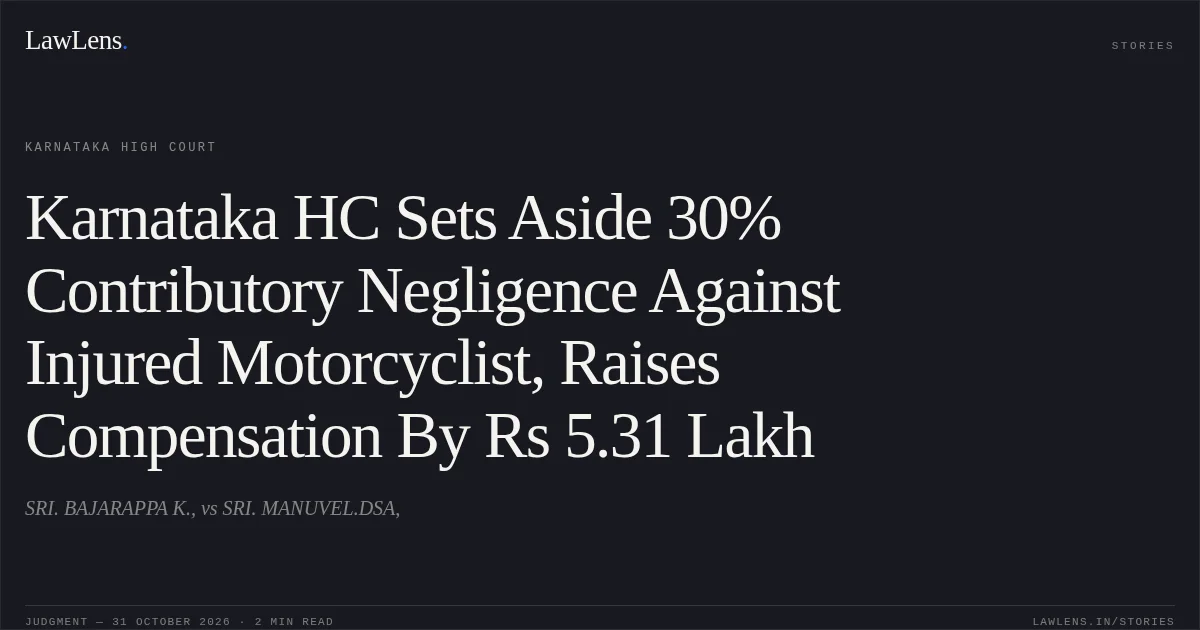
p. 7The Court therefore found the accident resulted solely from the car driver’s negligence and set aside the 30% deduction.
p. 7On compensation, it applied the multiplier of 11 for the claimant’s completed age of 55 and adopted monthly notional income of ₹16,250.
pp. 8–11It assessed whole-body disability at 14.66% from the doctor’s 44% lower-limb assessment, calculated future income loss at ₹3,14,457, and enhanced several other heads based on the injuries, hospitalisation, and expected implant-removal surgery.
pp. 8–11It declined to add future prospects because disability was below 20%.
pp. 8–11The resulting compensation table totals ₹10,17,207.
p. 1105Holding
The appeal was allowed in part.
pp. 12–13The Court set aside the finding of contributory negligence and held the claimant entitled to enhanced compensation, directing the insurer to deposit the enhanced amount with 6% annual interest within six weeks; 50% of the enhancement was to be released and 50% placed in a three-year fixed deposit.
pp. 12–13The judgment contains an apparent arithmetic inconsistency: the compensation table totals ₹10,17,207 and the stated enhancement of ₹5,31,207 corresponds to that total, but the operative order states total compensation of ₹10,70,207.
pp. 11–13Original Court PDF
SRI. BAJARAPPA K.,vsSRI. MANUVEL.DSA,
Click to open original judgment
Original judgment, available to read, download and summarize on LawLens.in