01Facts
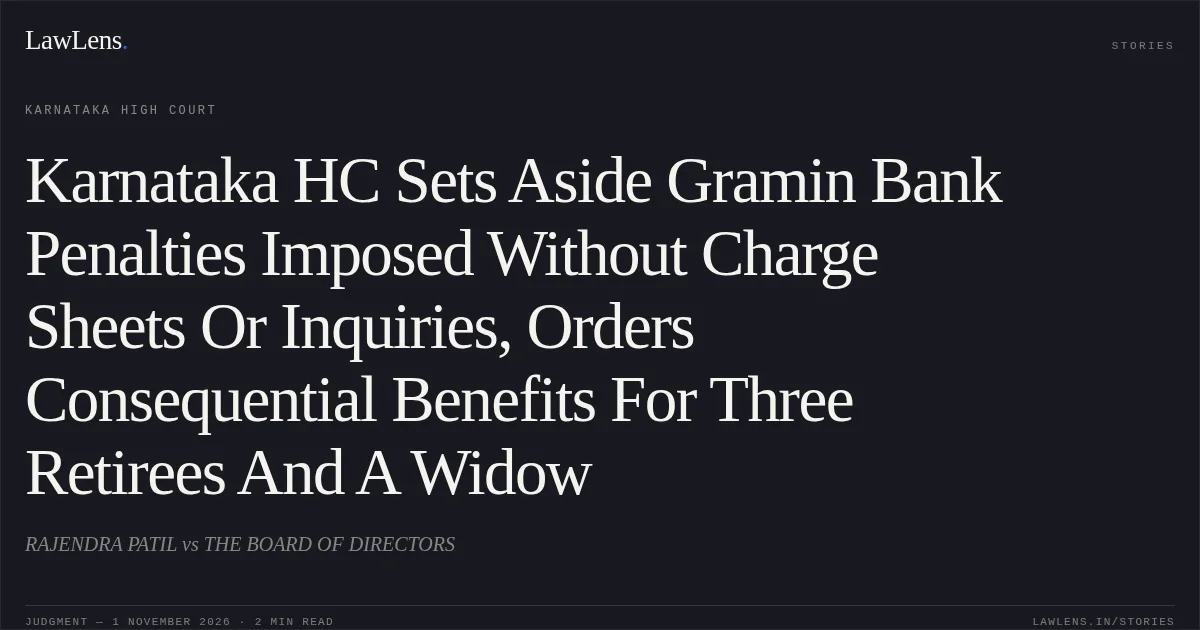
The petitioners, former employees of Karnataka Gramin Bank and the legal heirs of a deceased employee, challenged disciplinary orders imposing penalties including reduction to a lower stage in the pay scale and censure.
¶ 3They contended that the Bank had imposed the penalties without issuing articles of charge or conducting an enquiry.
¶ 3The Court considered the petitions together and noted a prior decision of the Karnataka High Court concerning a similar challenge to the Bank’s disciplinary procedure.
¶ 4–502Issues
i.Whether the Bank’s disciplinary orders were liable to be set aside because they were imposed without issuing articles of charge and conducting an enquiry.
¶ 3ii.Whether the petitioners were entitled to consequential benefits, including admissible interest, following the setting aside of the impugned orders.
pp. 6–8, 1003Law Applied
The Court proceeded under Articles 226 and 227 of the Constitution of India, invoked in the petitions.
pp. 2–6It relied on Subbarao v. The Board of Directors and Appellate Authority, Karnataka Gramin Bank and Others, W.P. No. 201832/2023, decided on 21 July 2026, which held that comparable Bank orders were unsustainable due to procedural lapses and violation of the principles of natural justice.
¶ 4The Court applied that precedent to the materially similar disciplinary orders before it.
¶ 504Reasoning
The Court identified the petitioners’ central challenge as the Bank’s imposition of disciplinary penalties without articles of charge or an enquiry.
¶ 3It found the disputes materially similar to the one decided in Subbarao, where comparable orders had been held procedurally defective and contrary to natural justice.
¶ 4–5On that basis, it followed the coordinate Bench’s reasoning and set aside the impugned orders.
¶ 5 · p. 1005Holding
The Court allowed all four writ petitions and set aside the impugned disciplinary orders dated 12 August 2022, 25 November 2022, 21 December 2022, 15 April 2023, 20 November 2021 and 11 July 2023.
p. 10It directed the Bank to grant, pay, disburse or release all consequential benefits, including admissible interest as permissible in law, within three months of receiving a copy of the order.
p. 10No order was made as to costs.
p. 10Original Court PDF
RAJENDRA PATILvsTHE BOARD OF DIRECTORS
Click to open original judgment
Original judgment, available to read, download and summarize on LawLens.in