01Facts
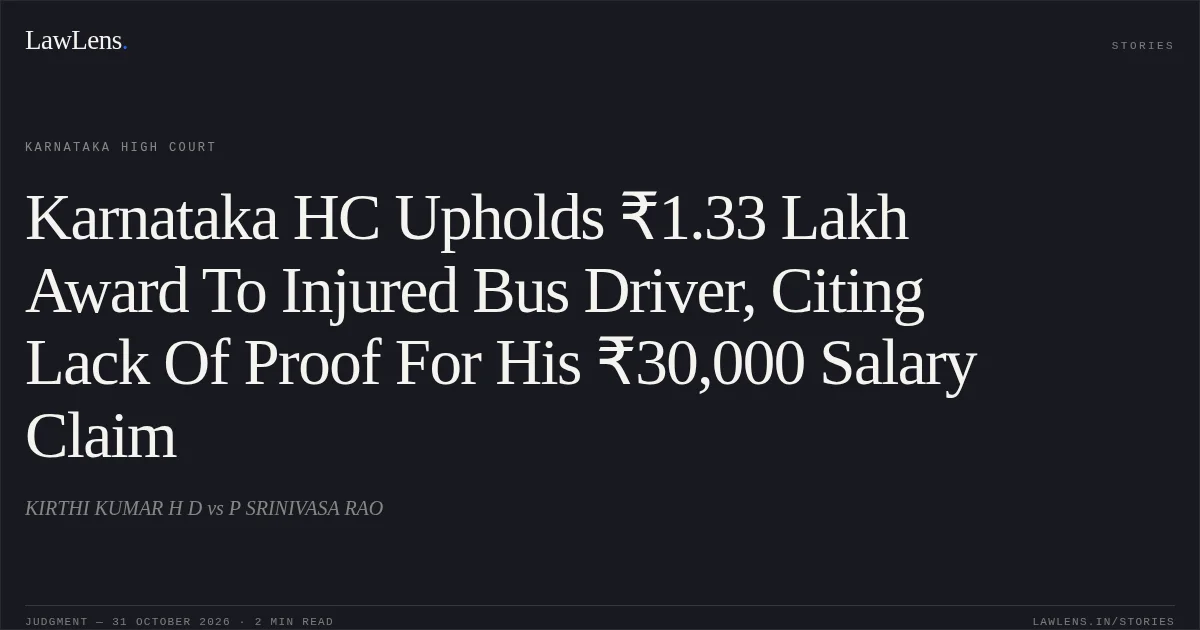
The claimant, employed by respondent No. 1 as a bus driver, sustained multiple fractures when the passenger bus he was driving was involved in a collision on 3 November 2019. He claimed compensation under the Employees’ Compensation Act, 1923, alleging a monthly salary of ₹30,000.
¶ 3–4The Commissioner assessed whole-body disability at 9%, took monthly income as ₹12,000, and awarded ₹1,33,115, including medical expenses.
¶ 6–7The claimant appealed under Section 30(1), seeking enhancement on the grounds that his income was undervalued and his disability was not properly assessed.
¶ 802Issues
i.Whether the claimant’s challenge to the assessment of his income and disability raised a substantial question of law permitting interference under Section 30(1) of the Act.
¶ 8–12, 19–21ii.Whether the Commissioner’s findings on income, disability and compensation were perverse or otherwise legally unsustainable.
¶ 18–2003Law Applied
Section 30(1) of the Employees’ Compensation Act, 1923 permits an appeal to the High Court only on a substantial question of law and in respect of the orders specified in that provision.
¶ 11The appeal is not equivalent to a first appeal on facts; factual findings may be interfered with where they are perverse, unsupported by evidence, or founded on an error of law.
¶ 12, 18Relying on North East Karnataka Road Transport Corporation v. Sujatha, the Court stated that matters such as employment, income and disability are ordinarily questions of fact, and that Section 30 appeals are confined to substantial questions of law.
¶ 16It also relied on Golla Rajanna v. Divisional Manager, United India Insurance Co. Ltd., which recognises the Commissioner as the final fact-finding authority under the Act, absent perversity or a finding based on no evidence.
¶ 17The Court further referred to Fulmati Dhramdev Yadav v. New India Assurance Co. Ltd. and Shakuntala Chandrakant Shreshti v. Prabhakar Maruti Garvali on appellate intervention where findings are perverse or essential legal and jurisdictional matters have not been addressed.
¶ 13, 15Provisions in the judgment · 1 · Linked ones open on LawLens
Code of Civil Procedure, 1908 Section 96
04Reasoning
The Court found that the Commissioner had considered the doctor’s evidence and given reasons for assessing whole-body disability at 9%, notwithstanding the differing percentage attributed to the doctor in the record.
¶ 19The claimant had not produced bank statements, pay slips, or other documentary proof of his asserted ₹30,000 monthly salary, nor examined his employer; the Commissioner therefore assessed income at ₹12,000 after considering the relevant notification.
¶ 19–20The High Court concluded that these findings were based on the evidence and that the claimant had not established perversity or an error of law. Because the challenges concerned factual assessments of income and disability, they did not raise a substantial question of law under Section 30.
¶ 18–2105Holding
The Court held that no substantial question of law arose and dismissed the appeal.
¶ 21The Commissioner’s award of ₹1,33,115 was left undisturbed.
p. 16Original Court PDF
KIRTHI KUMAR H DvsP SRINIVASA RAO
Click to open original judgment
Original judgment, available to read, download and summarize on LawLens.in