Facts
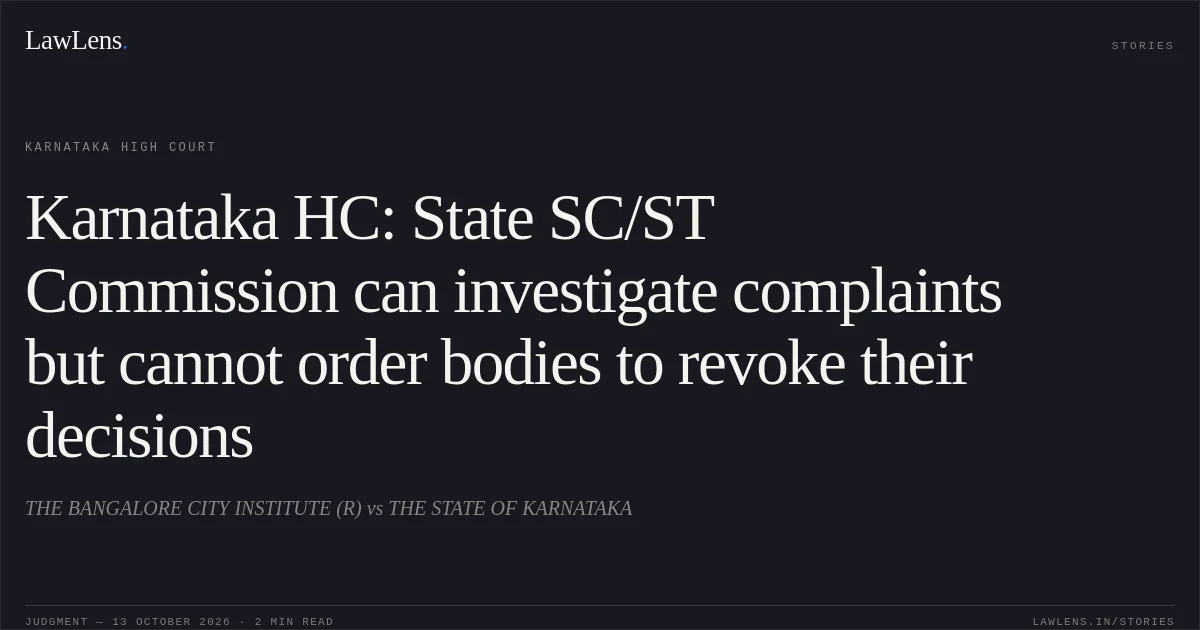
The Bangalore City Institute suspended respondent No. 3, one of its members, for three months following complaints of misconduct and breaches of the Institute’s rules
Source reference: para. 3Respondent No. 3 complained to the Karnataka State Commission for Scheduled Castes and Scheduled Tribes, which directed the Institute to revoke the suspension and permit him to use its facilities
Source reference: para. 4The Institute and others challenged that direction under Articles 226 and 227 of the Constitution. By the time the petition was considered, the suspension had expired
Source reference: paras. 5, 15Issues
1. Whether the Commission had authority under the Karnataka State Commission for Scheduled Castes and Scheduled Tribes Act, 2002 to direct the Institute to revoke the suspension and restore respondent No. 3’s access to its facilities
Source reference: paras. 8–142. Whether any further order was required where the three-month suspension had expired during the proceedings
Source reference: paras. 5, 15–16Law Applied
Under Section 8(b) of the Karnataka State Commission for Scheduled Castes and Scheduled Tribes Act, 2002, the Commission may inquire into complaints concerning deprivation of the rights or safeguards of Scheduled Castes and Scheduled Tribes and take up the matter with the appropriate authorities; that provision does not confer adjudicatory power to annul or direct revocation of another body’s decision
Source reference: paras. 8–9Section 10 gives the Commission specified civil-court powers for investigation, including summoning persons and requiring production of documents, but those procedural powers do not confer jurisdiction to adjudicate rights or set aside orders
Source reference: paras. 11–13The Act’s stated purposes and the Commission’s other functions are investigative, advisory and recommendatory in character
Source reference: paras. 6–10Reasoning
The Court accepted that the Commission could inquire into respondent No. 3’s complaint if it concerned deprivation of rights or safeguards protected by the Act, and could take the matter up with the appropriate authority or make a permissible recommendation
Source reference: para. 14But the Commission’s statutory inquiry functions and limited civil-court powers did not authorize it to adjudicate the Institute’s internal disciplinary action or command the Institute to revoke the suspension and restore access to its facilities
Source reference: paras. 9, 13–14As the suspension had already expired, the Court considered it spent, while clarifying the limits of the Commission’s jurisdiction
Source reference: paras. 5, 15–16Holding
The Court held that the Commission lacked adjudicatory jurisdiction to set aside, annul or direct revocation of an order passed by another authority or body, and that its direction to the Institute exceeded the powers conferred by the Act
Because the suspension had expired, no further order was necessary; the writ petition was disposed of with that clarification
Source reference: paras. 15–16Acts & Sections Cited
2 provisions across 1 statute referred to in this judgment. Each provision opens on LawLens.
KARNATAKA STATE COMMISSION FOR THE SCHEDULED CASTES AND THE SCHEDULED TRIBES ACT, 20022
Original Court PDF
THE BANGALORE CITY INSTITUTE (R)vsTHE STATE OF KARNATAKA
Click to open original judgment
Original judgment, available to read, download and summarize on LawLens.in