01Facts
Respondent No. 1 joined the Bank as a daily wager in 1991 and retired as Manager on 31 May 2025.
pp. 3–6 · ¶ 1, 3–4The Bank withheld his gratuity, leave encashment and fixed-deposit amount, referring to consumer proceedings arising from a complaint registered in 2011, which were pending before the National Consumer Disputes Redressal Commission.
pp. 3–6 · ¶ 1, 3–4After the Deputy Registrar of Co-operative Societies directed the Bank to pay any amounts due after lawful deductions, the Bank advised that the terminal benefits would be dealt with after the consumer proceedings.
pp. 4–6 · ¶ 3The employee petitioned the High Court.
p. 3 · ¶ 1The Single Judge directed payment of gratuity of ₹20,00,000, leave encashment of ₹2,23,944 and fixed deposits of ₹75,969, with 10% interest.
p. 3 · ¶ 1The Bank appealed, challenging both the writ petition’s entertainability and the direction to pay.
pp. 6–7 · ¶ 402Issues
i.1. Whether the writ petition seeking payment of terminal benefits was entertainable under Article 226, notwithstanding the Bank’s contention that it was not “State” under Article 12.
pp. 6–8 · ¶ 4, 7–8ii.2. Whether the Bank could withhold the employee’s gratuity and other terminal benefits pending the consumer proceedings, absent authority under law.
pp. 9–10, 15–16 · ¶ 9–1003Law Applied
Article 226 confers a discretionary remedy: maintainability and entertainability are distinct, and the Court must exercise its discretion to decide whether to entertain a petition.
pp. 8–9 · ¶ 7–8Under Section 4, including Section 4(6), of the Payment of Gratuity Act, 1972, gratuity may be forfeited only in the circumstances prescribed by the Act; it cannot be withheld merely because other proceedings are pending.
p. 9 · ¶ 9Article 300A protects property from deprivation except by authority of law.
pp. 10–16 · ¶ 10Relying on State of Jharkhand v. Jitendra Kumar Srivastava, (2013) 12 SCC 210, the Court applied the principle that accrued terminal benefits cannot be withheld without statutory authority.
pp. 10–16 · ¶ 10Provisions in the judgment · 1 · Linked ones open on LawLens
KARNATAKA HIGH COURT ACT, 1961 Section 4
04Reasoning
The employee sought his own accrued terminal benefits after first approaching the Deputy Registrar, and the Bank’s refusal rested on the pending consumer proceedings rather than any action under the Payment of Gratuity Act.
pp. 4–6, 9–10 · ¶ 3, 9The Court rejected the Bank’s Article 12 objection as a ground for denying relief: whether or not the Bank was “State,” the Court could exercise its Article 226 discretion to entertain the employee’s claim.
pp. 8–10 · ¶ 7–10No enquiry or termination for an offence involving moral turpitude was shown, and the Bank identified no statutory basis for withholding gratuity.
pp. 9–16 · ¶ 10The pending consumer proceedings therefore did not justify withholding the benefits; deprivation of accrued terminal benefits without authority of law was inconsistent with Article 300A.
pp. 9–16 · ¶ 1005Holding
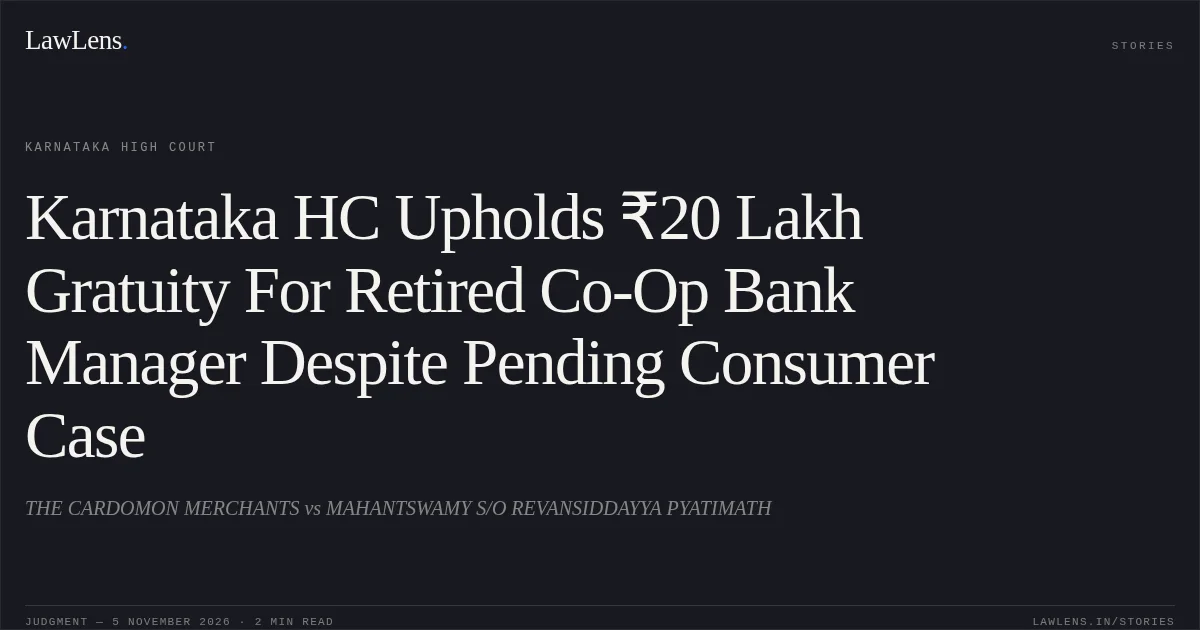
The Court held that the writ petition was entertainable and that the Bank could not withhold the employee’s terminal benefits merely because the consumer proceedings were pending.
pp. 16–17 · ¶ 10–11Finding no basis to interfere with the Single Judge’s order, it rejected the appeal and left in force the directions to pay ₹20,00,000 in gratuity, ₹2,23,944 in leave encashment and ₹75,969 in fixed deposits, with 10% interest.
pp. 16–17 · ¶ 10–11Original Court PDF
THE CARDOMON MERCHANTSvsMAHANTSWAMY S/O REVANSIDDAYYA PYATIMATH
Click to open original judgment
Original judgment, available to read, download and summarize on LawLens.in