01Facts
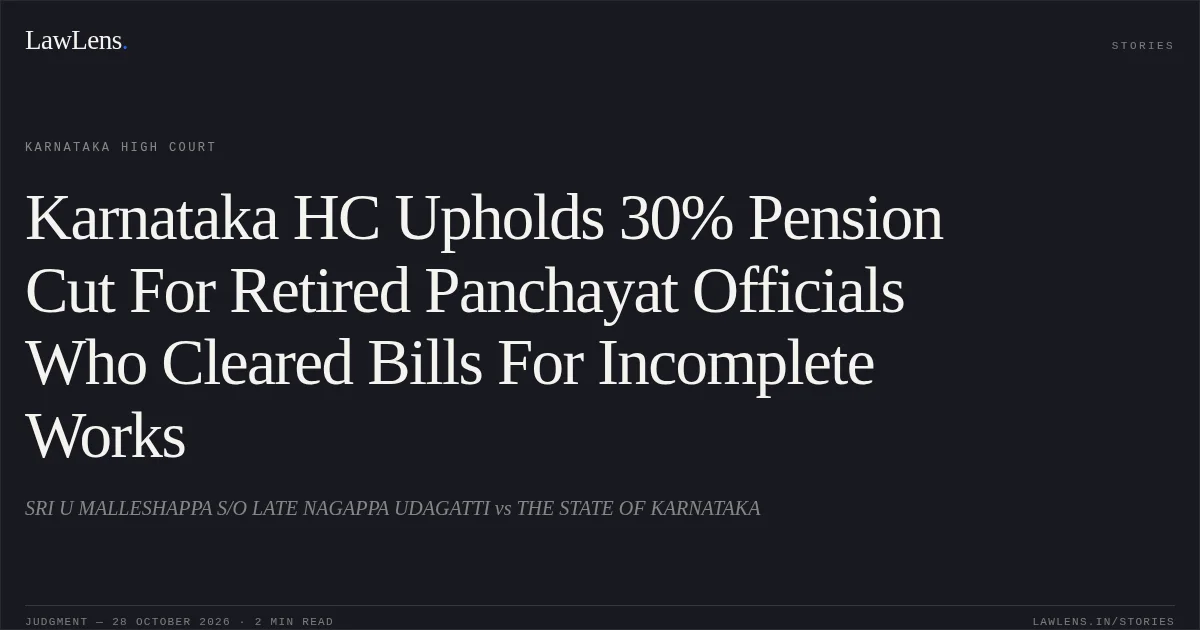
The petitioners, former Panchayat Raj officials, faced departmental charges alleging that they approved payments for works at a school, graveyard and anganwadi despite deficiencies in the work actually completed.
pp. 8–15The enquiry officer found the charges proved, including that the officials recorded, supervised or sanctioned payments for work falling short of the estimates.
pp. 8–15Following their retirement, the Lokayukta recommended withholding 30% of their pension for five years; the State imposed the penalty, which the petitioners challenged before the Karnataka State Administrative Tribunal (KAT).
pp. 11–13The KAT dismissed their applications, rejecting, among other grounds, their challenges concerning the specificity of the charges, procedural fairness and the evidentiary basis for the findings.
pp. 15–23The petitioners then sought review under Articles 226 and 227.
pp. 4–702Issues
i.Whether the High Court should interfere with the Tribunal’s refusal to set aside the disciplinary findings and pension penalty, including on the grounds that the charges were vague or the enquiry findings unsupported by evidence.
pp. 23–24, 37–38ii.Whether the penalty warranted interference in the exercise of judicial review.
pp. 23–24, 30–3203Law Applied
Under Articles 226 and 227, judicial review of disciplinary proceedings is supervisory, not appellate: a court ordinarily cannot reappreciate evidence or substitute its own factual conclusions where the findings are supported by some evidence.
pp. 24–31, 32–37Interference may be warranted for, among other things, breach of natural justice or statutory procedure, findings based on no evidence, perversity, or a conclusion no reasonable person could reach (Union of India v. P. Gunasekaran, (2015) 2 SCC 610; B.C. Chaturvedi v. Union of India, (1995) 6 SCC 749).
pp. 24–31, 32–37The Court also relied on State of Jharkhand v. Ranjan Kumar, 2026 SCC OnLine SC 824, which reiterates these limits and states that punishment is ordinarily open to review only where it is shockingly disproportionate.
pp. 23–32The disciplinary proceedings were conducted under Rule 14-A of the Karnataka Civil Services (Classification, Control and Appeal) Rules, 1957, and the alleged misconduct was framed by reference to Rule 3(1) of the Karnataka Civil Services (Conduct) Rules, 1966.
p. 5, 10Provisions in the judgment · 2 · Linked ones open on LawLens
KARNATAKA LOKAYUKTA ACT, 1984 Section 12Section 9
04Reasoning
The enquiry record included the investigating officer’s evidence and documents describing discrepancies between the sanctioned work and the work found on inspection; the enquiry officer attributed responsibility to the petitioners according to their roles in recording measurements, supervising works and passing payments.
pp. 13–15, 19–21The Tribunal had considered the objections concerning the charges, procedure and evidence and found them insufficient to invalidate the enquiry.
pp. 16–23Applying the limited standard of judicial review, the High Court held that the Tribunal’s order disclosed no perversity warranting interference and declined to reassess the evidence as an appellate court.
pp. 37–38It also considered the alleged financial loss insufficient, by itself, to justify disturbing the concurrent findings.
p. 3805Holding
The High Court rejected both writ petitions and left the Tribunal’s decision and the disciplinary penalty undisturbed.
pp. 38–39It observed that the petitioners could make representations to the State concerning pension drawn while interim orders were in force, and directed the State to decide those representations in accordance with law.
p. 38Pending interlocutory applications were disposed of as not requiring adjudication.
p. 39Original Court PDF
SRI U MALLESHAPPA S/O LATE NAGAPPA UDAGATTIvsTHE STATE OF KARNATAKA
Click to open original judgment
Original judgment, available to read, download and summarize on LawLens.in