01Facts
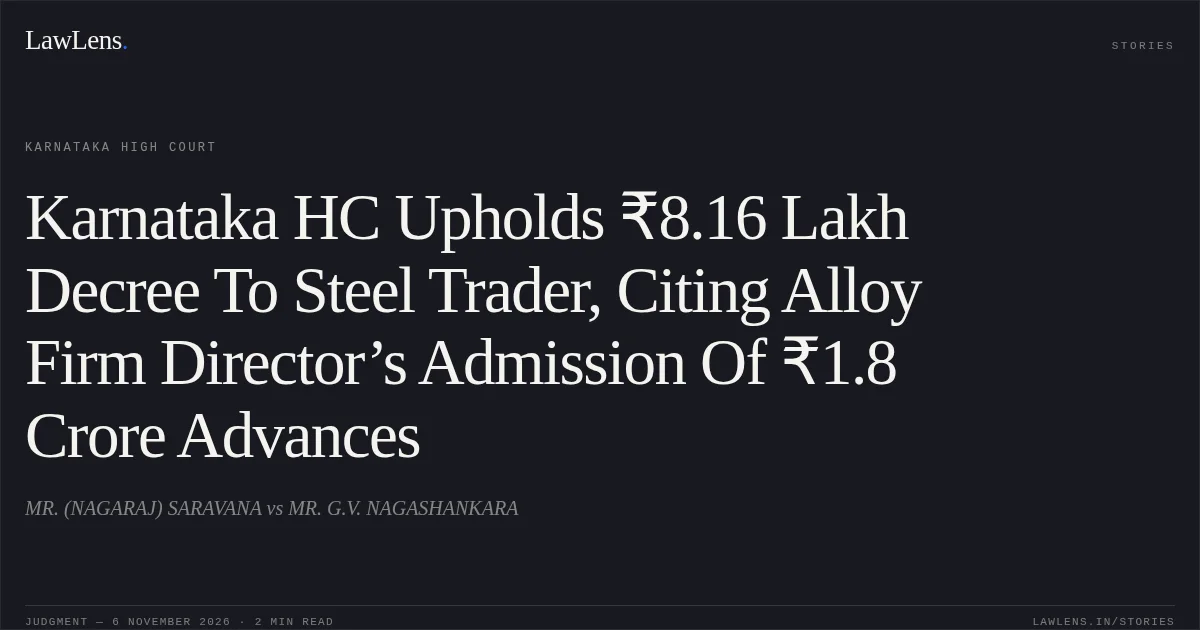
The plaintiff, a steel and building-materials trader, alleged that he made advance payments to the defendants for steel supplies and that ₹8,16,363 remained unadjusted or unpaid.
¶ 3–4, 8–11He sued for recovery; the suit was decreed for ₹8,16,284, with interest and costs.
¶ 3–4, 8–11The defendants appealed, contending, among other things, that the company had not been properly impleaded, its directors could not be held personally liable, the plaintiff had not pleaded the subsequent advances relied on by the Commercial Court, and the suit was barred by limitation.
¶ 5–6, 13–1402Issues
i.Whether the Commercial Court could rely on evidence of subsequent advances and transactions that were not specifically pleaded in the original plaint?
¶ 15–16, 21–22ii.Whether the evidence supported the finding that ₹8,16,284 remained due from the defendants?
¶ 17–25iii.Whether the suit was barred by limitation or otherwise liable to fail on the objections concerning jurisdiction and non-joinder of the company?
¶ 26–27iv.Whether the appellants established grounds for appellate interference with the decree?
¶ 1503Law Applied
The Court applied the principle that a party ordinarily cannot travel beyond its pleadings and that evidence cannot establish an unpleaded case.
¶ 16It also considered the evidentiary significance of admissions and the drawing of an adverse inference where a party with access to relevant business records fails to produce them.
¶ 17, 19–20, 25The Court considered Article 26 of the Limitation Act, 1963, as applied by the Commercial Court to the account claim.
¶ 8, 26The Court considered provisions of the Code of Civil Procedure concerning amendment of pleadings and joinder of parties, including Order VI Rule 17 and Order I Rule 10.
¶ 6, 21, 27The appeal was brought under Section 13(1A) of the Commercial Courts Act, 2015.
¶ 12Provisions in the judgment · 2 · Linked ones open on LawLens
Commercial Courts Act, 2015 Section 13
Limitation Act, 1963 Section 26
04Reasoning
The Court accepted that the original plaint did not specifically plead all nine advances, but held that the deficiency did not displace the combined evidentiary record: the plaintiff’s bank statement showed payments totalling ₹1,80,00,000, and the defendants’ witness admitted the business relationship, receipt of the pleaded advance, maintenance of accounts, and the total receipts disclosed in the company’s audit report.
¶ 17–19Because the defendants did not produce their accounts to show that the advances had been fully adjusted, the Commercial Court was justified in drawing an adverse inference.
¶ 20The Court also noted the supplies, repayments and resulting accounting that supported the balance decreed.
¶ 23–25The Court upheld the limitation finding based on the admitted continuation of transactions until 23 September 2013 and the suit’s filing on 12 April 2016, and found no basis to disturb the rulings on jurisdiction or the company’s joinder.
¶ 26–2705Holding
The Court answered the appellate question against the appellants, finding no perversity or other ground warranting interference.
¶ 28–30It dismissed the appeal and affirmed the decree for ₹8,16,284, with interest at 12% per annum from 3 December 2015 to the date of suit and 6% per annum thereafter until realisation; pending applications were disposed of, with no order as to costs.
¶ 29–30Original Court PDF
MR. (NAGARAJ) SARAVANAvsMR. G.V. NAGASHANKARA
Click to open original judgment
Original judgment, available to read, download and summarize on LawLens.in