01Facts
The complainant alleged that the accused borrowed ₹8,00,000 and issued a cheque for repayment. The cheque was dishonoured for insufficient funds; a demand notice was served, and the complainant filed a complaint under Section 138 of the Negotiable Instruments Act, 1881 (NI Act).
pp. 3–4The trial court convicted the accused and imposed a fine of ₹8,00,000, payable to the complainant as compensation. The appellate court affirmed the conviction.
pp. 4–5In revision, the accused disputed the loan and signature, and claimed the cheque was given as security in connection with a sale transaction; she also argued that she had not been given a full opportunity to cross-examine the complainant.
pp. 5–6, 9–1002Issues
i.1. Whether the concurrent judgments of conviction disclosed perversity or another ground warranting interference in revisional jurisdiction
p. 7 · ¶ 12ii.2. Whether the accused had rebutted the presumptions under Sections 118 and 139 of the NI Act concerning consideration and a legally enforceable debt
pp. 11–13 · ¶ 16–1803Law Applied
Section 138 of the NI Act penalises the dishonour of a cheque issued in discharge, wholly or partly, of a legally enforceable debt or liability, subject to the statutory requirements concerning presentation, dishonour, demand notice and non-payment.
pp. 11–12 · ¶ 16Sections 118 and 139 create rebuttable presumptions in favour of consideration and that the cheque was received in discharge of a debt or liability.
pp. 12–13 · ¶ 17–18In revision under Sections 397 and 401 of the Code of Criminal Procedure, 1973, the High Court exercises supervisory rather than appellate jurisdiction and ordinarily does not reappreciate evidence; interference is justified where the finding or order is perverse, grossly erroneous, unreasonable or untenable, based on irrelevant or no material, or reflects arbitrary exercise of discretion.
pp. 7–11 · ¶ 14–15In revision under Sections 397 and 401 of the Code of Criminal Procedure, 1973, the High Court exercises supervisory rather than appellate jurisdiction and ordinarily does not reappreciate evidence; interference is justified where the finding or order is perverse, grossly erroneous, unreasonable or untenable, based on irrelevant or no material, or reflects arbitrary exercise of discretion, citing Kuntegowda v. Thurubaiah and State of Kerala v. Puttumana Illath Jathavedan Namboodiri.
pp. 7–11 · ¶ 14–15Provisions in the judgment · 6 · Linked ones open on LawLens
Code of Criminal Procedure, 1973 Section 397Section 401Section 200Section 313
Bharatiya Nagarik Suraksha Sanhita, 2023 Section 438Section 442
04Reasoning
The Court found that the cheque had been presented and dishonoured, that notice had been served, and that the accused’s signature on the cheque was established; the complainant’s evidence also disclosed income, while the cross-examination did not establish an absence of financial capacity.
pp. 13–15 · ¶ 19–21The accused had not replied to the notice or led defence evidence, and her cross-examination did not sufficiently support the claim that the cheque was security for the sale transaction or otherwise rebut the statutory presumptions.
pp. 16–17 · ¶ 20–21The Court therefore found no perversity or other basis to disturb the concurrent findings in revision.
p. 17 · ¶ 2105Holding
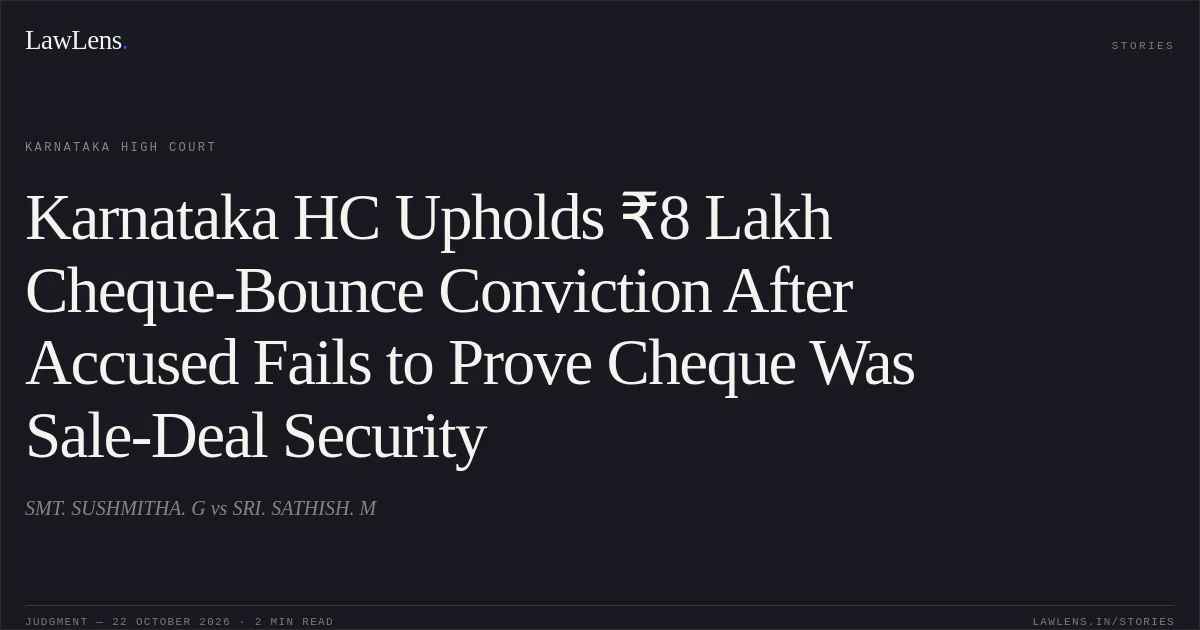
The High Court dismissed the revision petition and left undisturbed the trial court’s conviction and sentence, as affirmed by the appellate court.
p. 17 · ¶ 22Although paragraph 13 records the point for consideration as answered “in Affirmative,” the Court’s reasons and operative order conclude that no ground for revisional interference was established.
p. 7, 17 · ¶ 13, 21–22Original Court PDF
SMT. SUSHMITHA. GvsSRI. SATHISH. M
Click to open original judgment
Original judgment, available to read, download and summarize on LawLens.in



