01Facts
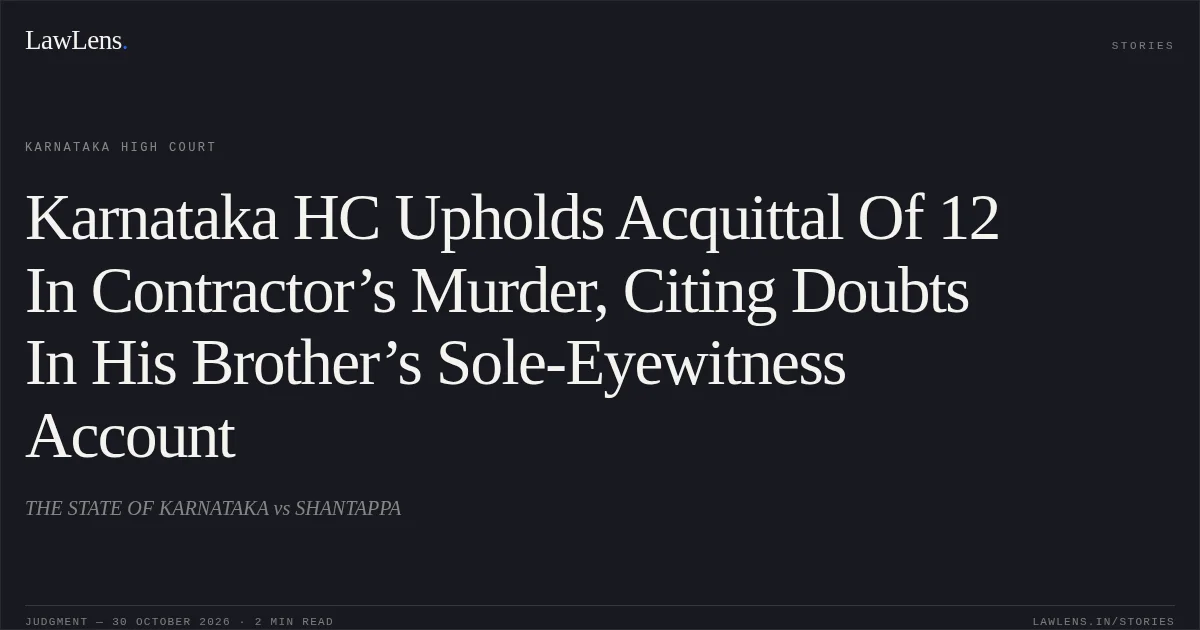
The State appealed the acquittal of 12 accused by the II Additional Sessions Judge and Special Judge, Kalaburagi, in Special Case (SC/ST) No. 14/2020.
pp. 5–9, 15–16The prosecution alleged that, following disputes over Gram Panchayat matters and a road construction project, the accused conspired to attack and kill Shivalingappa Bhavikatti on 4 November 2019.
pp. 5–9, 15–16The prosecution case rested principally on PW9, the deceased’s brother, who claimed to have witnessed the attack.
pp. 5–9, 15–16The trial court found the homicidal death established but acquitted the accused of the charged offences under the IPC, the SC/ST (Prevention of Atrocities) Act, 1989, and the Arms Act, 1959.
pp. 5–9, 15–16The State challenged that acquittal, arguing that the trial court had failed to appreciate the evidence properly.
pp. 16–1702Issues
i.Whether the State established that the acquittal was perverse, arbitrary, or based on a failure to appreciate the evidence, warranting appellate interference.
p. 17ii.Whether the prosecution proved the accused’s guilt beyond reasonable doubt, including the alleged attack, conspiracy and caste-related offences.
pp. 10–15, 29–3103Law Applied
The appeal was brought under Section 378(1) and (3) of the Code of Criminal Procedure, 1973 (corresponding to Section 419(1) and (3) of the Bharatiya Nagarik Suraksha Sanhita, 2023).
p. 4The charges arose under Sections 120-B, 143, 147, 148, 302, 307, 504, 427 and 109 read with Section 149 of the IPC, Sections 3(1)(r) and 3(2)(v) of the SC/ST Act, and Section 25 of the Arms Act.
pp. 5, 8–9On appeals against acquittal, the appellate court considers whether the trial court’s view is a possible one on the evidence; acquittal reinforces the presumption of innocence, and interference requires thorough scrutiny on the accepted legal principles.
p. 32The Court applied this rule from Jafarudheen and Others v. State of Kerala, (2022) 8 SCC 440, para 25.
p. 32Provisions in the judgment · 16 · Linked ones open on LawLens
Bharatiya Nagarik Suraksha Sanhita, 2023 Section 419
Code of Criminal Procedure, 1973 Section 378Section 207Section 164
Indian Penal Code, 1860 10 provisions
Section 143Section 147Section 148Section 427Section 109Section 307Section 504Section 302Section 149Section 34Scheduled Castes and the Scheduled Tribes (Prevention of Atrocities) Act, 1989 Section 3
Arms Act, 1959 Section 25
04Reasoning
The Court treated PW9 as the prosecution’s sole eyewitness but found material discrepancies between his first information, further statement and trial testimony, including improvements concerning the accused’s individual acts and the manner of assault.
pp. 26–29These inconsistencies, together with the absence of any attempt by PW9 to assist the deceased, raised doubt about his presence at the scene.
pp. 26–29Other witnesses were either hearsay witnesses or had turned hostile, leaving no independent evidence that resolved those doubts.
pp. 18–25, 29The Court also found no adequate evidence of caste-based abuse or the requisite caste-related elements of the SC/ST Act offences.
pp. 29–31Given these evidentiary deficiencies, the trial court’s acquittal was a possible view and did not warrant interference under the standard governing appeals against acquittal.
pp. 31–3305Holding
The High Court answered the issue of appellate interference in the negative, found no error in the acquittal, and dismissed the State’s appeal.
pp. 32–33Any pending applications were also disposed of.
pp. 32–33Original Court PDF
THE STATE OF KARNATAKAvsSHANTAPPA
Click to open original judgment
Original judgment, available to read, download and summarize on LawLens.in