01Facts
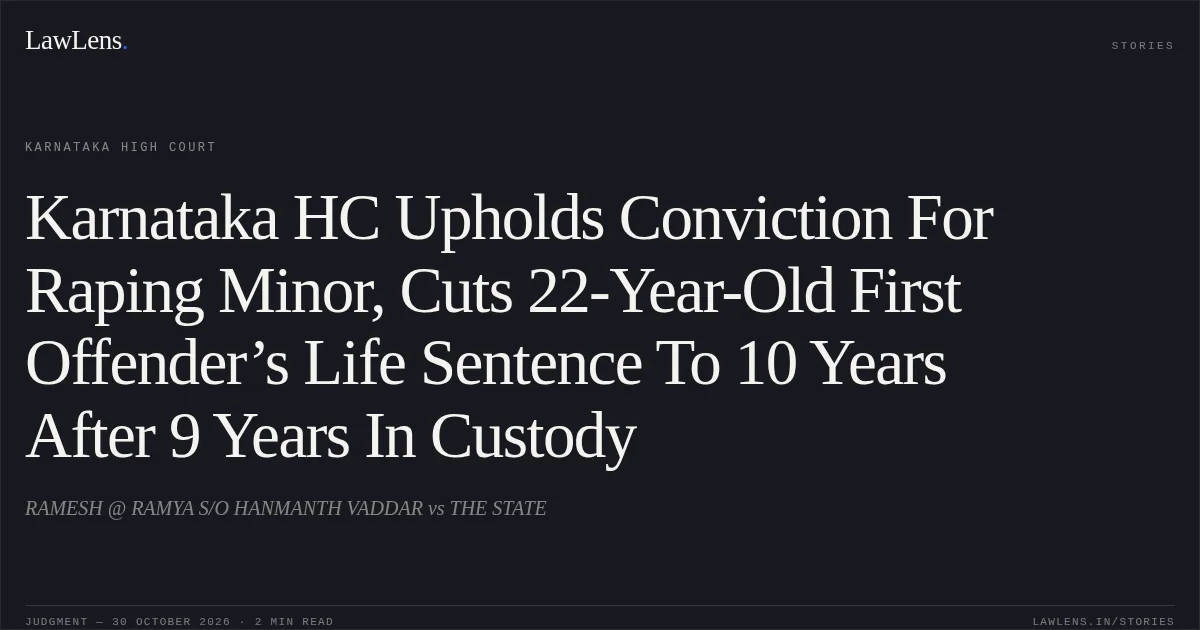
The prosecution alleged that on 19 December 2012, the appellant restrained and raped the victim, who was about 11–12 years old.
pp. 3, 8–9, 11–14The victim’s mother lodged a complaint after a delay of three days; the prosecution attributed the delay to the police initially refusing to register the complaint and the family approaching village elders and senior police officials
pp. 3, 8–9, 11–14The Sessions Court convicted the appellant under Sections 341 and 376(2)(l) of the IPC and Section 6 of the POCSO Act, sentencing him to life imprisonment for the sexual offences and imposing fines
pp. 6–7The appellant challenged the conviction and sentence, including on the grounds of delay, alleged false implication, and the severity of the sentence
pp. 7–802Issues
i.1. Whether the prosecution evidence established the appellant’s guilt under Sections 341 and 376(2)(l) of the IPC and Section 6 of the POCSO Act, warranting interference with the conviction
p. 10 · ¶ 8–9, 21–24ii.2. Whether the life sentence imposed by the Sessions Court was proportionate and lawful in the circumstances, or required modification
pp. 21–24 · ¶ 25–2903Law Applied
The Court applied Sections 341 and 376(2)(l) of the IPC and Section 6 of the POCSO Act to the offences proved against the appellant
pp. 6, 21–22It held that the applicable version of Section 6 was the provision in force on the date of the offence, before the 2019 amendment; that version prescribed rigorous imprisonment of not less than ten years, extendable to life imprisonment
pp. 22–23 · ¶ 27The Court considered that imposing the maximum sentence required valid reasons, and that sentencing should also account for the offender’s circumstances and the objectives of reformation and rehabilitation.
p. 24 · ¶ 29It relied on Sandeep v. State of Uttarakhand, Criminal Appeal No. 2224 of 2014, disposed of on 14 October 2024, in support of the latter principle
p. 24 · ¶ 29Provisions in the judgment · 9 · Linked ones open on LawLens
Code of Criminal Procedure, 1973 Section 374Section 207Section 313Section 428
Indian Penal Code, 1860 Section 341Section 376
Protection of Children from Sexual Offences Act, 2012 Section 5Section 6Section 61
04Reasoning
The Court upheld the conviction, relying principally on the victim’s account, the medical evidence of hymenal injury and bleeding, and the FSL report showing blood on the victim’s clothing and the appellant’s innerwear
pp. 15, 19–21 · ¶ 13, 21–22It also accepted the prosecution’s explanation for the delay in lodging the complaint
pp. 20–21 · ¶ 23On sentence, the Court found that the Sessions Court had not given reasons for imposing life imprisonment.
pp. 22–24 · ¶ 25–29Given the appellant’s age, lack of prior criminal antecedents, first-offender status, and period of incarceration, it considered life imprisonment disproportionate and reduced the sentence to the statutory minimum of ten years’ rigorous imprisonment
pp. 22–24 · ¶ 25–2905Holding
The appeal was allowed in part.
pp. 24–25 · ¶ 30–31The conviction was maintained, but the sentence for the offences under Section 376(2)(l) of the IPC and Section 6 of the POCSO Act was modified to ten years’ rigorous imprisonment and a fine of ₹50,000, with six months’ simple imprisonment in default of payment.
pp. 24–25 · ¶ 30–31The remaining part of the Sessions Court’s judgment and sentence was maintained
pp. 24–25 · ¶ 30–31Original Court PDF
RAMESH @ RAMYA S/O HANMANTH VADDARvsTHE STATE
Click to open original judgment
Original judgment, available to read, download and summarize on LawLens.in