Facts
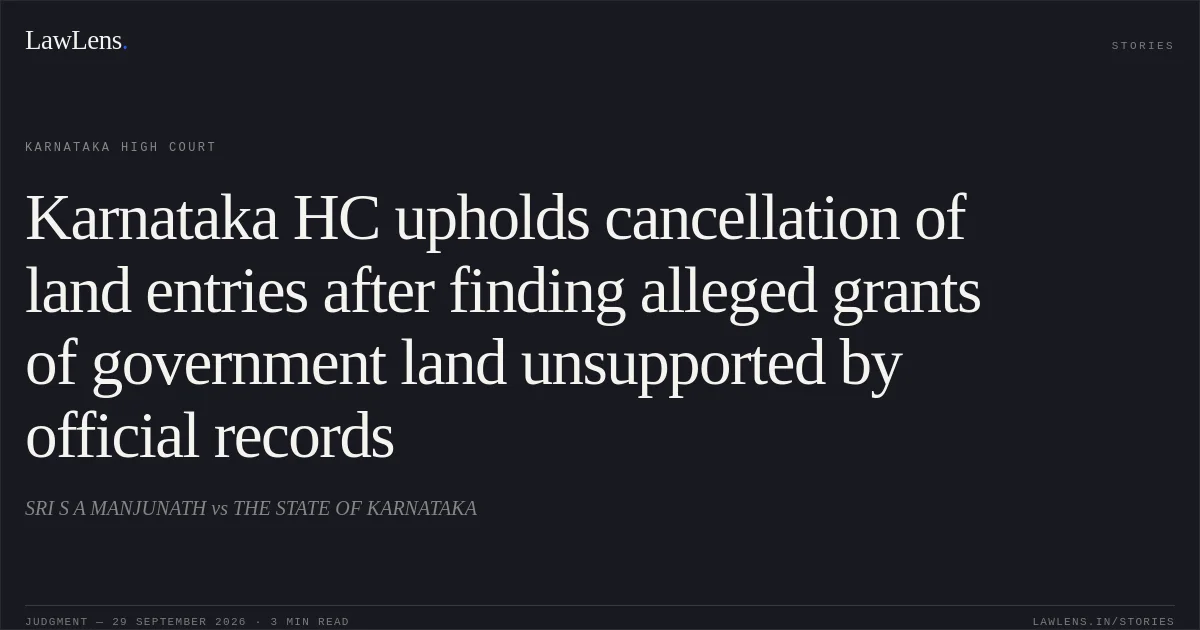
The petitioners challenged orders of the Special Deputy Commissioner cancelling mutation and consequential revenue entries relating to lands in Sy. No. 80, Shettigere Village.
Source reference: para. 1–3, 5–13, 16–19The petitioners claimed rights through grants allegedly made on 12 October 1979 to them and their family members, or to their predecessors, and relied on sale deeds, revenue records and copies of grant documents.
Source reference: para. 1–3, 5–13, 16–19Earlier suo motu proceedings under Section 136(3) of the Karnataka Land Revenue Act, 1964, had been dropped in 2005; later proceedings resulted in the impugned orders.
Source reference: para. 1–3, 5–13, 16–19Issues
Whether the Special Deputy Commissioner could exercise suo motu powers under Section 136(3) of the Karnataka Land Revenue Act, 1964, to examine the disputed revenue entries and the basis for the claimed grants.
Source reference: para. 6, 17Whether the alleged grants and consequential revenue entries could be sustained when the claimed grants were unsupported by original or contemporaneous records and appeared to exceed the Tahsildar’s authority under the Karnataka Land Grant Rules, 1969.
Source reference: para. 8–12, 14–16, 19Whether the Special Deputy Commissioner’s orders warranted interference for want of jurisdiction, proper record verification or reasoned satisfaction.
Source reference: para. 5–7, 19Law Applied
Section 136(3) of the Karnataka Land Revenue Act, 1964, empowers the Deputy Commissioner to call for and examine records of rights and decide the matter in accordance with law.
Source reference: para. 17Under Rules 6 and 7 of the Karnataka Land Grant Rules, 1969, land grants are governed by prescribed priorities and limits on the powers of revenue officers; where a proposed grant exceeds an officer’s authority, the matter must be dealt with through the procedure, including Government consideration or sanction, prescribed by the Rules.
Source reference: para. 14–15, 18In M. Manjegowda v. State of Karnataka, the Court held that where the grant sought exceeds the authority conferred on subordinate revenue officers, the matter must be placed before the Government under Rule 7(v).
Source reference: para. 14The Court also relied on W.S. Insulators of India Ltd. v. Chief Secretary, Government of Karnataka concerning the Deputy Commissioner’s suo motu powers, and on Mackinnon Mackenzie & Co. Ltd. v. Mackinnon Employees Union for the principle that a statutory authority must follow the procedure prescribed by statute.
Source reference: para. 13, 17–18Reasoning
The Court found that the petitioners had produced no original grant orders or contemporaneous departmental records to substantiate the alleged grants.
Source reference: para. 19The Special Deputy Commissioner had obtained and examined records from the relevant revenue offices and land-record authorities, which did not disclose the claimed grants for Sy. No. 80; the grant reference identified in the records related instead to Sy. No. 90 of Tarahunase Village.
Source reference: para. 19The Court also considered that the land available for disposal was recorded as only 13 acres and 7 guntas, whereas the alleged grants in Sy. No. 80 totalled 32 acres, including grants to several members of the same family on the same date.
Source reference: para. 14–16, 19Applying Rule 7 and M. Manjegowda, it concluded that the alleged grants exceeded the Tahsildar’s authority and lacked the required Government sanction or supporting records.
Source reference: para. 14–16, 19It therefore rejected the challenges to the Deputy Commissioner’s jurisdiction and the adequacy of the decision-making process.
Source reference: para. 17, 19Holding
The Court held that the Deputy Commissioner was empowered to examine the disputed revenue records under Section 136(3), and found no sufficient basis to interfere with the impugned orders cancelling the mutation and consequential entries.
The writ petition was dismissed as devoid of merit.
Source reference: para. 17, 19–20Acts & Sections Cited
1 provisions across 1 statute referred to in this judgment. Linked provisions open on LawLens.
Karnataka Land Revenue Act, 19641
Original Court PDF
SRI S A MANJUNATHvsTHE STATE OF KARNATAKA
Click to open original judgment
Original judgment, available to read, download and summarize on LawLens.in