01Facts
Respondent No. 3, Suresh, was appointed as a daily-wage employee in 1984.
pp. 3–5, 13In 1994, his services were regularised as a Group ‘C’ Literate Assistant with effect from 2 May 1993.
pp. 3–5, 13The appellants modified that order in 1995, placing him in a Group ‘D’ post on the ground of alleged tampering with his appointment records.
pp. 3–5, 13In 2000, the High Court set aside the modification and remitted the matter for reconsideration after notice; the appellants then regularised him as a Literate Assistant with effect from 2 June 2000.
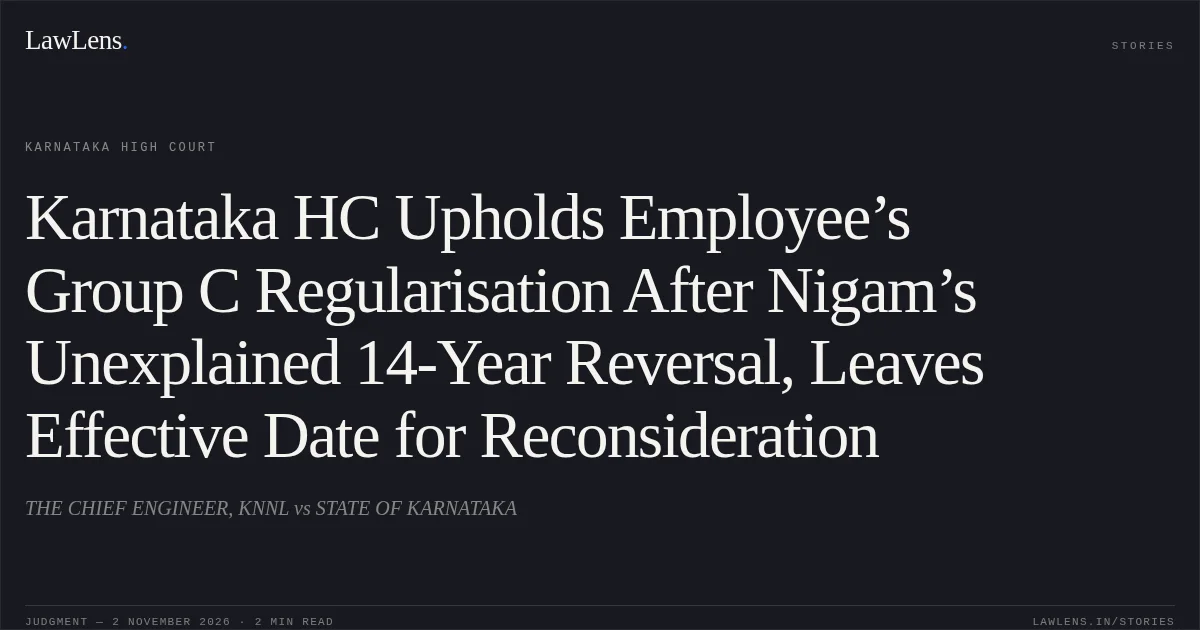
pp. 3–5, 13In 2014, after Suresh sought benefits based on regularisation from 1993, the appellants passed a further order placing him in a Group ‘D’ post and withdrawing the earlier orders.
pp. 3–5, 13The Single Judge set aside the 2014 order, upheld the 2000 order, and remitted the question of the effective date of regularisation—2 May 1993 or 2 June 2000—to the appellants for reconsideration.
pp. 3–5, 13The appellants challenged that decision in this writ appeal.
pp. 3–5, 1302Issues
i.Whether the appellants could revisit or withdraw the 2000 regularisation order after approximately 14 years, without explaining the delay.
pp. 13–14ii.Whether the Single Judge’s direction to the appellants to determine the effective date of Suresh’s Group ‘C’ regularisation warranted interference in an intra-court appeal.
pp. 14–1703Law Applied
Where no limitation period is prescribed, an action to review or revisit an earlier decision must nevertheless be taken within a reasonable time; whether the time is reasonable depends on the circumstances and the interests of the affected parties.
pp. 9–12The Court relied on Chhedi Lal Yadav v. Hari Kishore Yadav, (2018) 12 SCC 527, for the principle that unexplained action after an inordinate delay may be impermissible.
pp. 9–12It also applied the standard for intra-court appellate review stated in Bihar Industrial Area Development Authority v. Scope Sales Private Limited, 2026 SCC OnLine SC 112: interference is warranted where the Single Judge’s decision is demonstrably erroneous or perverse, not merely because another view is possible.
pp. 15–17Provisions in the judgment · 3 · Linked ones open on LawLens
KARNATAKA HIGH COURT ACT, 1961 Section 4
Limitation Act, 1963 Section 137
Motor Vehicles Act, 1988 Section 166
04Reasoning
The appellants produced no material explaining why they had waited approximately 14 years after the 2000 order before seeking to revisit it.
pp. 13–17The 2014 order also failed to address the delay and, as the Single Judge found, did not provide adequate reasons for reverting Suresh to a Group ‘D’ post.
pp. 13–17The Division Bench therefore found no basis to disturb the Single Judge’s conclusion that the 2014 order could not stand.
pp. 13–17As to the effective date of regularisation, the Single Judge had left the issue to the appellants for reconsideration; the Division Bench found no perversity or illegality in that direction and applied the restrained standard governing intra-court appeals.
pp. 13–1705Holding
The writ appeal was dismissed.
pp. 16–17The 2014 order remained set aside, and the appellants were directed to comply with the Single Judge’s order by determining whether Suresh’s Group ‘C’ regularisation as a Literate Assistant should take effect from 2 May 1993 or 2 June 2000, and to do so as expeditiously as possible.
pp. 16–17Original Court PDF
THE CHIEF ENGINEER, KNNLvsSTATE OF KARNATAKA
Click to open original judgment
Original judgment, available to read, download and summarize on LawLens.in