01Facts
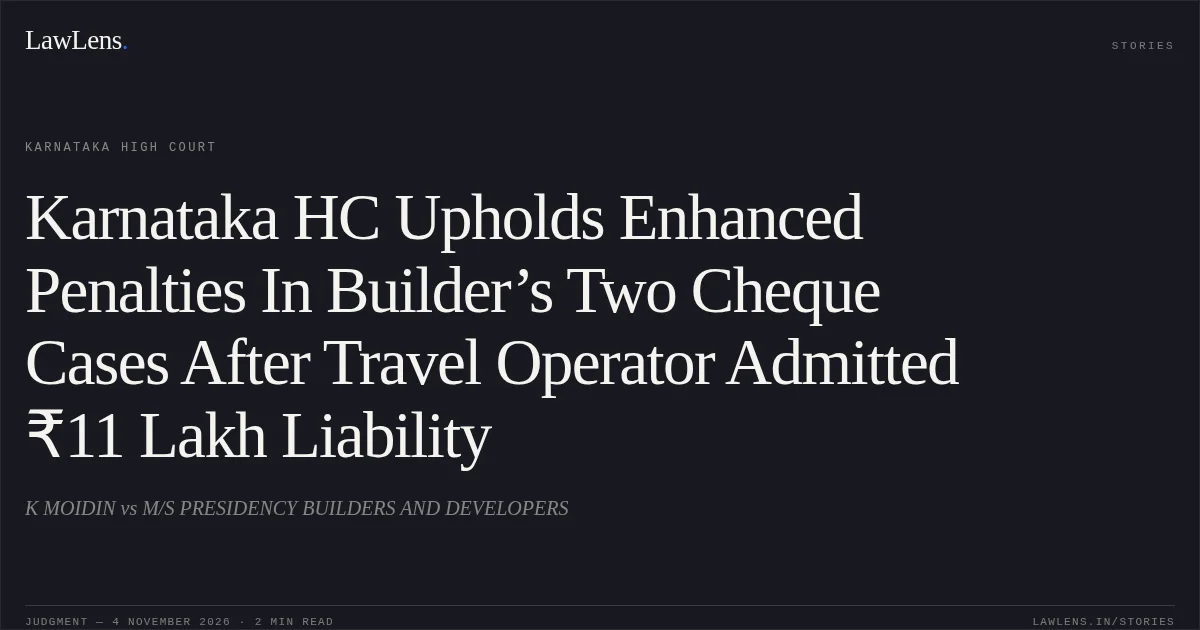
The complainant initiated proceedings under Section 138 of the Negotiable Instruments Act, 1881, alleging that the accused had issued cheques for ₹5,00,000 and ₹6,00,000 towards a liability arising from a transaction concerning the proposed sale of a passenger bus; the cheques were dishonoured and the demand was not met
pp. 6–7The Trial Court convicted the accused in C.C. Nos. 1496/2015 and 1497/2015 and ordered payment of ₹6,10,000 and ₹5,10,000 respectively
p. 7The Sessions Court dismissed the accused’s appeals and allowed the complainant’s revision petitions, enhancing the amounts to ₹10,20,000 and ₹8,50,000 respectively and providing for six months’ imprisonment in default
p. 7The accused challenged the convictions and the enhancement before the High Court
pp. 7–802Issues
i.Whether the accused’s admission of the cheques and the corresponding liability supported the convictions under Section 138, despite the contention that the admitted liability related to a different transaction
pp. 12–15ii.Whether the High Court should interfere with the concurrent findings of conviction and the Sessions Court’s enhancement of the amounts
pp. 10, 15–1603Law Applied
Section 138 of the Negotiable Instruments Act criminalises dishonour of a cheque where the statutory requirements, including those in clauses (a), (b) and (c) of its proviso, are fulfilled
p. 14Under Section 58 of the Evidence Act, facts admitted need not be proved
p. 12The Court relied on Yogendra Pratap Singh v. Savitri Pandey, (2014) 10 SCC 713, for the proposition that the offence under Section 138 becomes effective upon fulfilment of the proviso’s requirements
pp. 10–11, 14It distinguished Navneetdas Narayandas Barshikar v. Bacchubhai Mulji Tanna, 2012 (1) MWN (Cr.) (DCC) 87 (Bom.), because, unlike that case, the accused here had admitted the relevant liability
p. 9, 13Provisions in the judgment · 5 · Linked ones open on LawLens
Code of Criminal Procedure, 1973 Section 482Section 397Section 401Section 200
Negotiable Instruments Act, 1881 Section 138
04Reasoning
The High Court noted that the accused did not dispute issuance of the cheques, their dishonour, or the demand; further, the Court found that the reply notice and the accused’s evidence contained an admission of liability in relation to the cheques
pp. 10, 12–15In light of that admission, the Court rejected the argument that the cheques related to a different transaction and that the presumption had been rebutted; it considered the cited authorities distinguishable or inapplicable
pp. 13–16Finding no basis to disturb the lower courts’ factual conclusions, the Court declined to interfere
p. 1505Holding
The High Court dismissed all four petitions, leaving in place the convictions and the Sessions Court’s enhancement of the amounts
p. 16It expressly stated that its observations did not concern the separate case in which the accused had been acquitted and an appeal was pending, and should not influence the court hearing that appeal
p. 16Original Court PDF
K MOIDINvsM/S PRESIDENCY BUILDERS AND DEVELOPERS
Click to open original judgment
Original judgment, available to read, download and summarize on LawLens.in