01Facts
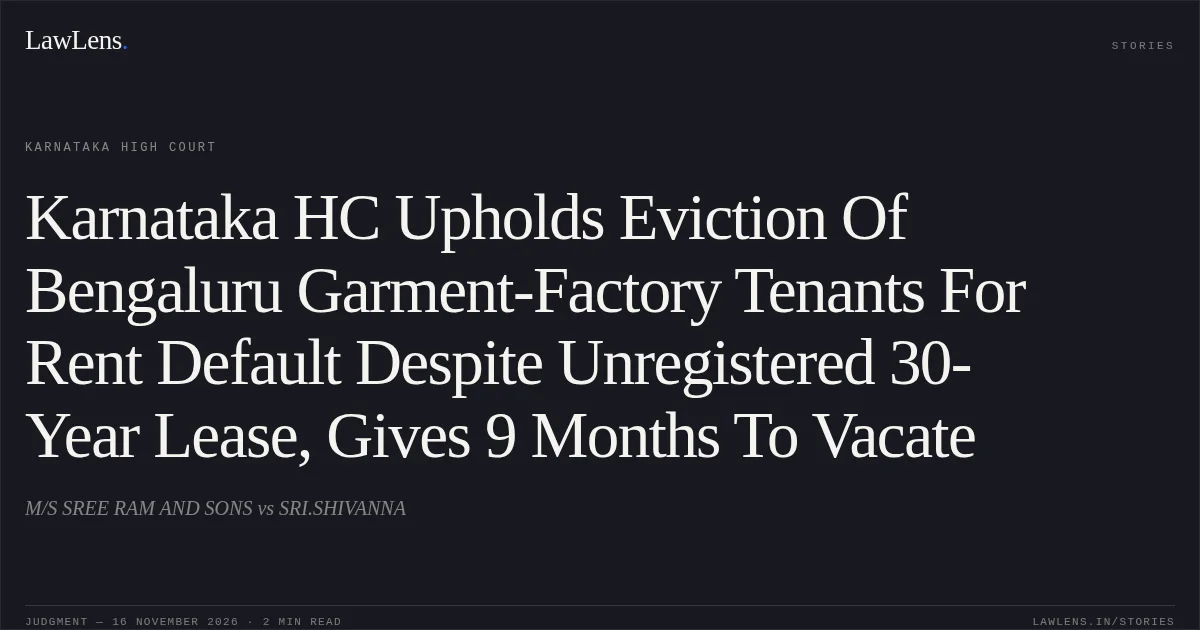
The plaintiff, owner of the suit premises, brought an ejectment suit against the defendants, who occupied the premises under an unregistered lease agreement dated 19 January 2001. The agreement recorded a 30-year term, monthly rent of ₹7,500 and an advance of ₹7,00,000.
pp. 3–6, 8The defendants resisted eviction, relying on the stated lease term and denying rent default. The trial court decreed ejectment with damages, finding the lease unregistered and relying on defendant No. 3’s admission that rent had not been paid from 2018 to December 2019. The defendants appealed.
pp. 3–6, 802Issues
i.1. Whether the unregistered lease agreement entitled the defendants to remain in possession for the stated 30-year term.
pp. 7–10ii.2. Whether the trial court’s decree directing the defendants to deliver vacant possession required appellate interference.
p. 7iii.3. Whether the evidence established rent default supporting ejectment.
p. 1603Law Applied
Under Sections 107 of the Transfer of Property Act, 1882, and 17(1)(d) of the Registration Act, 1908, a lease for a term exceeding one year must be made by a registered instrument; an unregistered instrument cannot establish the claimed fixed-term lease.
pp. 9–10The court treated the tenancy as one terminable by notice under Section 106 of the Transfer of Property Act. It also relied on Payal Vision Limited v. Radhika Choudhary, (2012) 11 SCC 405, in support of the requirement of registration for a lease exceeding one year.
pp. 9–10, 15–16Provisions in the judgment · 5 · Linked ones open on LawLens
Code of Civil Procedure, 1908 Section 96
Transfer of Property Act, 1882 Section 106Section 107Section 116
Registration Act, 1908 Section 17
04Reasoning
The defendants relied on the unregistered agreement to claim possession until 2031. Applying Sections 107 and 17(1)(d), the court held that the agreement could not confer an enforceable 30-year leasehold term and treated the tenancy as month-to-month.
p. 10The plaintiff had issued a quit notice, and the defendants had replied to it. Further, defendant No. 3 admitted in cross-examination that rent had not been paid for the period from 2018 to December 2019. The court therefore found no basis to disturb the trial court’s ejectment decree.
pp. 16–1705Holding
The appeal was dismissed, and the trial court’s judgment and decree were confirmed.
p. 17On the appellants’ request, the court granted nine months from the date of judgment to vacate, subject to payment of all arrears and continued payment of monthly rent until possession was delivered. The defendants were directed to file an undertaking within three weeks; upon non-payment, the plaintiff could seek execution of the decree.
p. 17Original Court PDF
M/S SREE RAM AND SONSvsSRI.SHIVANNA
Click to open original judgment
Original judgment, available to read, download and summarize on LawLens.in