01Facts
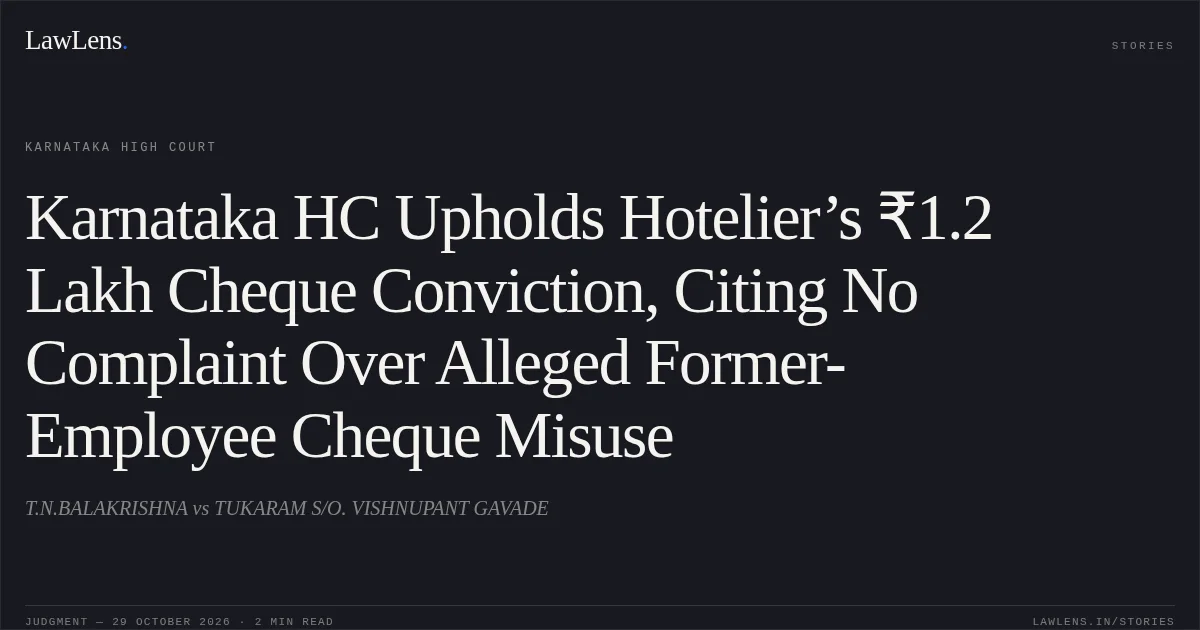
The complainant alleged that, at the request of his brother-in-law, Satyanarayan Jadhav, he lent the accused ₹1,30,000 in cash on 2 October 2013.
pp. 3–5, 11–12After the accused repaid ₹10,000, he allegedly issued a cheque for the remaining ₹1,20,000; the cheque was dishonoured for insufficient funds.
pp. 3–5, 11–12The complainant sent a statutory notice, which was returned, and then filed a complaint under Section 138 of the Negotiable Instruments Act, 1881 (NI Act).
pp. 3–5, 11–12The accused admitted that the cheque and signature were his, but denied borrowing from the complainant.
pp. 11, 13–14, 18He claimed that he had given blank cheques to Jadhav, who had misused one; he also relied on a statement marked Ex.P5 referring to a loan from Jadhav and a remaining balance of ₹62,000.
pp. 11, 13–14, 18The trial court convicted the accused and ordered payment of ₹1,30,000, including ₹1,20,000 as compensation; the first appellate court affirmed.
pp. 5–8The accused’s revision challenged both decisions.
pp. 5–802Issues
i.1. Whether the judgments of the trial court and first appellate court suffered from illegality or perversity warranting interference in revision.
p. 7ii.2. Whether the accused’s defence and the evidence on record rebutted the statutory presumptions under Sections 118 and 139 of the NI Act.
pp. 19–2203Law Applied
Sections 118 and 139 of the NI Act create rebuttable presumptions concerning consideration and the existence of a legally enforceable debt once execution of the cheque is admitted.
pp. 19–20The accused may rebut those presumptions on a balance of probabilities; the accused need not prove the defence beyond reasonable doubt, but a bare denial is insufficient.
pp. 19–20, 22–23The court also referred to the limited scope of revisional review, observing that revision is not an occasion to reassess evidence as if exercising trial or appellate jurisdiction; interference is warranted where a legal bar or a manifest error justifies it.
pp. 19–20, 22–23The judgment records the parties’ reliance on Basalingappa v. Mudibasappa, M/s Kumar Exports v. M/s Sharma Carpets, and Pushparaj R. Ullal v. Herald D’Souza, among other authorities.
pp. 9–10, 19–22Provisions in the judgment · 5 · Linked ones open on LawLens
Code of Criminal Procedure, 1973 Section 397Section 401
Negotiable Instruments Act, 1881 Section 138Section 118Section 139
04Reasoning
The accused admitted the cheque and his signature, thereby attracting the statutory presumptions.
pp. 16–18, 23–24Although he claimed that Jadhav had supplied the cheque and that the debt was owed to Jadhav rather than the complainant, the court found that the accused had not acted against Jadhav for the alleged misuse and admitted that they remained on cordial terms.
pp. 16–18, 23–24It also considered Ex.P4, concerning creditors seeking repayment, and Ex.P5, which recorded Jadhav’s role in arranging the money, alongside the cheque, return memo and notice.
pp. 16–18, 23–24The court concluded that the concurrent findings that the complainant had proved the debt were supported by the record and disclosed no glaring or manifest error warranting revision.
p. 2405Holding
The High Court answered the issue against the accused and dismissed the revision petition.
pp. 24–25It confirmed the first appellate court’s judgment affirming the trial court’s conviction and sentence under Section 138 of the NI Act, and directed that the original records be returned with a copy of the judgment.
pp. 24–25Original Court PDF
T.N.BALAKRISHNAvsTUKARAM S/O. VISHNUPANT GAVADE
Click to open original judgment
Original judgment, available to read, download and summarize on LawLens.in