01Facts
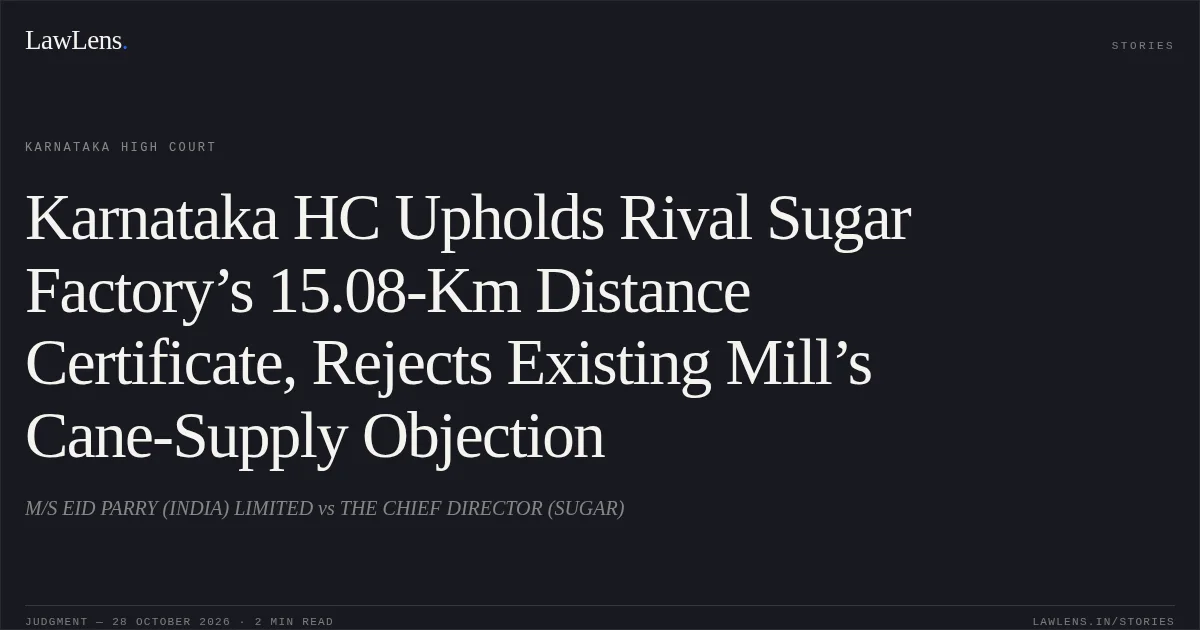
The petitioner operated an integrated sugar factory at Hullatti and relied on prior notifications reserving villages for its factory under the Sugarcane (Control) Order, 1966.
¶ 2–8, 22It challenged communications and a distance certificate issued in connection with respondent No. 4’s proposed sugar factory, contending that the new factory would encroach on its cane supply and fall within the prohibited distance.
¶ 2–8, 22The Survey of India-certified distance was 15.08 kilometres; the petitioner also referred to material indicating approximately 15.50 kilometres.
¶ 2–8, 22It sought, among other reliefs, to quash the certificate and prevent respondent No. 4’s factory from proceeding.
¶ 2–8, 2202Issues
i.1. Whether the petitioner had locus to challenge the proposed factory merely because it might compete for sugarcane
¶ 16(i)ii.2. Whether reservation of villages conferred an exclusive, permanent, or indefeasible right to prevent another factory beyond the prohibited distance
¶ 16(ii)iii.3. Whether the distance certificate, based on the official survey, warranted interference under Article 226
¶ 16(iii)iv.4. Whether the precedents relied upon by the petitioner supported its case
¶ 16(iv)03Law Applied
The Court applied the Sugarcane (Control) Order, 1966, including its provisions concerning reserved areas and the prescribed distance restriction.
¶ 19–20It held that reservation of a cane-growing area is a regulatory mechanism and does not, without express statutory authority, create a perpetual proprietary right or commercial monopoly for an existing factory; the relevant question is whether the proposed factory falls within the prescribed distance embargo.
¶ 19–20Under Article 226, the Court will not substitute its assessment for that of a competent technical authority absent demonstrated arbitrariness, incorrect coordinates, methodological non-compliance, mala fides, or procedural impropriety.
¶ 23The Court considered Ojas Industries (P) Ltd. v. Oudh Sugar Mills Ltd., (2007) 4 SCC 723; The Purtabpore Co. Ltd. v. Cane Commissioner of Bihar, (1969) 1 SCC 308; Tungabhadra Sugarcane and Banana Growers Association v. State of Karnataka, ILR 2012 Kar 6380; NSL Sugars Ltd. (Unit-II, Aland) v. Commissioner for Cane Development & Ors., W.A. No. 200021/2023; and Gangamai Industries & Construction Ltd. v. State of Maharashtra & Ors., W.P. No. 8145/2009, distinguishing them on their statutory or factual contexts.
¶ 25–3004Reasoning
The petitioner’s reserved-area status and investment did not establish an exclusive right to cane or a veto over competing factories; its concern about reduced cane availability was a commercial apprehension, not a basis to extend the distance prohibition beyond its terms.
¶ 18–21The competent authorities had undertaken an inspection and technical verification, and the Survey of India authenticated the distance as 15.08 kilometres—beyond the 15-kilometre restriction. The petitioner did not establish any defect in the survey or certificate warranting judicial review.
¶ 22–24The cited authorities did not establish an absolute right to prevent a factory situated beyond the prescribed distance.
¶ 25–3005Holding
The Court answered all five points against the petitioner and dismissed the writ petition.
¶ 31–33The challenges to the communication dated 23 February 2022, the distance certificate, and the consequential communication dated 5 April 2022 therefore failed.
¶ 31–33The dismissal was confined to the alleged breach of the distance restriction and did not prevent competent authorities from examining other applicable statutory or regulatory requirements.
¶ 31–33Original Court PDF
M/S EID PARRY (INDIA) LIMITEDvsTHE CHIEF DIRECTOR (SUGAR)
Click to open original judgment
Original judgment, available to read, download and summarize on LawLens.in