01Facts
The respondent filed a suit for specific performance against the petitioner’s father, relying on an agreement of sale dated 17 April 2015. The suit was filed on 26 September 2015; on the return date, 17 October 2015, the defendant appeared through counsel, the matter was referred to the Lok Adalat, and a compromise decree was recorded that day.
pp. 2–5, 7The compromise stated that the defendant had received Rs.21,00,000 in cash, but did not specify when or how payment was made. After the defendant’s death, the respondent sought enforcement of the decree, and the petitioner was brought on record as his legal heir. The petitioner challenged the compromise decree, alleging fraud.
pp. 2–5, 702Issues
i.1. Whether the petitioner’s challenge to the Lok Adalat compromise decree was maintainable by way of a writ petition under Articles 226 and 227 of the Constitution.
pp. 4–5, 8–9ii.2. Whether the circumstances in which the compromise was recorded justified setting aside the compromise decree on the ground that the defendant had been induced by fraud.
pp. 6–1003Law Applied
Order XXIII Rule 3 of the Code of Civil Procedure permits a court to record a lawful compromise. Under Section 21 of the Legal Services Authorities Act, 1987, a Lok Adalat award has the status of a decree.
pp. 4–5, 7–8In K. Srinivasappa v. M. Mallamma, (2022) 17 SCC 460, the Supreme Court held that a compromise under Order XXIII Rule 3 may be recorded before a Legal Services Authority and explained the need for the Lok Adalat to record that the parties admitted the compromise terms after those terms were read over and explained to them.
pp. 4–5, 7–8Under Bhargavi Constructions v. Kothakapu Muthyam Reddy, (2018) 13 SCC 480, and K. Srinivasappa, a challenge to a Lok Adalat award may be brought under Articles 226 or 227 of the Constitution.
pp. 8–9The Court also relied on RBANMS Educational Institution v. B. Gunashekar, (2025 LiveLaw (SC) 429), concerning the forwarding of a plaint to the Income Tax Authorities where a suit for specific performance involves a cash transaction exceeding the prescribed limit.
pp. 10–11Provisions in the judgment · 1 · Linked ones open on LawLens
Legal Services Authorities Act, 1987 Section 21
04Reasoning
The Court found that the compromise record did not state that the parties admitted its terms or that the terms had been read over and explained to them. It also did not identify the date or mode of payment of Rs.21,00,000; the order-sheet endorsement was made by another person and was silent on those matters. The Court considered these deficiencies alongside the defendant’s age, the same-day sequence of summons, referral and compromise, and the absence of any apparent need to obtain a compromise decree if the parties had simply agreed to execute the sale deed. Taken together, these circumstances supported the petitioner’s allegation that the compromise was induced by fraud.
pp. 6–8, 10The Court rejected the objection to writ maintainability, relying on the Supreme Court authorities recognising Articles 226 and 227 as the means to challenge a Lok Adalat award.
pp. 8–905Holding
The High Court allowed the writ petition and quashed the compromise dated 17 October 2015 in O.S. No. 310/2015. It restored the suit and kept the parties’ contentions open.
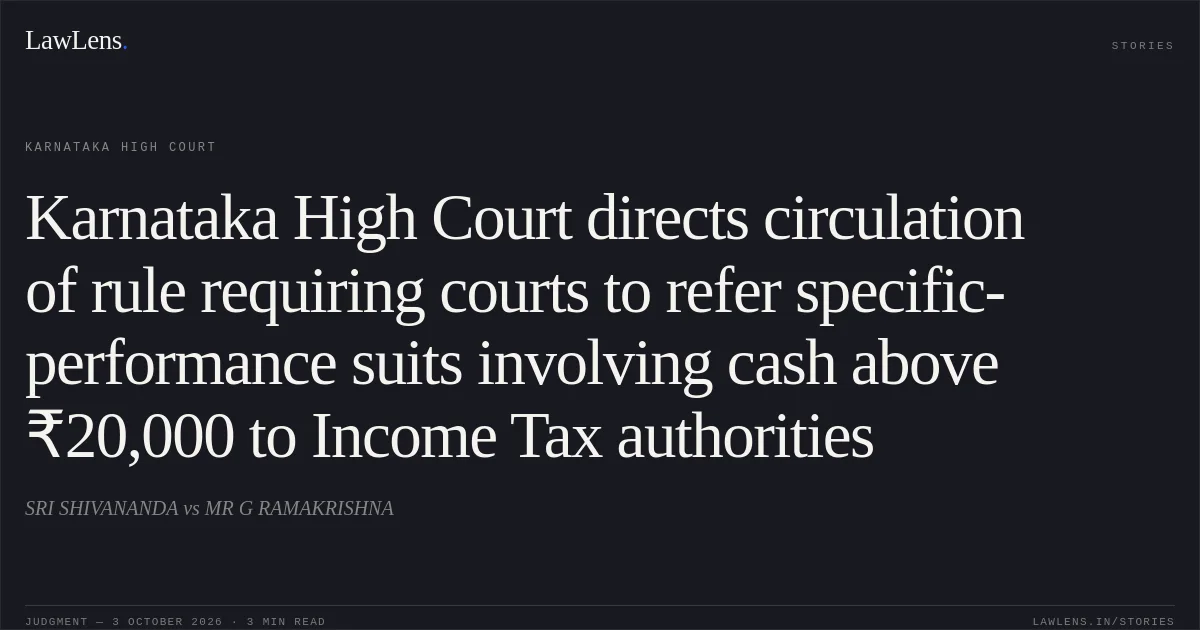
p. 10Following RBANMS Educational Institution, the Court directed the trial court to forward a copy of the plaint to the Director General of Income Tax, Bengaluru, and directed the Registrar General to circulate that Supreme Court judgment to courts in Karnataka.
pp. 10–11Original Court PDF
SRI SHIVANANDAvsMR G RAMAKRISHNA
Click to open original judgment
Original judgment, available to read, download and summarize on LawLens.in