Facts
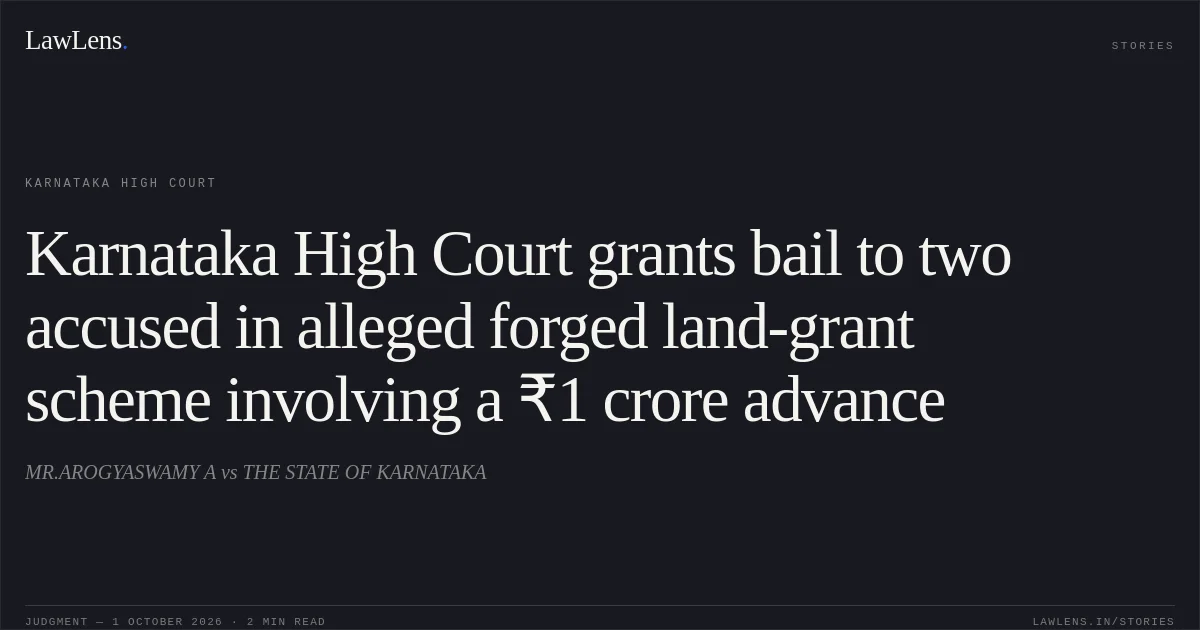
The petitioners, accused Nos. 1 and 2, sought regular bail under Section 483 of the Bharatiya Nagarik Suraksha Sanhita, 2023 (“BNSS”) in Crime No. 140 of 2026, registered for offences under Sections 318(4), 319(2), 336(2), 336(3), 329(3), 338, 340(2) and 351(2), read with Section 3(5) of the Bharatiya Nyaya Sanhita, 2023 (“BNS”).
Source reference: p.3The case arose from a complaint by the Secretary of Sri Adi Chunchanagiri Educational Trust concerning a claim to six acres within land granted to the Trust in 2004.
Source reference: p.5Accused No. 1 had brought a civil suit claiming that the land had been granted to his father in 1961; the Trust questioned the genuineness of the grant documents.
Source reference: p.5The petitioners were arrested on 26 June 2026, and their bail application before the Sessions Court was rejected.
Source reference: p.4By the time of the High Court hearing, the investigation was complete and the charge sheet had been filed. The petitioners also relied on the grant of bail to accused No. 5.
Source reference: p.4Issues
1. Whether the petitioners should be enlarged on regular bail under Section 483 of the BNSS after completion of the investigation and filing of the charge sheet.
Source reference: pp.4, 8–92. Whether the invocation of Section 338 of the BNS, carrying a potential life sentence, and the alleged roles of the petitioners warranted refusal of bail.
Source reference: pp.4, 7–8Law Applied
The petitions were considered under Section 483 of the BNSS, which provides the High Court’s power to grant regular bail.
Source reference: p.3The alleged offences were under Sections 318(4), 319(2), 336(2), 336(3), 329(3), 338, 340(2) and 351(2), read with Section 3(5) of the BNS.
Source reference: pp.3, 8The Court noted that the offences other than the offence invoked under Section 338 were triable by a Magistrate and carried a maximum punishment of seven years; it also considered whether the prosecution had demonstrated that the charge-sheet allegations attracted Section 338.
Source reference: p.7The order cites no precedent and sets out no broader bail test.
Source reference: no citationReasoning
The Court considered that the investigation was complete and the charge sheet had been filed, and noted the petitioners’ reliance on the bail granted to accused No. 5.
Source reference: pp.4, 5–6, 8Although the prosecution relied on the petitioners’ alleged roles and the gravity of the offences, the Government Pleader could not explain how the charge-sheet allegations attracted Section 338, despite its potential life sentence.
Source reference: p.7The Court also noted that the other offences were Magistrate-triable, carried a maximum sentence of seven years, and that the petitioners had no criminal antecedents—a submission the prosecution did not seriously dispute.
Source reference: pp.7–8In those circumstances, it found that regular bail was warranted, subject to conditions.
Source reference: p.8Holding
The High Court allowed both petitions and directed that the petitioners be released on bail in Crime No. 140 of 2026.
Each petitioner was required to execute a personal bond of ₹1,00,000 with two sureties for the like sum and comply with conditions requiring attendance before the Trial Court, non-interference with prosecution witnesses, avoidance of similar offences, and not leaving the Trial Court’s jurisdiction without permission until disposal of the case.
Source reference: pp.8–9Acts & Sections Cited
10 provisions across 3 statutes referred to in this judgment. Each provision opens on LawLens.
Code of Criminal Procedure, 19731
Bharatiya Nagarik Suraksha Sanhita, 20231
Bharatiya Nyaya Sanhita, 20238
Original Court PDF
MR.AROGYASWAMY AvsTHE STATE OF KARNATAKA
Click to open original judgment
Original judgment, available to read, download and summarize on LawLens.in