Facts
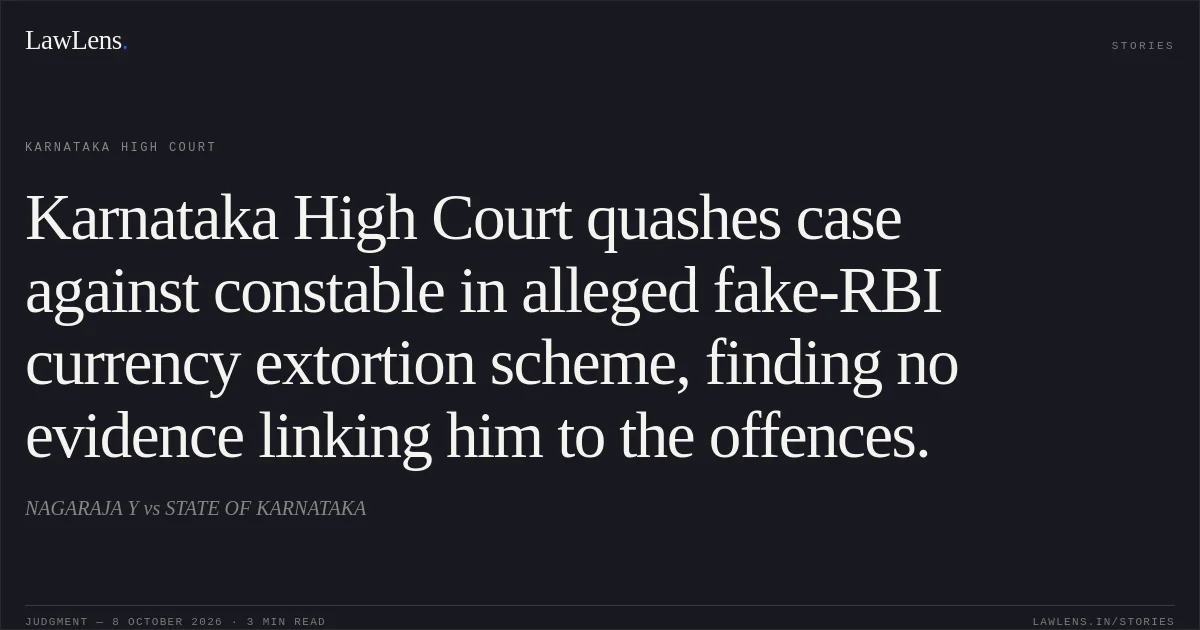
The petitioner, accused No. 4, sought to quash the charge sheet in Crime No. 277/2025, alleging offences under Sections 318(4), 319(2), and 308(2), read with Section 3(5) of the Bharatiya Nyaya Sanhita, 2023 (BNS).
Source reference: pp. 2, 5The complainant alleged that other accused had repeatedly obtained money from him through deception and threats.
Source reference: no citationThe petitioner was not named in the original complaint; the material against him consisted principally of a later statement by the complainant, who died before giving evidence before a court, statements of co-accused, a hearsay witness, and evidence that he was apprehended at Hiriyur.
Source reference: pp. 6–8, 13The State opposed quashing, contending that the charge sheet placed the petitioner in the car during the alleged extraction of money and that co-accused statements implicated him.
Source reference: p. 7Issues
Whether the prosecution material disclosed a prima facie case against the petitioner for the alleged offences under Sections 318(4), 319(2), and 308(2), read with Section 3(5) of the BNS.
Source reference: pp. 8, 10–13Whether the complainant’s FIR or further statement, statements of co-accused, and the petitioner’s apprehension at Hiriyur could sustain the proceedings against him.
Source reference: pp. 8–10, 13Law Applied
The Court considered Sections 318(4) (cheating), 319(2) (cheating by personation), 308(2) (extortion), and 3(5) (common intention) of the BNS.
Source reference: pp. 7, 11–13Applying the principles in Mohd. Ibrahim v. State of Bihar, it stated that cheating requires deception, dishonest or fraudulent inducement, and resulting delivery of property or other specified consequence; Hira Lal Hari Lal Bhagwati v. CBI requires fraudulent or dishonest intention at the time of the promise.
Source reference: pp. 10–11Cheating by personation requires concealment of true identity and false representation, while extortion requires intentional fear of injury that dishonestly induces delivery of property.
Source reference: pp. 11–12For common intention under Section 3(5), the Court required material indicating prior concert or a pre-arranged plan.
Source reference: p. 12It further relied on Lalita v. Vishwanath for the principle that an FIR is not substantive evidence and, where its maker dies from causes unrelated to the case, its contents cannot be proved through the investigating officer unless the requirements for a dying declaration are met; Surinder Kumar Khanna v. Directorate of Revenue Intelligence for the rule that a co-accused’s confession is not substantive evidence against another accused; and Rajeev Kourav v. Baisahab for the rule that Section 161 CrPC statements are inadmissible as evidence when adjudicating a petition under Section 482 CrPC.
Source reference: p. 9Reasoning
The Court found that the petitioner was implicated only through the deceased complainant’s further statement, hearsay evidence from CW.8, the evidence of CW.15 concerning his apprehension, and statements of co-accused.
Source reference: p. 8The FIR could not independently prove its contents, the co-accused statements were not substantive evidence, and the remaining circumstance of apprehension at Hiriyur raised, at most, suspicion.
Source reference: pp. 9, 12The prosecution material did not attribute to the petitioner any specific act of deception, personation, extortion, receipt of money, or participation pursuant to a prior concert; accordingly, the essential ingredients of the alleged offences were not made out against him.
Source reference: pp. 10–13Holding
The Court held that the prosecution material failed to establish a prima facie case against the petitioner and that continuing the proceedings against him would amount to an abuse of process.
The petition was allowed, and the charge sheet and proceedings in C.C. No. 24880/2026 were quashed qua accused No. 4.
Source reference: p. 13Acts & Sections Cited
9 provisions across 3 statutes referred to in this judgment. Each provision opens on LawLens.
Code of Criminal Procedure, 19732
Bharatiya Nyaya Sanhita, 20234
Indian Penal Code, 18603
Original Court PDF
NAGARAJA YvsSTATE OF KARNATAKA
Click to open original judgment
Original judgment, available to read, download and summarize on LawLens.in