Facts
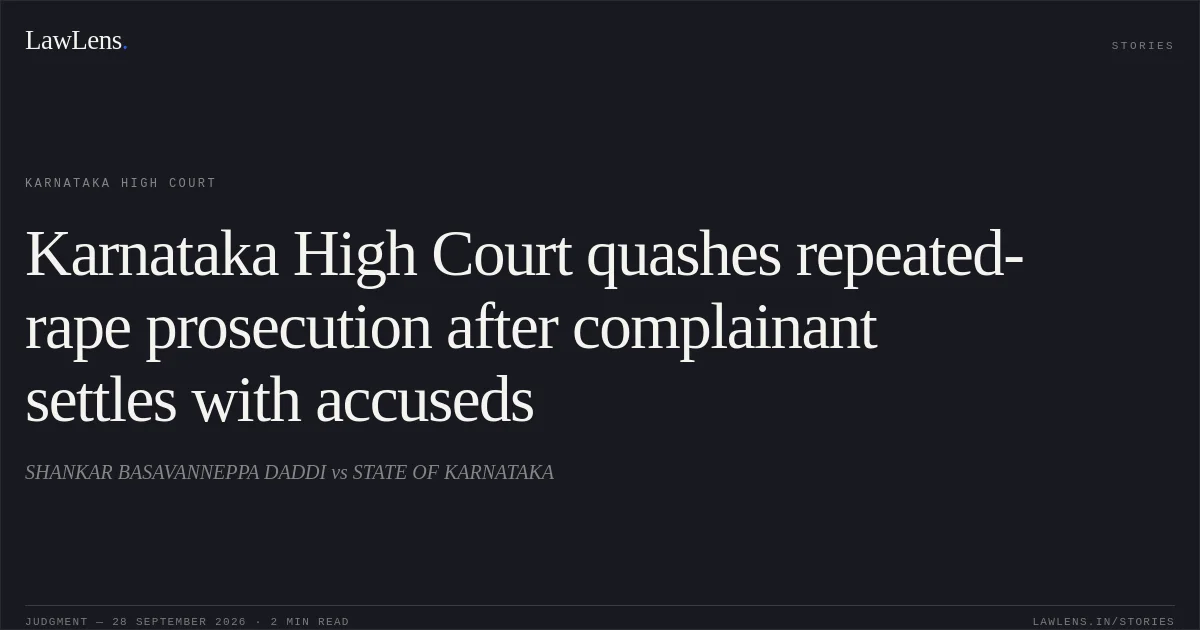
The petitioners, accused Nos. 1–3, 6 and 8, sought to quash proceedings in S.C. No. 111/2023 arising from Crime No. 68/2022 of Haveri Women Police Station. The case involved allegations under Sections 143, 147, 376(2)(n), 420, 323, 504 and 506 read with Section 149 IPC.
Source reference: pp. 3–6, paras. 2–4The de facto complainant and petitioners filed a compromise petition and affidavits stating that they had settled voluntarily and that the complainant wished to withdraw her complaint.
Source reference: pp. 3–6, paras. 2–4The case was pending before the Principal District and Sessions Court and FTSC-I, Haveri.
Source reference: p. 15Issues
1. Whether the High Court should exercise its inherent jurisdiction under Section 482 Cr.P.C. / Section 528 BNSS to quash the pending proceedings on the basis of the parties’ settlement, although the alleged offences were non-compoundable
Source reference: pp. 3, 7, paras. 2, 72. Whether the alleged offences and the circumstances of the settlement justified quashing the proceedings as an abuse of process, notwithstanding the allegation under Section 376(2)(n) IPC
Source reference: pp. 7–9, 12–14, paras. 7–8, 10–11Law Applied
The Court relied on Section 482 Cr.P.C. and Section 528 BNSS, invoking the High Court’s inherent power to quash proceedings to secure the ends of justice or prevent abuse of process; that power is distinct from statutory compounding and may extend to non-compoundable offences in appropriate cases.
Source reference: pp. 7–8, para. 8It cited Narinder Singh v. State of Punjab, (2014) 6 SCC 466, which directs courts to consider the nature and gravity of the offence, the likelihood of conviction, the stage of proceedings and the effect of settlement; it also states that prosecutions for heinous offences, including rape, ordinarily should not be quashed merely on compromise.
Source reference: pp. 8–10, para. 8The Court additionally referred to a co-ordinate Bench decision quashing proceedings under Section 306 IPC following settlement.
Source reference: p. 12, para. 9Reasoning
The Court accepted the compromise as voluntary, noting the complainant’s stated wish to withdraw the case, the intervention of family elders, and the parties’ decision to live peacefully.
Source reference: pp. 7, 13, paras. 7, 10It considered the accused persons’ roles insufficiently clear, the complainant’s allegations insufficiently specific as to their direct connection to the offences, and the prospect of conviction remote; it therefore concluded that continuing the prosecution would be unnecessary.
Source reference: pp. 13–14, para. 11The Court relied on Narinder Singh and the co-ordinate Bench decision but did not explain how quashing allegations that included rape under Section 376(2)(n) IPC could be reconciled with Narinder Singh’s caution against quashing rape prosecutions on the basis of compromise.
Source reference: pp. 8–10, 12–14, paras. 8–11Holding
The Court allowed the petition and quashed the proceedings in S.C. No. 111/2023, arising from Crime No. 68/2022, against the petitioners for the offences under Sections 143, 147, 376(2)(n), 420, 323, 504 and 506 read with Section 149 IPC.
Pending interlocutory applications were disposed of as unnecessary.
Source reference: p. 15Acts & Sections Cited
16 provisions across 3 statutes referred to in this judgment. Each provision opens on LawLens.
Code of Criminal Procedure, 19732
Bharatiya Nagarik Suraksha Sanhita, 20232
Original Court PDF
SHANKAR BASAVANNEPPA DADDIvsSTATE OF KARNATAKA
Click to open original judgment
Original judgment, available to read, download and summarize on LawLens.in