Facts
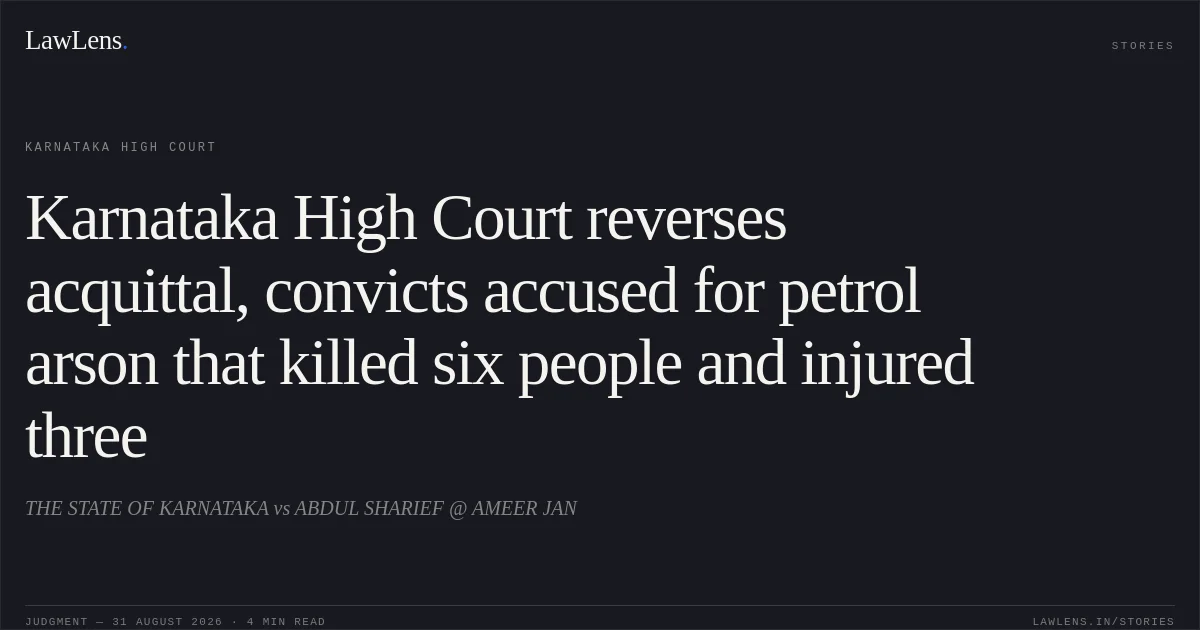
During the intervening night of 11–12 April 2013, a fire occurred at the residence of PW1 in Mysuru, where eight persons were sleeping. The prosecution alleged that the accused, owing to prior hostility with PW1’s father arising from financial and treatment-related disputes, poured petrol into the house and ignited it with a matchstick. Six occupants, including PW1’s father, died from burn injuries, while PW1, PW2 and PW5 sustained injuries.
Source reference: pp.2–4, paras 3–4PW1’s statement was recorded at the hospital between 8:00 and 9:00 a.m. in the presence of a doctor, and an FIR was registered for offences under Sections 302, 307 and 436 of the IPC.
Source reference: pp.14–16, para 17The III Additional Sessions Judge, Mysuru, disbelieved the material witnesses, treated the prosecution evidence and recoveries as insufficiently corroborated, and acquitted the accused on 28 April 2018.
Source reference: p.5, para 6The State appealed under Section 378 Cr.P.C., challenging the acquittal.
Source reference: p.6, para 7Issues
Whether the Trial Court erred in acquitting the accused by extending the benefit of doubt, and whether its appreciation of the evidence was perverse or erroneous?
Source reference: pp.13–14, para 16Whether the evidence established beyond reasonable doubt that the accused intentionally set fire to the house, causing the deaths of six persons, injuries to surviving occupants, and destruction of the house, thereby attracting Sections 302, 307 and 436 of the IPC?
Source reference: pp.16–17, paras 17–19; pp.51–53, para 47Whether the High Court, upon reversing the acquittal and recording conviction for the first time, was required to hear the accused on the question of sentence before imposing punishment?
Source reference: pp.53–58, paras 48–51Law Applied
The Court applied Sections 302, 307 and 436 of the IPC concerning murder, attempt to murder and mischief by fire or explosive substance, respectively.
Source reference: pp.6–7, paras 8–11In an appeal against acquittal, interference is justified where the trial judgment is perverse, based on misreading or omission of material evidence, or where no two reasonable views are possible; however, a reasonable and plausible view favouring the accused ordinarily should not be disturbed, as stated in Chandrappa v. State of Karnataka, as discussed in Rajesh Prasad v. State of Bihar and Babu Sahebagouda Rudragoudar v. State of Karnataka.
Source reference: pp.35–37, paras 35–36Under Section 313 Cr.P.C., the accused must be given an opportunity to explain incriminating circumstances; while silence or denial cannot substitute for proof, an unexplained incriminating circumstance may constitute an additional link in a circumstantial chain, particularly under Sections 106 and 114 of the Evidence Act, as recognised in State of Maharashtra v. Suresh, Munna Kumar Upadhyay v. State of Andhra Pradesh, Munish Mubar v. State of Haryana, Sanjeev v. State of Kerala and Chetan v. State of Karnataka.
Source reference: pp.10–12, 27–33, paras 12, 30–33The Court also relied on the principle that the trial judge must actively ascertain the truth and may examine witnesses under Section 165 of the Evidence Act, as explained in State of Rajasthan v. Ani @ Hanif, Bablu Kumar v. State of Bihar and Dinesh Kumar v. State of Haryana.
Source reference: pp.44–50, paras 44–46Finally, under Sections 235(2) and 386(a) Cr.P.C., an accused must be heard on sentence, and an appellate court recording conviction for the first time may adjourn the matter for that purpose, as held in Suryamoorthi v. Govindaswamy, Allauddin Mian v. State of Bihar and Mukesh Kumar Yadav v. State (UT of Andaman and Nicobar Islands).
Source reference: pp.53–58, paras 48–51Reasoning
The High Court held that the Trial Court had misread and omitted material evidence. PW1 was an injured eyewitness whose statement identifying the accused was recorded within hours of the incident, after medical certification that she was fit to speak.
Source reference: pp.14–16, paras 17, 26PW2, another injured occupant, also placed the accused at the scene, while PW3 and PW4 corroborated the occurrence of the fire and the statement attributed to PW1’s mother, who later died.
Source reference: pp.19–25, paras 22–24, 27–28, 38The Court treated the prior financial and personal hostility as establishing motive, although it observed that motive was not essential in view of the direct eyewitness evidence.
Source reference: pp.18–19, paras 21, 37The forensic report recorded petroleum residues on several seized articles, including clothing, mattress and other burnt materials, supporting the allegation that petrol had been used.
Source reference: pp.25–26, para 28; pp.51–52, para 47The accused’s burn injuries, burnt hair and his absence from home during the relevant night were also considered incriminating circumstances.
Source reference: pp.21–23, paras 25–26, 34Despite a specific question under Section 313 Cr.P.C., the accused offered no explanation for his burn injuries or burnt hair; the Court treated this unexplained circumstance as an additional link corroborating the eyewitness account.
Source reference: pp.21–23, paras 25–26, 34The Trial Court’s focus on inconsistencies concerning the gas-cylinder blast, the timing of the blast, and the non-examination of the petrol seller was held to be misplaced, because those matters did not displace the injured eyewitness testimony and positive forensic evidence.
Source reference: pp.39–43, paras 40–43, 47Accordingly, the High Court found the acquittal perverse and concluded that the prosecution had proved the accused’s guilt under Sections 302, 307 and 436 IPC beyond reasonable doubt.
Source reference: pp.51–53, para 47Holding
The appeal was allowed, and the acquittal dated 28 April 2018 in S.C. No. 258/2013 was set aside.
The accused was convicted under Sections 302, 307 and 436 IPC on the basis of the injured eyewitness evidence, corroborative circumstances, medical evidence and FSL report.
Source reference: p.58, para 52(iii)Since the conviction was recorded for the first time by the appellate court, the Court deferred sentencing and directed the High Court Legal Services Committee, defence counsel and the State Public Prosecutor to secure the accused’s presence on 3 September 2026 for a hearing on sentence.
Source reference: p.58, para 52(iv)Acts & Sections Cited
13 provisions across 3 statutes referred to in this judgment. Each provision opens on LawLens.
Code of Criminal Procedure, 19738
Indian Penal Code, 18604
Bharatiya Nagarik Suraksha Sanhita, 20231
Original Court PDF
THE STATE OF KARNATAKAvsABDUL SHARIEF @ AMEER JAN
Click to open original judgment
Original judgment, available to read, download and summarize on LawLens.in