Facts
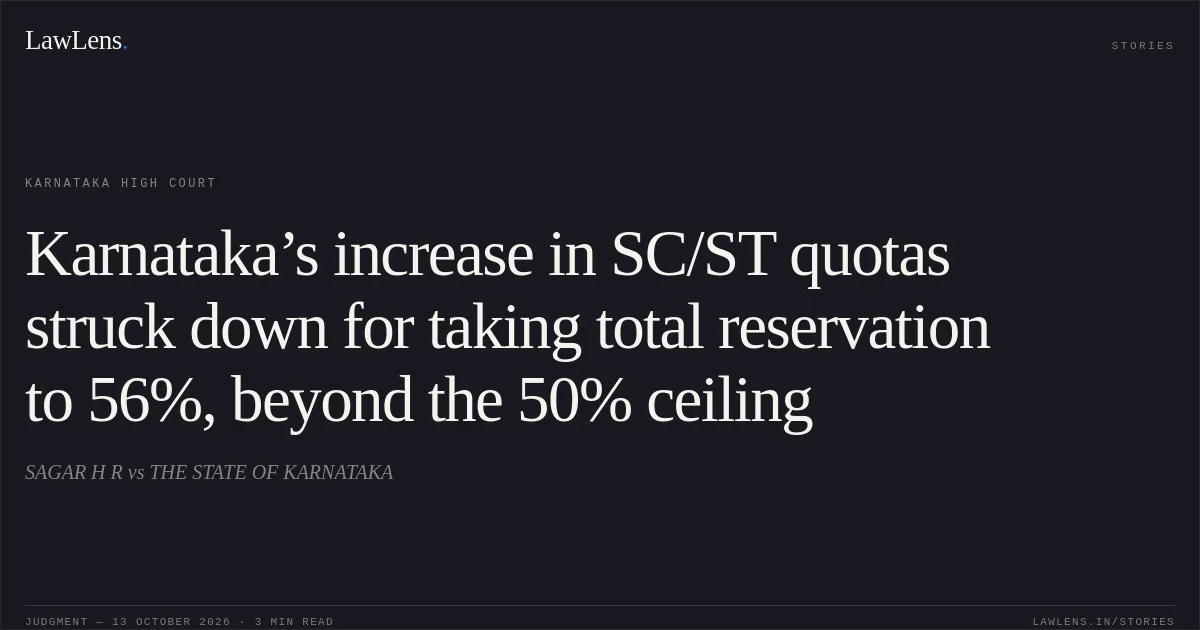
Karnataka Act No. 1 of 2023 increased reservation for Scheduled Castes (SCs) from 15% to 17% and for Scheduled Tribes (STs) from 3% to 7%, while leaving the 32% reservation for other backward classes unchanged.
Source reference: para. 17–19The aggregate reservation therefore rose from 50% to 56% in educational institutions and State services
Source reference: para. 17–19One petition challenged the Act’s constitutional validity; the other challenged, among other matters, its application to recruitment to Assistant Engineer posts
Source reference: para. 5–9The State relied on committee and commission reports, including the Nagamohan Das Commission Report, to support the increase
Source reference: para. 13–14, 49Issues
1. Whether the 50% ceiling on reservations under Articles 15(4) and 16(4) remained binding after the Constitution (One Hundred and Third Amendment) Act, 2019
Source reference: para. 136–1442. Whether the State had established extraordinary circumstances permitting reservation above 50%
Source reference: para. 124–126, 161–1653. Whether the State’s reports and data established a lawful basis for the increase, including adequate representation and the applicable requirements under Articles 15(4) and 16(4)
Source reference: para. 145–161, 181–2174. Whether prior consultation with the National Commissions for Scheduled Castes and Scheduled Tribes was mandatory before enactment of the Act
Source reference: para. 218–224Law Applied
Articles 14, 15(4) and 16(4) operate together as part of the constitutional equality scheme.
Source reference: no citationUnder Indra Sawhney v. Union of India, reservations under Articles 15(4) and 16(4) are generally subject to a 50% ceiling; departure is confined to extraordinary situations, requiring a special case and extreme caution
Source reference: para. 86–88, 94–99M. Nagaraj v. Union of India confirms that quantifiable data concerning backwardness and inadequate representation does not displace the ceiling, and that reservation must not breach it absent a recognised exception
Source reference: para. 112–113, 158–160“Adequate representation” is not “proportionate representation”; population share alone does not determine the permissible reservation
Source reference: para. 181–185The 50% ceiling applies to reservations in education under Article 15(4) as well as public employment under Article 16(4)
Source reference: para. 212–217Article 338(9) and Article 338A(9) require consultation with the respective National Commissions on major policy matters affecting SCs and STs; that consultation must be meaningful and precede the decision
Source reference: para. 218–223Reasoning
The Act raised total reservation to 56%, exceeding the ceiling affirmed in Indra Sawhney
Source reference: para. 18–19, 94–99The State’s reliance on population growth and representation below population proportions did not establish an extraordinary circumstance: the governing standard is adequate, not proportionate, representation, and the reports’ population-based approach was therefore insufficient
Source reference: para. 181–185, 197–208The Court also found that the Nagamohan Das Commission relied substantially on older data and the Ratnaprabha Committee’s material, which had been prepared in the context of promotional reservation; later State data showed SC and ST representation exceeding the existing reservation percentages in many departments
Source reference: para. 166–168, 176–192Even if data supported the State’s assessment of backwardness or representation, it could not by itself justify breaching the 50% ceiling
Source reference: para. 157–161The Court rejected the argument that the 103rd Amendment displaced the ceiling, relying on Janhit Abhiyan v. Union of India and the distinct basis of EWS reservations
Source reference: para. 136–144It further held that prior consultation with the National Commissions was mandatory and that letters sent after enactment did not satisfy the requirement; however, it found it unnecessary to examine that ground further after concluding that the Act violated the equality guarantees
Source reference: para. 219–224Holding
The Court held that the State had not established extraordinary circumstances warranting reservation beyond 50%.
It struck down Section 3 of the Act insofar as it took aggregate reservation in educational institutions beyond that ceiling, holding it contrary to Articles 14 and 15; it also struck down Section 4 as contrary to Articles 14 and 16
Source reference: para. 225–226The petitions were allowed in those terms
Source reference: para. 227Acts & Sections Cited
3 provisions across 3 statutes referred to in this judgment. Each provision opens on LawLens.
Commissions of Inquiry Act, 19521
Administrative Tribunals Act, 19851
CHHATTISGARH EDUCATIONAL INSTITUTIONS ( RESERVATION IN ADMISSION) ACT,20121
Original Court PDF
SAGAR H RvsTHE STATE OF KARNATAKA
Click to open original judgment
Original judgment, available to read, download and summarize on LawLens.in