Facts
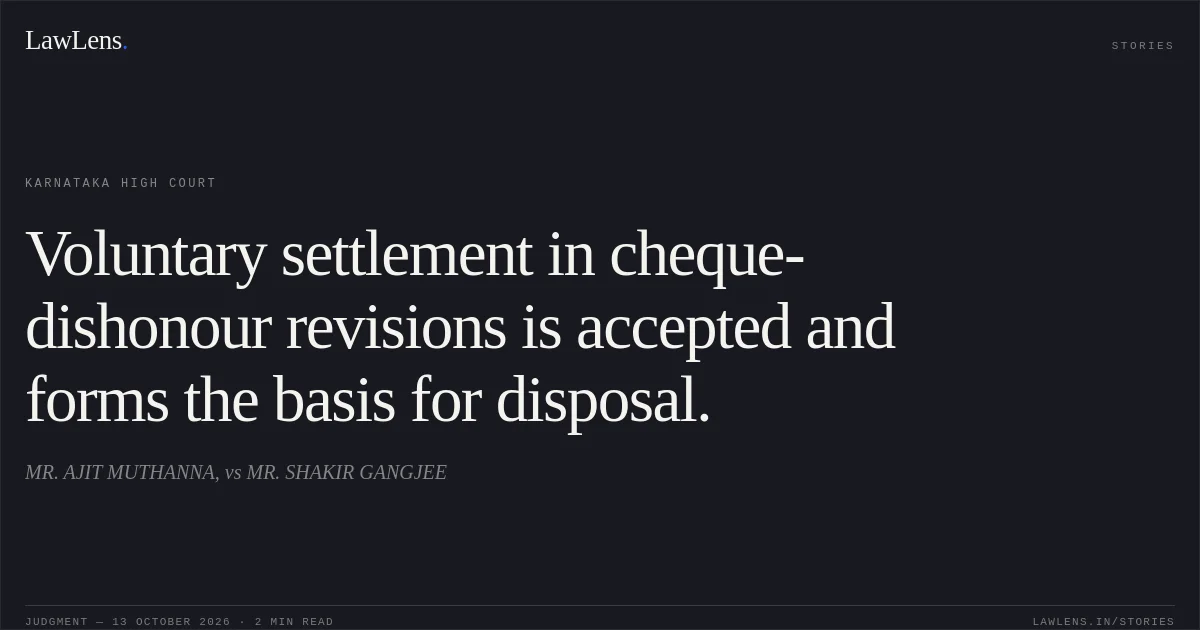
The petitioners challenged judgments of conviction for offences under Section 138 of the Negotiable Instruments Act, 1881, in C.C. Nos. 57662/2022 and 57663/2022, as affirmed in appeals by the Sessions Court
Source reference: pp. 2–3During the revision proceedings, the parties entered into a mediation settlement.
Source reference: p. 4In Crl.R.P. No. 401/2026, the petitioner undertook to withdraw the petition unconditionally.
Source reference: p. 4, para. 2In Crl.R.P. No. 400/2026, the petitioner agreed to pay a total settlement amount of ₹2.4 crore in ten instalments, in addition to ₹49,17,359 already deposited in specified proceedings.
Source reference: pp. 4–7, para. 3The settlement also provided for an additional ₹30 lakh in the event of default and reserved the respondents’ right to take steps available under law.
Source reference: pp. 4–7, para. 3Issues
Whether the parties’ mediation settlement was voluntary and lawful and could be accepted by the Court
Source reference: p. 7, para. 4Whether the connected revision petitions should be disposed of in terms of the settlement, including the undertaking to withdraw Crl.R.P. No. 401/2026 unconditionally
Source reference: pp. 4, 8, paras. 2, 4Law Applied
The revision petitions were invoked under Sections 397 and 401 of the Code of Criminal Procedure, 1973 (stated in the petitions alongside the corresponding BNSS provisions), and concerned convictions under Section 138 of the Negotiable Instruments Act, 1881.
Source reference: pp. 2–3The Court applied the principle that it may accept a voluntary and lawful settlement placed before it and dispose of proceedings in accordance with the parties’ agreed terms.
Source reference: pp. 4, 7–8, paras. 2–4The order cites no precedent and does not set out or apply a separate substantive rule concerning the merits of the Section 138 convictions.
Source reference: pp. 4, 7–8, paras. 2–4Reasoning
The Court considered the mediation settlement and recorded the parties’ agreed payment terms, including the instalment schedule, the no-extension provision, and the consequences of default.
Source reference: pp. 4–7, para. 3Having found the settlement voluntary and lawful, the Court accepted it and disposed of both revision petitions on its terms.
Source reference: p. 8, para. 4The order does not revisit the evidence or determine the merits of the underlying convictions.
Source reference: no citationHolding
The Court accepted the memorandum of settlement as voluntary and lawful and disposed of Crl.R.P. Nos. 400/2026 and 401/2026 in its terms.
The petitioner in Crl.R.P. No. 401/2026 had undertaken to withdraw that petition unconditionally; the settlement in Crl.R.P. No. 400/2026 required payment of ₹2.4 crore in instalments, with the agreed default provisions.
Source reference: pp. 4–7, paras. 2–3Acts & Sections Cited
5 provisions across 3 statutes referred to in this judgment. Each provision opens on LawLens.
Code of Criminal Procedure, 19732
Bharatiya Nagarik Suraksha Sanhita, 20232
Negotiable Instruments Act, 18811
Original Court PDF
MR. AJIT MUTHANNA,vsMR. SHAKIR GANGJEE
Click to open original judgment
Original judgment, available to read, download and summarize on LawLens.in