01Facts
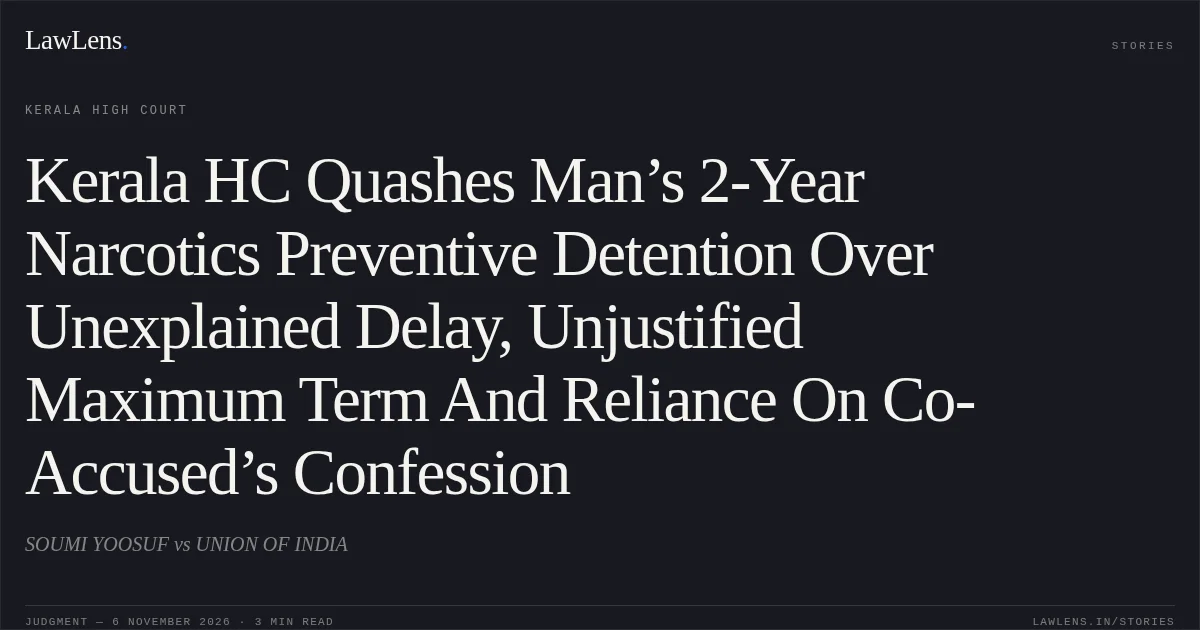
The petitioner, the detenu’s mother, challenged a detention order dated 14 May 2026 under Section 3(1) of the Prevention of Illicit Traffic in Narcotic Drugs and Psychotropic Substances Act, 1988 (PITNDPS Act), subsequently confirmed on 7 July 2026 for two years.
¶ 1 · p. 3The order relied on three NDPS cases registered between 2024 and 2026; the last concerned alleged possession of methamphetamine and hashish oil on 15 January 2026.
¶ 2–7 · pp. 4–8The detenu was released on bail on 9 March 2026, the sponsoring authority initiated the detention proposal on 31 March 2026, and the detention order was issued on 14 May 2026.
¶ 53–54 · pp. 59–62The petitioner challenged, among other matters, compliance with statutory timelines, the sufficiency and legibility of documents supplied, reliance on a police confession in one case, the delay in making the order, and the two-year detention period.
¶ 9–15 · pp. 9–2202Issues
i.1. Whether the State complied with the ten-day reporting requirement under Section 3(2) of the PITNDPS Act and the Advisory Board timelines under Sections 9(b) and 9(c).
¶ 22–34 · pp. 28–38ii.2. Whether the detenu was denied an effective opportunity to make a representation because the relied-upon documents were untranslated or illegible.
¶ 35–43 · pp. 38–52iii.3. Whether the Detaining Authority could rely on a police confession as a basis for its subjective satisfaction.
¶ 44–45 · pp. 52–53iv.4. Whether the unexplained delay in initiating and issuing the detention order snapped the live and proximate link between the alleged prejudicial activity and preventive detention.
¶ 48–58 · pp. 55–65v.5. Whether the decision to impose the maximum two-year detention period was supported by adequate reasons and material.
¶ 46–47 · pp. 53–5503Law Applied
Section 3(2) of the PITNDPS Act requires the State Government to forward a report concerning a detention order to the Central Government within ten days; Sections 9(b) and 9(c) require referral to the Advisory Board within five weeks of detention and submission of the Board’s report within eleven weeks.
¶ 22, 31–32 · pp. 28–29, 35–36Article 22(5) of the Constitution requires the detenu to receive the grounds and relied-upon material in a form that enables an effective representation; illegible documents may infringe that safeguard (Pramod Singla v. Union of India).
¶ 35–42 · pp. 38–51Under Mulla Afroz v. Union of India, a police confession, by itself, cannot provide a sufficient basis for preventive-detention satisfaction and requires careful scrutiny.
¶ 12, 44–45 · pp. 13–19, 52–53A delay in making a detention order is not automatically fatal, but must be satisfactorily explained; unexplained delay may snap the live and proximate link between the prejudicial activity and the need for detention (Bhawarlal Ganeshmalji v. State of Tamil Nadu; Licil Antony v. State of Kerala).
¶ 49–52 · pp. 56–59The period of detention must also be supported by cogent reasons and relevant material.
¶ 46–47 · pp. 53–55Provisions in the judgment · 10 · Linked ones open on LawLens
Prevention of Illicit Traffic in Narcotic Drugs and Psychotropic Substances Act, 1988 Section 3Section 9Section 10Section 11Section 12
Narcotic Drugs and Psychotropic Substances Act, 1985 Section 20Section 22Section 29
Bharatiya Sakshya Adhiniyam, 2023 Section 23
General Clauses Act, 1897 Section 21
04Reasoning
The Court found that the report was forwarded on 19 May 2026, within ten days of the 14 May detention order, and that the Advisory Board referral and report were also within the statutory periods.
¶ 29, 34 · pp. 34, 37–38It rejected the document-supply challenge after finding the relied-upon pages legible and noting that the materials had been furnished in Malayalam; the detenu’s acknowledgement supported that finding.
¶ 37, 43 · pp. 44, 51–52However, the detention order did not show adequate scrutiny of the allegation in one case, which was founded on a co-accused’s police confession.
¶ 44–45 · pp. 52–53 · ¶ 62 · p. 67The Court held that the explanation referring generally to procedural formalities did not adequately account for the 22 days before the proposal was initiated after the detenu’s release on bail, or the subsequent time taken to issue the order; the live and proximate link was therefore snapped.
¶ 53–58 · pp. 59–65It also found no cogent reasons or material justifying the maximum two-year period, indicating non-application of mind.
¶ 46–47 · pp. 53–5505Holding
The Court allowed the petition, holding that although the statutory reporting and Advisory Board timelines were met and the document-supply objections failed, the unexplained delay, inadequate justification for the two-year detention period, and reliance on a police confession without proper scrutiny rendered the subjective satisfaction unsustainable.
¶ 59–63 · pp. 65–67It quashed the detention order dated 14 May 2026 and the confirmation order dated 7 July 2026, and directed that the detenu be released forthwith unless required in another case or proceeding.
¶ 64 · p. 68Original Court PDF
SOUMI YOOSUFvsUNION OF INDIA
Click to open original judgment
Original judgment, available to read, download and summarize on LawLens.in