01Facts
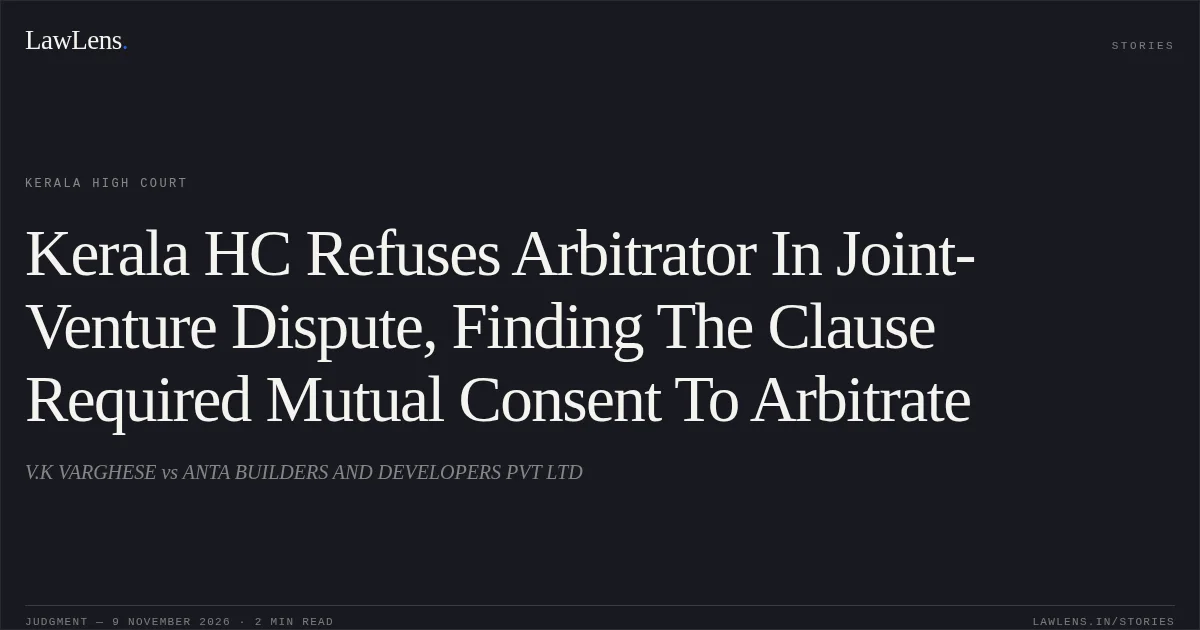
The petitioner sought appointment of an arbitrator under Section 11(6) of the Arbitration and Conciliation Act, 1996, alleging breach of a Joint Venture Agreement dated 20 August 2016.
pp. 3–4After issuing a Section 21 notice on 20 January 2026, nominating an arbitrator and calling on the respondents to nominate theirs within 30 days, the petitioner received no response.
pp. 3–4The respondents opposed the application, contending that Clause 12.2 was not a binding arbitration agreement because arbitration required mutual consent; they also raised a limitation objection.
pp. 5–6The application was dismissed.
02Issues
i.1. Whether Clause 12.2 of the Joint Venture Agreement constituted an enforceable arbitration agreement under Section 7 of the 1996 Act, permitting appointment of an arbitrator under Section 11(6).
pp. 8–9 · pp. 22–24ii.2. Whether the respondents’ failure to nominate an arbitrator after the Section 21 notice entitled the petitioner to seek appointment under Section 11(6).
pp. 3–4 · pp. 22–2403Law Applied
Section 7 of the 1996 Act requires a binding agreement and consensus between the parties to refer disputes to arbitration; a clause contemplating arbitration only if the parties later agree is not, without that further agreement, an arbitration agreement.
pp. 6–8Section 11(6) appointment jurisdiction depends on the existence of an arbitration agreement.
pp. 6–8The court referred to Jagdish Chander v. Ramesh Chander, (2007) 5 SCC 719, on clauses requiring a further mutual decision; Tarun Dhameja v. Sunil Dhameja, 2024 INSC 973, where the clause first established a mandatory reference to arbitration; and Shubham Equipment Pvt. Ltd. v. Rothwell Water Company Ltd., 2026 SCC OnLine SC 2089, on clear arbitral intent and minimal judicial inquiry.
pp. 10–23It also relied on Nagreeka Indcon Products Pvt. Ltd. v. Cargocare Logistics (India) Pvt. Ltd., 2026 INSC 384, and the principles discussed in Cox & Kings Ltd. v. SAP India (P) Ltd., (2024) 4 SCC 1, that arbitral jurisdiction rests on the parties’ consent and that contractual language must be read in context.
pp. 6–8 · pp. 10–23Provisions in the judgment · 4 · Linked ones open on LawLens
Arbitration and Conciliation Act, 1996 Section 21Section 11Section 9Section 7
04Reasoning
Clause 12.2 provided that disputes “shall, upon mutual consent of parties,” be referred to arbitration, followed by a procedure for each party to nominate an arbitrator.
pp. 8–9The Court held that the nomination procedure was dependent on the prior mutual-consent requirement and did not independently establish an obligation to arbitrate.
p. 9Unlike the clause in Tarun Dhameja, which first stated that disputes “shall be referred to arbitration,” Clause 12.2 made arbitration itself conditional on subsequent agreement.
pp. 12–14The clause therefore fell within the principle in Jagdish Chander and Nagreeka that a provision requiring further consent does not constitute a binding arbitration agreement.
pp. 10–11 · pp. 16–23The respondents’ failure to nominate an arbitrator could not cure the absence of an enforceable arbitration agreement.
The Court did not determine the limitation objection.
05Holding
The Court held that Clause 12.2 did not establish an enforceable arbitration agreement in the absence of mutual consent to refer the dispute to arbitration.
pp. 22–24Accordingly, the petitioner could not obtain an appointment under Section 11(6); the application was dismissed, with no order as to costs.
pp. 22–24Original Court PDF
V.K VARGHESEvsANTA BUILDERS AND DEVELOPERS PVT LTD
Click to open original judgment
Original judgment, available to read, download and summarize on LawLens.in