01Facts
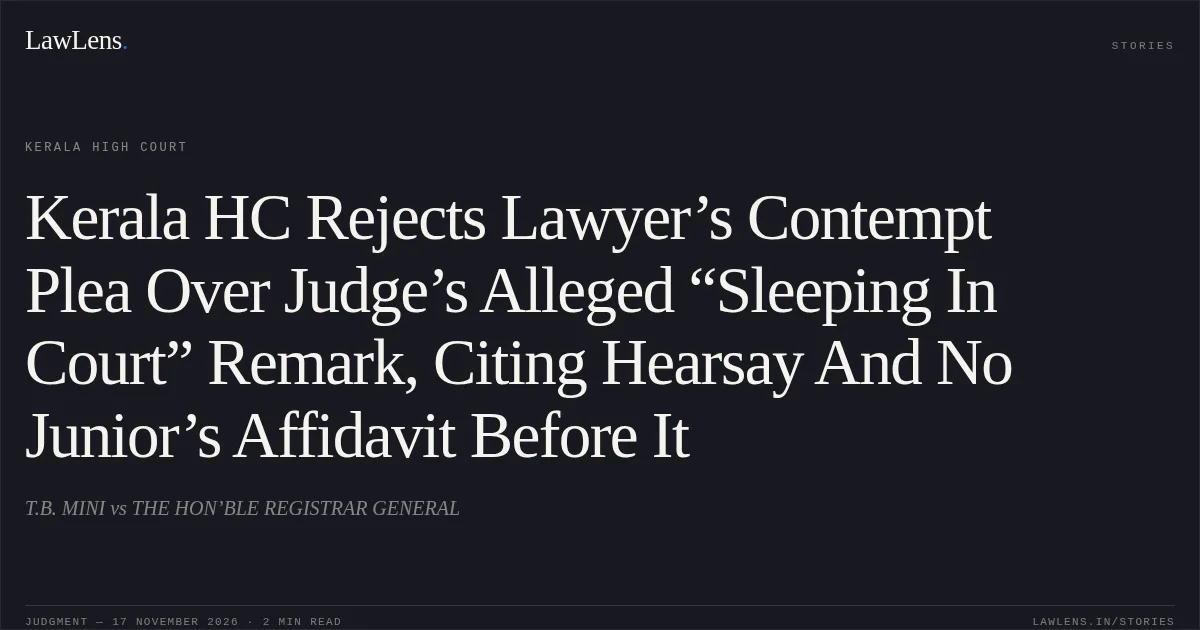
The petitioner, an advocate, alleged that the third respondent, then Principal District and Sessions Judge, Ernakulam, made derogatory remarks about her attendance and conduct in court on 12 January 2026. The petitioner was not present when the remarks were allegedly made and relied on what her junior told her and on media reports.
pp. 3–18, 21–24She sought, among other reliefs, a direction to place her complaint before the Chief Justice for suo motu contempt proceedings, expungement of the remarks, and directions to remove related media content. The Advocate General had declined to initiate contempt proceedings, finding that the alleged remarks, even if made, did not amount to criminal contempt.
pp. 21–24, 30–3202Issues
i.1. Whether the material placed before the Court provided a sufficient factual basis to refer the complaint for consideration of suo motu contempt proceedings against the judicial officer.
pp. 23–26ii.2. Whether the alleged remarks, even if made, amounted to criminal contempt or otherwise warranted the reliefs sought, including expungement.
pp. 27–29, 32–3403Law Applied
Section 16 of the Contempt of Courts Act, 1971 makes a judge or other person acting judicially liable for contempt in the same manner as any other person; Section 15(2) provides for action concerning criminal contempt of a subordinate court on a reference by that court or a motion by the Advocate General.
pp. 30–32The Court recognised that it may consider suo motu action, but, under Joseph Kuzhanjalil v. Joseph Pulikunnel, the Advocate General’s view is entitled to weight and due consideration, and the statutory procedure helps prevent frivolous contempt proceedings.
pp. 29–30, 32Applying Berely v. Xavier, the Court stated that excessive or extravagant language must be distinguished from contempt.
pp. 31–33It also referred to State of Uttar Pradesh v. Mohammed Naim for the principle that judicial pronouncements should ordinarily remain judicial in tone, sobriety and restraint.
pp. 27–28Provisions in the judgment · 4 · Linked ones open on LawLens
Contempt of Courts Act, 1971 Section 2Section 15Section 16
Bharatiya Nagarik Suraksha Sanhita, 2023 Section 218
04Reasoning
The Court found no adequate evidence that the remarks had been made: the petitioner was absent, her junior had not filed an affidavit in the writ petition, the alleged statement was not recorded in the judicial proceedings, and media reports could not establish the allegation, particularly when the media outlets were not parties.
pp. 21–26The Court declined to rely on the third respondent’s confidential remarks because the petitioner had no access to them and could not contradict them. It further agreed with the Advocate General that, even if the alleged words were spoken, they would at most constitute excessive or extravagant language and would not meet the definition of criminal contempt. The Court therefore found no basis to direct a reference or initiate further inquiry.
pp. 21–22, 31–3305Holding
The Court dismissed the writ petition, holding that there was no sufficient material to support the alleged courtroom statement and no basis to treat it, even if made, as criminal contempt.
pp. 33–34It also rejected the applications to implead media organisations and to call for the records of the related criminal miscellaneous petition.
pp. 34–35Original Court PDF
T.B. MINIvsTHE HON’BLE REGISTRAR GENERAL
Click to open original judgment
Original judgment, available to read, download and summarize on LawLens.in