01Facts
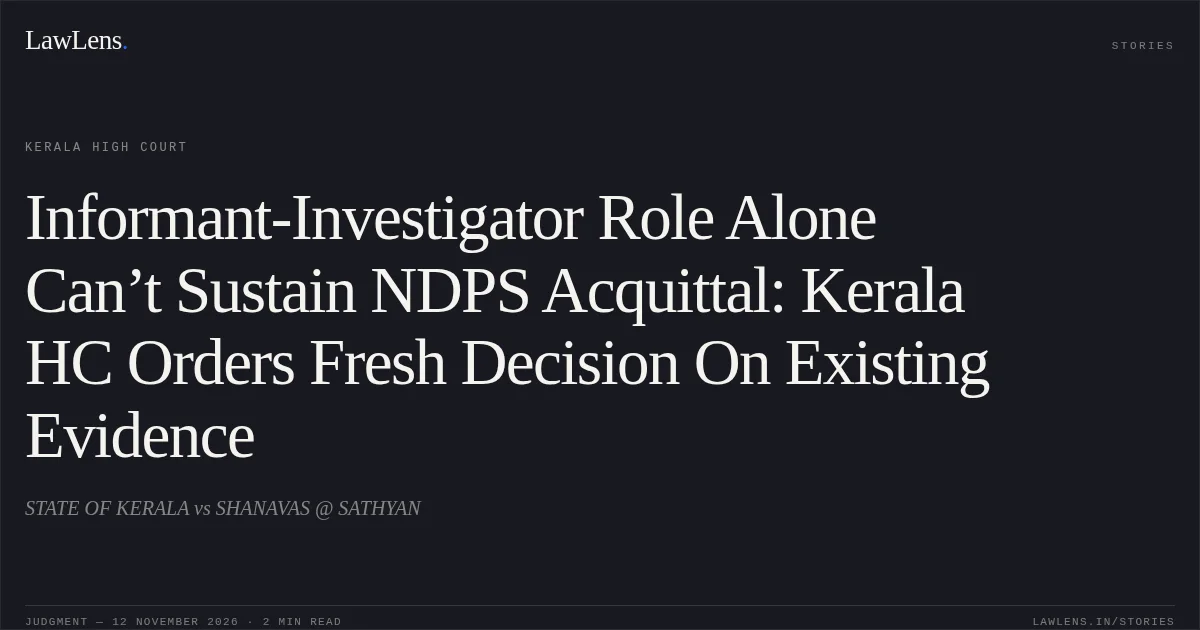
The State appealed the Special Judge’s judgment acquitting the respondent of offences under Sections 20(b)(ii)(B) and 22(a), read with Section 8(c), of the NDPS Act.
pp. 2–3The acquittal rested on Mohanlal v. State of Punjab, on the ground that the informant and investigating officer were the same person.
pp. 2–3The State relied on the subsequent five-Judge Bench decision in Mukesh Singh v. State (Narcotic Branch of Delhi), which overruled Mohanlal on that point.
pp. 3–7The High Court observed that the trial court had not considered compliance with Sections 42, 50 and 57 of the NDPS Act or whether the evidence established the alleged offences.
p. 702Issues
i.1. Whether an acquittal may be based solely on the fact that the informant and investigating officer were the same person, in light of Mukesh Singh.
pp. 3–8ii.2. Whether the acquittal could be set aside and the matter remanded when the trial court had not considered statutory compliance or the sufficiency of the evidence.
pp. 7–803Law Applied
Under Mukesh Singh v. State (Narcotic Branch of Delhi), the fact that the informant is also the investigator does not, by itself, establish bias, unfairness or prejudice, nor does it automatically entitle the accused to acquittal; the question must be assessed on the facts and circumstances of each case, and bias or prejudice must be established.
pp. 3–7Mukesh Singh specifically overruled the contrary rule in Mohanlal v. State of Punjab.
pp. 6–7The prosecution alleged offences under Sections 20(b)(ii)(B) and 22(a), read with Section 8(c), of the NDPS Act; compliance with Sections 42, 50 and 57 and the sufficiency of the evidence remained matters for the trial court to consider.
p. 7Provisions in the judgment · 8 · Linked ones open on LawLens
Narcotic Drugs and Psychotropic Substances Act, 1985 Section 20Section 22Section 8Section 68Section 58Section 42Section 50Section 57
04Reasoning
The Special Judge acquitted the respondent solely by applying Mohanlal, without determining whether the informant-investigator arrangement caused bias or prejudice on the facts, or addressing the NDPS Act compliance and evidentiary questions.
pp. 7–8Since Mukesh Singh had overruled Mohanlal’s general rule, the acquittal could not stand on that sole ground.
pp. 7–8However, the High Court did not itself decide whether the statutory requirements were met or whether the evidence proved the charges; it remitted those questions for fresh consideration on the evidence already recorded.
p. 805Holding
The High Court allowed the appeal, reversed and set aside the acquittal, and remanded the matter to the Special Court (Additional Sessions Court–II), Thiruvananthapuram, for fresh consideration after hearing both sides and deciding the matter on the evidence already adduced.
pp. 8–9No fresh evidence may be adduced.
pp. 8–9The parties were directed to appear before the Special Court on 9 December 2026 at 11:00 a.m.
pp. 8–9Original Court PDF
STATE OF KERALAvsSHANAVAS @ SATHYAN
Click to open original judgment
Original judgment, available to read, download and summarize on LawLens.in